A chemical dosing tank dilution calculation must use a consistent concentration basis and include the actual final batch quantity, stock strength, residual heel, and any rinse additions. For simple non-reacting solutions expressed as mass fractions, the active-material balance is stock mass multiplied by stock fraction plus any active material already in the heel equals final mass multiplied by target fraction. The calculation tells you how much material to prepare. It does not prove chemical compatibility, a safe addition order, complete dissolution, or treatment effectiveness. Verify those requirements before transferring chemicals into the tank.
State what the concentration means
Percent by mass, percent by volume, mass per unit volume, and active-ingredient percentage are different quantities. A label reading 10 percent is incomplete without its basis. Commercial products may also report an equivalent chemical strength rather than the actual mass of the named solution component. Use the supplier documentation and the process specification to align the definitions.
For example, 10 percent by mass means 10 kilograms of the stated component per 100 kilograms of final solution. It does not mean 10 kilograms added to 100 kilograms of water. The latter produces 110 kilograms of solution before losses and therefore a different fraction. Keep the basis next to every input instead of relying on a note elsewhere in the worksheet.
Choose a mass balance where practical
Mass is generally a clearer basis when mixing solutions of different densities. Volumes are not always additive, and density changes with composition and temperature. A calculation using litres can still be valid, but it must use appropriate density values and a justified model. Do not assume the final volume equals the sum of separately measured volumes for every chemical mixture.
The NIST SI unit reference supports consistent units, and NIST calibration resources explain traceable measurement. Neither supplies the density of your commercial chemical. Obtain density and assay from an appropriate supplier document or validated laboratory measurement at the relevant conditions.
The existing chemical make-up tank design guide addresses the vessel and preparation arrangement. This article focuses on the calculation and its verification so that equipment decisions do not hide an incorrect recipe basis.
Calculate a batch with no residual heel
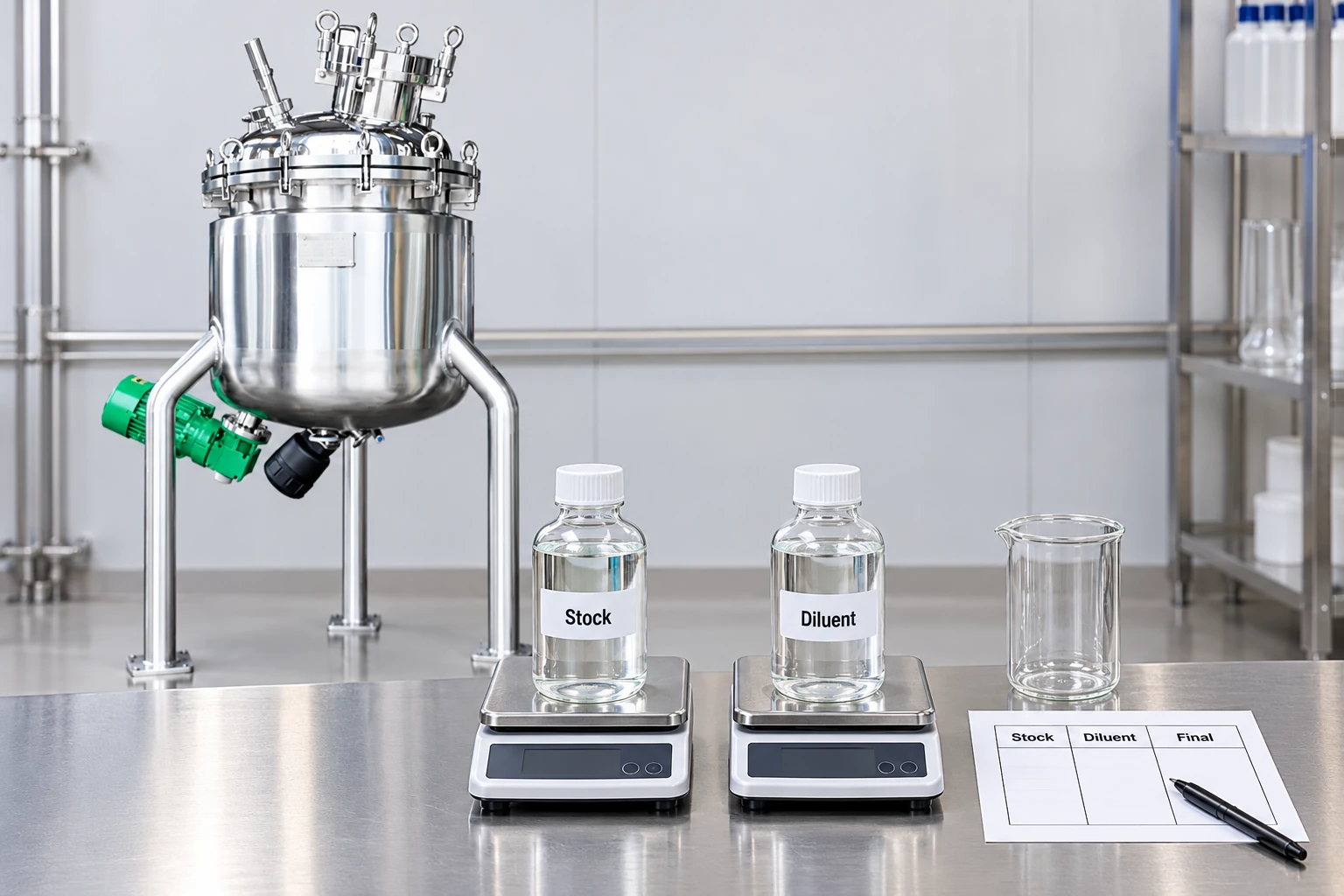
For a non-reacting mass-fraction dilution with no active material in the diluent, let Ms be stock mass, ws stock active fraction, Mf final batch mass, and wt target active fraction. The balance is Ms × ws = Mf × wt, giving Ms = Mf × wt / ws. Diluent mass is Mf − Ms, assuming no other additions, losses, or reactions.
Consider a hypothetical 500-kilogram final batch at 2 percent active material prepared from a stock at 20 percent active material by mass. The final active mass is 500 × 0.02 = 10 kilograms. Required stock is 10 / 0.20 = 50 kilograms, leaving 450 kilograms of diluent. These numbers demonstrate the calculation only; they are not a safe preparation instruction for any named chemical.
Check plausibility before accepting the result. Stock strength must be above the target for a simple dilution. Negative diluent mass or a stock quantity larger than the final batch indicates an incompatible input or a different preparation problem. A spreadsheet should flag such conditions rather than display a seemingly precise answer.
Include the heel explicitly
If a known heel remains in the tank, include its mass and concentration. With heel mass Mh and active fraction wh, the balance becomes Ms × ws + Mh × wh = Mf × wt. Thus Ms = [Mf × wt − Mh × wh] / ws. The new diluent mass is Mf − Mh − Ms, after accounting for all other additions.
For illustration, retain 50 kilograms of solution at 1 percent active material and prepare a final 500 kilograms at 2 percent using 20 percent stock. The heel contains 0.5 kilograms of active material, so the stock must supply 9.5 kilograms. That requires 47.5 kilograms of stock and 402.5 kilograms of new diluent. The balance totals 500 kilograms and 10 kilograms of active material.
An unknown heel concentration cannot be repaired by assuming it equals the last batch target. Stratification, evaporation, cleaning liquid, or a partial discharge may have changed it. Measure or remove the heel by an approved method, or carry a justified uncertainty into the decision. A settled solids layer requires a separate assessment because the heel may not be a uniform solution.
Convert between volume and mass carefully
When stock is delivered volumetrically, convert using Ms = Vs × density at the relevant temperature and concentration. State the units so litres and cubic metres cannot be confused. If density is in kilograms per litre, multiplying by litres gives kilograms. If it is in kilograms per cubic metre, the volume must use cubic metres.
For a hypothetical density of 1.20 kilograms per litre, 50 kilograms of stock corresponds to about 41.7 litres. Using 50 litres would introduce 60 kilograms instead. The example shows the consequence of treating mass and volume as interchangeable. Use an actual verified density for the chemical, and do not infer accuracy from a large number of displayed decimal places.
| Input or check | Required basis | Common error to prevent |
|---|---|---|
| Stock strength | Assayed active fraction and chemical basis | Confusing commercial product with active ingredient |
| Target | Final batch concentration and quantity | Applying a percentage to the diluent only |
| Residual heel | Actual mass and representative concentration | Assuming the heel is empty or unchanged |
| Density | Composition and temperature | Using water density for concentrated stock |
| Rinse liquid | Included in final mass or volume | Adding uncounted water after preparation |
| Measurement | Verified weighing or volume method | Treating an uncalibrated level indication as exact |
| Final check | Appropriate sample and analytical method | Releasing solely from the recipe calculation |
Separate calculation from safe preparation
A mathematically correct recipe does not establish the safe direction or rate of addition. Some dilutions release substantial heat or gas. Follow chemical-specific instructions, safety data, and the site procedure. Confirm available cooling, ventilation, containment, and the consequence of an interrupted addition. Do not apply a generic instruction from an unrelated chemical to your formulation.
Where hazardous chemicals are involved, the hazard communication standard explain the role of labels and safety data. The calculation sheet should reference the approved handling instruction, not replace it. Record who has authority to approve a deviation or a recovery addition if the final concentration is outside the permitted range.
Verify mixing and sampling before analysis
A correct total mass balance does not ensure that a sample represents the tank. Establish an appropriate mixing period and sampling method for the liquid properties and fill range. A concentrated layer near the inlet can produce a misleading result. Sampling immediately after an addition can also reflect local conditions rather than the final solution.
Use an analytical method suitable for the chemical and concentration range. Density or conductivity can be useful only where a validated relationship exists and temperature effects are managed. They do not identify every contaminant or distinguish every chemical mixture. Record sample location, time, temperature, result, and any correction applied.
Review mixing-time calculation for preliminary mixing inputs and mixing-tank level measurement for measurement limitations. Those pages support the preparation process without replacing a final concentration check.
Link the prepared stock to the dosing requirement
Once the stock is verified, calculate the active mass delivered from measured feed flow. If the process requirement changes, decide whether to adjust pump delivery, stock concentration, or both within the approved operating range. Changing stock concentration can affect viscosity, pump behavior, compatibility, and storage stability. A nominally equivalent active dose may therefore create a different operating problem.
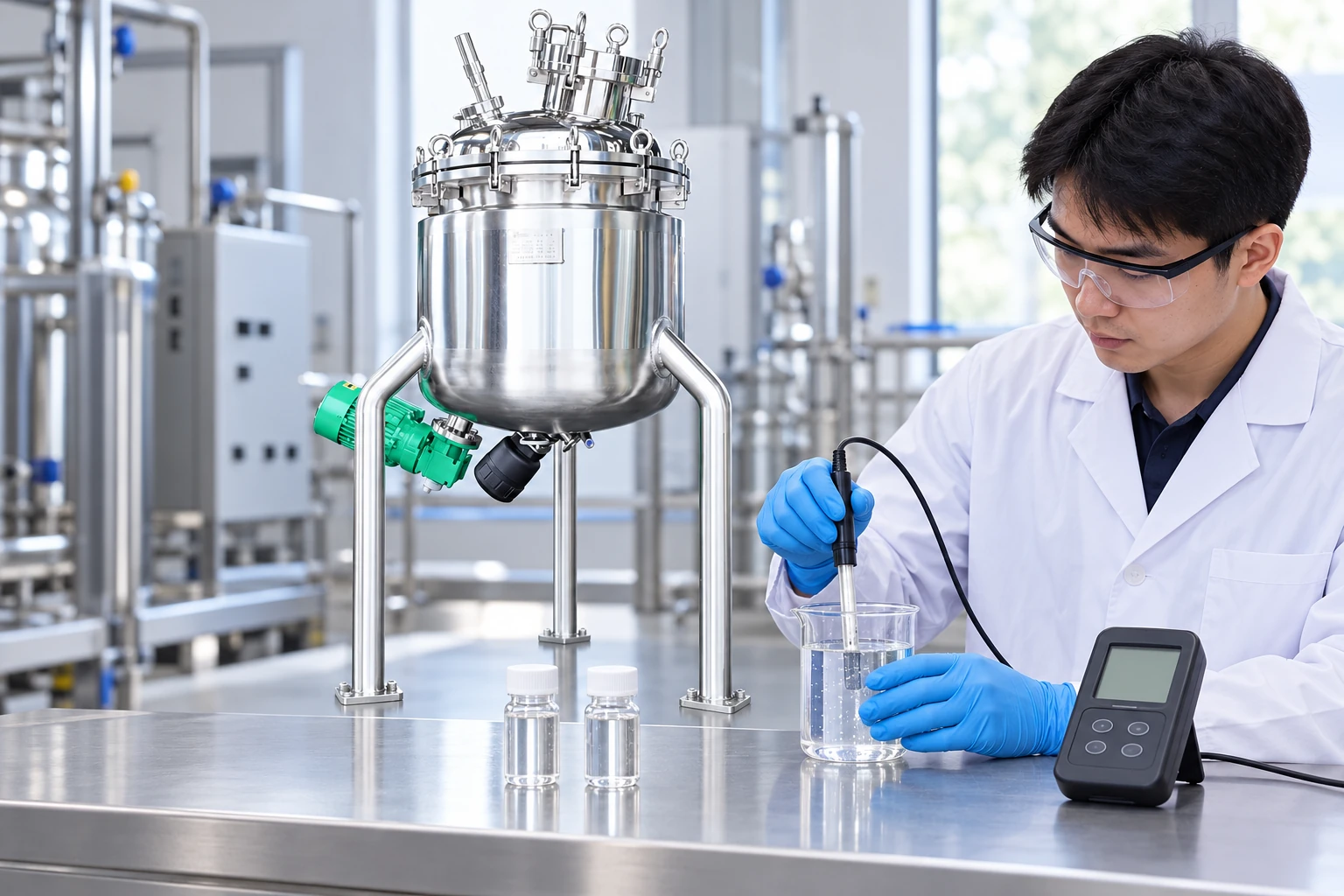
For procurement of a compatible solution-preparation tank, provide the real chemistry, batch range, preparation temperature, concentration verification method, and measurement needs. Ask for documented material compatibility and operating limits. The website product image identifies a vessel configuration, but it does not establish suitability for every chemical solution.
If the target is specified as active material but the stock certificate reports a different chemical equivalent, obtain the documented conversion before calculating additions. Keep that conversion visible with its source. Do not combine percentages from two different bases in the same equation. A second reviewer should be able to reproduce the result from the recorded values without asking which interpretation the operator intended.
Verify delivered feed flow using a suitable drawdown calibration method rather than relying only on a nominal pump setting when converting prepared-stock strength into dose.
Keep the calculation reviewable
Retain inputs with their sources, the equation, unit conversions, heel treatment, measurement uncertainty, and an independent plausibility check. Record actual additions alongside planned quantities. If the batch is corrected, preserve the original result and the approved correction so the record explains what was actually prepared.
Further learning: a blending mass balance
This university-produced lesson develops a mass balance for a blending tank. It supports the stock-and-diluent accounting used here; chemical-specific handling and final concentration verification remain separate requirements.
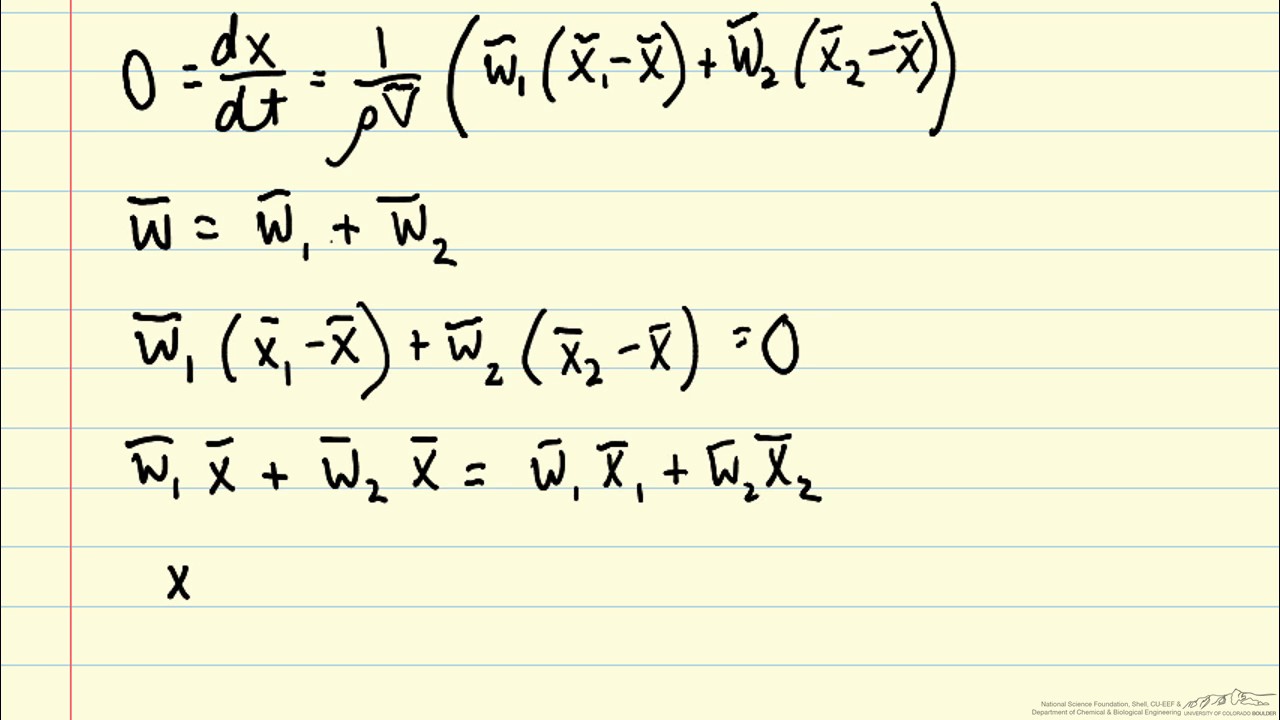
Watch Blending Process: Steady-State by LearnChemE
FAQ
Can I always use C1V1 equals C2V2?
Only when the concentration definitions and volume assumptions make that relationship valid. Mass fractions, different densities, non-additive volumes, reactions, and residual heels can require a fuller balance.
Does a calculated concentration remove the need for sampling?
No. Weighing errors, assay variation, losses, incomplete mixing, and uncounted additions can change the actual batch. Use an appropriate verification method.
What if the residual heel concentration is unknown?
Do not assume a convenient value. Characterize or remove it by an approved method, or assess the uncertainty before deciding whether the batch can be prepared reliably.