Fermenter inoculum transfer moves a prepared culture into the next vessel while preserving the required culture condition and contamination-control boundary. A reliable procedure defines the receiving vessel’s readiness, transfer path, connection method, driving pressure or pump arrangement, transfer quantity, and evidence required for acceptance. It must also account for gas displacement, filter condition, residual material, and the effect of transfer time on the organism. The correct method depends on the culture, containment requirements, equipment, and process. A closed-looking hose or a successful previous batch does not independently establish an aseptic transfer.
Separate seed sizing from transfer execution
The seed-fermenter sizing guide addresses how much culture is needed and how production stages relate. Transfer execution asks whether that culture reaches the correct receiving environment without introducing contamination or an unacceptable change in condition. A correctly sized seed stage can still fail if the connection, receiving medium, or transfer sequence is unsuitable.
Begin with the process requirement: inoculum quantity and condition, receiving volume, temperature, pH, oxygen conditions, and maximum permitted timing. These values must come from the verified process rather than a general rule. Organisms differ, and a method suitable for one fermentation may be inappropriate for another or for a different containment category.
Verify the receiving vessel before connecting
Confirm the receiving vessel identity, medium preparation, cleaning and sterilization status where required, instrument readiness, and approved release conditions. Check that the culture will enter the intended batch. A connection to the correct physical tank is insufficient if the medium, volume, or operating state is wrong. Use equipment and batch identifiers that can be read and recorded without ambiguity.
The FDA’s biotechnology inspection guide provides background on process control and contamination considerations in biotechnology. Its scope and age must be considered with current requirements and the actual application. It does not prescribe one universal transfer procedure for every industrial fermenter.
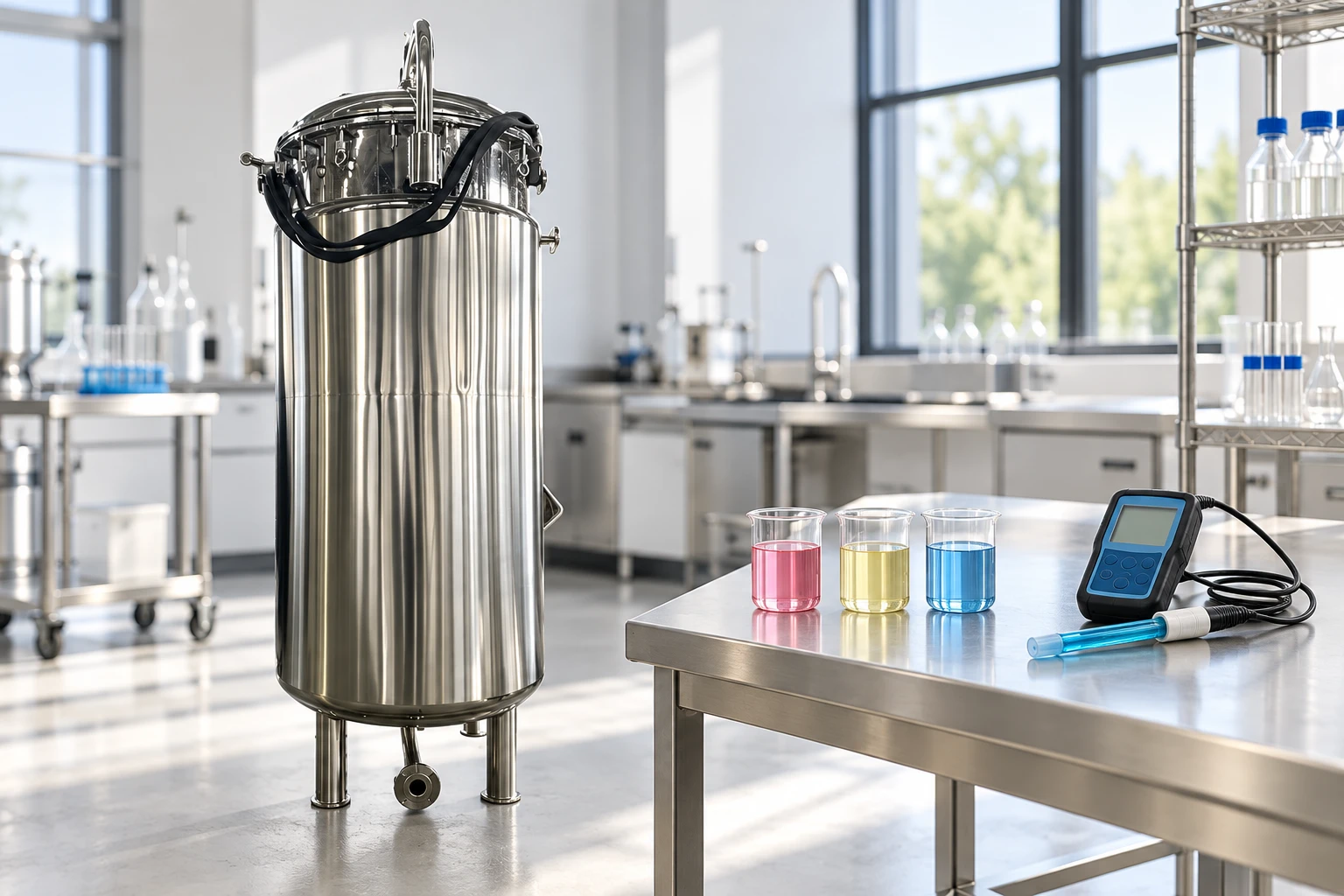
Where oxygen measurement forms part of receiver readiness or post-transfer monitoring, verify dissolved-oxygen probe calibration and scaling separately from preparation of the aseptic transfer path.
Define and maintain the transfer boundary
Identify every component between donor and receiver: outlet, valves, tubing or pipework, connection, sample points, filters where applicable, and receiving nozzle. State how the path is prepared, how its status is maintained, and what happens if the connection is interrupted. A route can be physically closed while still containing an unprepared section or an unsuitable dead leg.
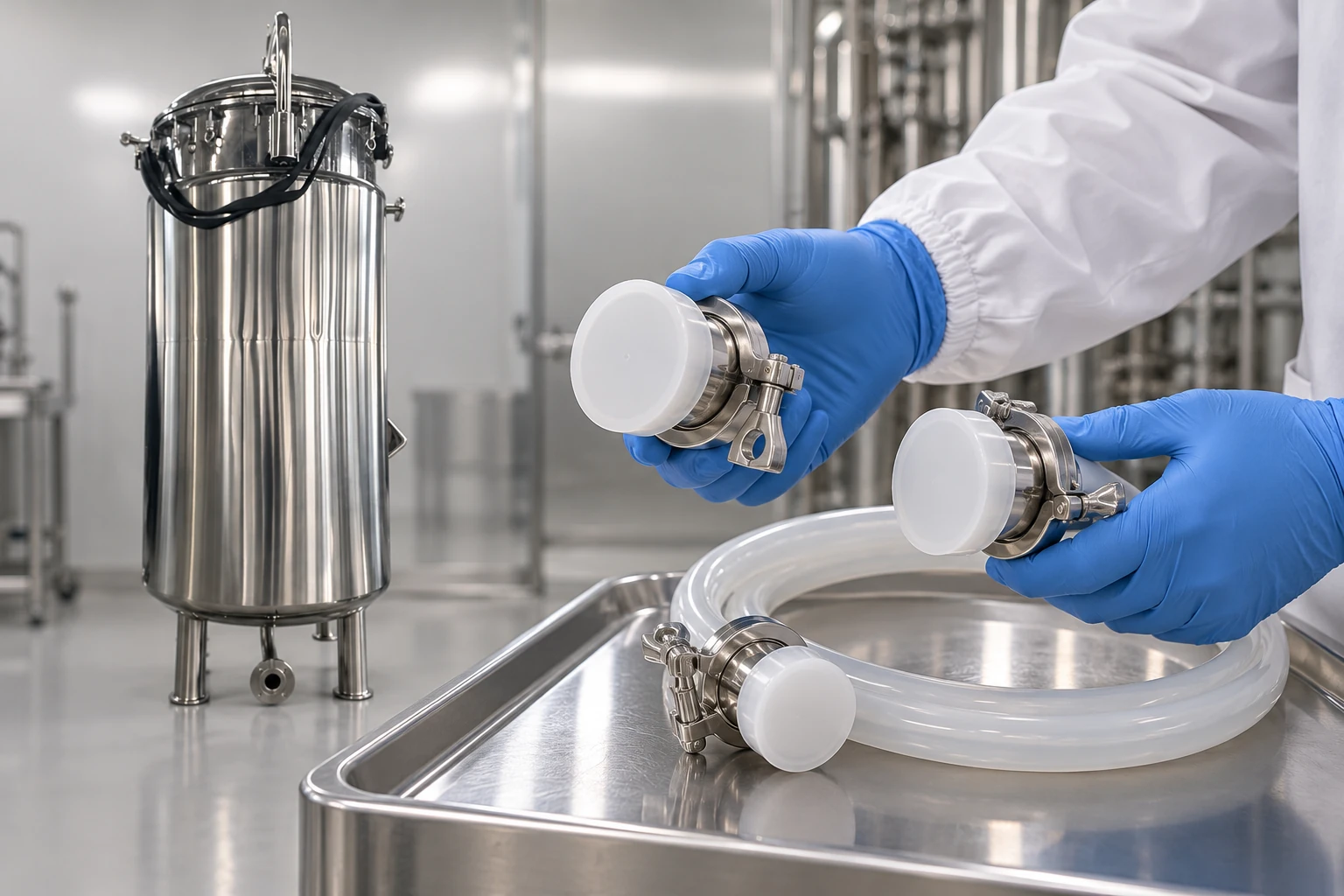
Connection methods require their own validated instructions. Steamable connections, suitable single-use assemblies, and other approaches have different materials, temperature limits, and handling requirements. Do not infer sterility or a permitted connection method from appearance. Verify compatibility with the culture, cleaning agents, sterilization conditions, and the intended number of uses.
Plan liquid movement and gas displacement together
Liquid entering the receiver displaces gas or changes the vessel pressure. Liquid leaving the donor changes its headspace and available driving pressure. Review both vessels, the transfer path, filters, and vent routes as one system. A restricted gas path can affect transfer rate or create an unsafe pressure condition even when the liquid line is unobstructed.
Do not choose a transfer pressure from a generic example. Confirm the permitted pressures and differentials of both vessels, seals, hoses, filters, and connections at the relevant temperatures. The HSE pressure-systems resources provide general safety context where applicable. The actual pressure strategy needs the equipment documentation and a competent review.
If a pump is used, assess shear, heating, residence time, priming, cleanability, and the contamination-control boundary. A pressure-driven transfer has different control and failure cases. Neither method is inherently suitable for every culture. Document how transfer stops and how trapped liquid or pressure is managed after the target quantity is reached.
Establish readiness checks and hold points
A useful checklist ties each prerequisite to evidence rather than a verbal assumption. Define who releases the donor culture, who confirms the receiver, and who authorizes the connection. Identify conditions that require stopping before any material moves. The procedure should prevent operators from discovering a missing sterilization record after the culture has already entered the receiver.
| Transfer stage | Required evidence | Failure to prevent |
|---|---|---|
| Donor release | Culture identity, condition, batch reference | Moving the wrong or unsuitable inoculum |
| Receiver release | Medium, volume, temperature, preparation status | Inoculating an unready batch |
| Path preparation | Component identities and verified preparation | An untreated section inside a closed route |
| Connection | Approved method and intact boundary | Contamination during assembly |
| Transfer | Quantity, time, pressures and relevant culture conditions | Uncontrolled delivery or stress |
| Completion | Isolation, residual handling and final quantity | Backflow, wrong yield or unreviewed hold-up |
| Post-transfer review | Defined monitoring and sample evidence | Treating successful movement as proof of acceptance |
The table is a framework, not a validation protocol. Set acceptance criteria from the process and the required quality system. Keep quantity and timing records in consistent units using the NIST SI reference.
Measure transferred quantity with a clear basis
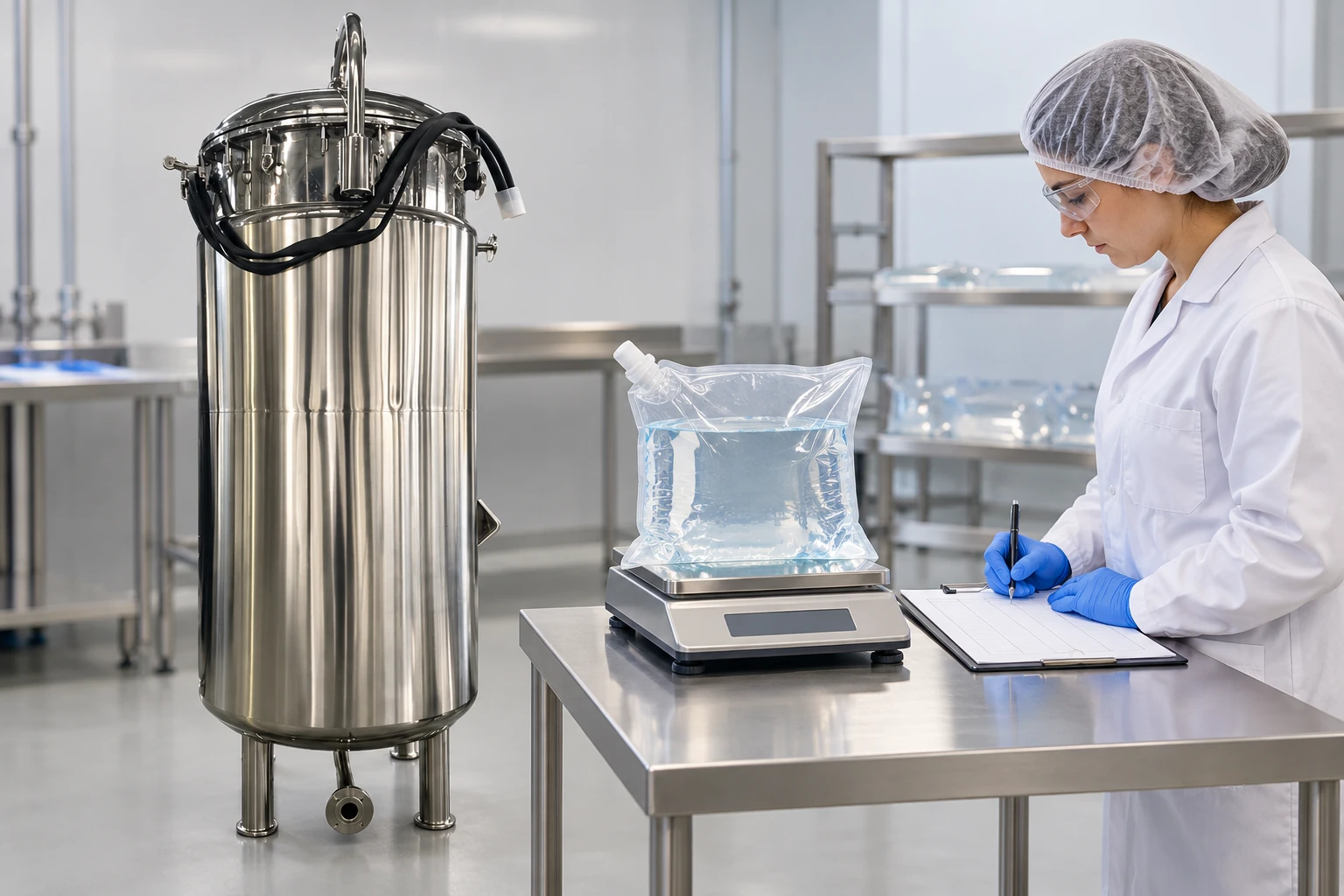
Choose an appropriate measurement method such as verified mass change, a suitable flow measurement, or a justified vessel-volume difference. Consider foam, gas, density, line hold-up, and the accuracy needed for the inoculation ratio. A level change can be misleading when vessel geometry or foam behavior is not accounted for.
For illustration only, a target of 50 kilograms transferred to 950 kilograms already in the receiver creates 1,000 kilograms before losses and gives an inoculum mass fraction of 5 percent. If the line retains 4 kilograms, the actual delivered quantity differs unless that hold-up is accounted for. These hypothetical values show the denominator and transfer-loss issue; they are not a recommended inoculation ratio or line-flush instruction.
A flush can change medium composition and culture conditions. Use only an approved flush identity, quantity, and route. Do not automatically chase the culture with water, air, or another liquid simply to improve yield. Record whether the measured amount is the donor withdrawal or the amount actually received.
Control timing, oxygen, and temperature exposure
The culture’s condition can change during waiting and transfer. Define the permitted hold conditions and the response to an interruption. Review whether agitation or aeration continues in the donor, how the receiver is prepared, and whether the line can cool or warm the culture. The correct values are organism- and process-specific.
After transfer, evaluate the expected process response using the approved monitoring plan. A dissolved-oxygen or pH change can be useful evidence, but it does not independently prove culture identity or absence of contamination. The fermenter oxygen-transfer guide and fermenter exhaust handling guide explain complementary gas-management considerations.
Investigate deviations without erasing the record
If transfer slows, stops, leaks, or exceeds an approved condition, follow the deviation procedure. Preserve pressure and flow trends, connection status, timing, and operator actions. Do not open the route to investigate while pressure, biological exposure, or contamination risk remains uncontrolled. A recovery action may change the acceptance status of both donor and receiver.
An apparently normal subsequent fermentation does not automatically resolve every contamination concern. Review the process evidence and sampling results with the responsible quality and engineering personnel. State which material is affected and what evidence supports release or rejection. A clear record is more useful than a retrospective statement that transfer was completed normally.
Verify filters and connections within their intended role
A gas filter protects a defined boundary only when the selected assembly and operating conditions are suitable. Review wetting, condensate, pressure differential, integrity evidence where required, and the preparation method. Do not assume that a filter continues to perform as intended after an unreviewed liquid carryover or pressure event. Likewise, a connector needs an approved assembly method and compatible materials; its marketing category alone does not prove the installed connection was made correctly. Record the relevant component identifiers and any inspection or test evidence before transfer. This helps distinguish a prepared path from a collection of individually suitable parts that were never verified as a complete route.
Specify transfer capability when purchasing
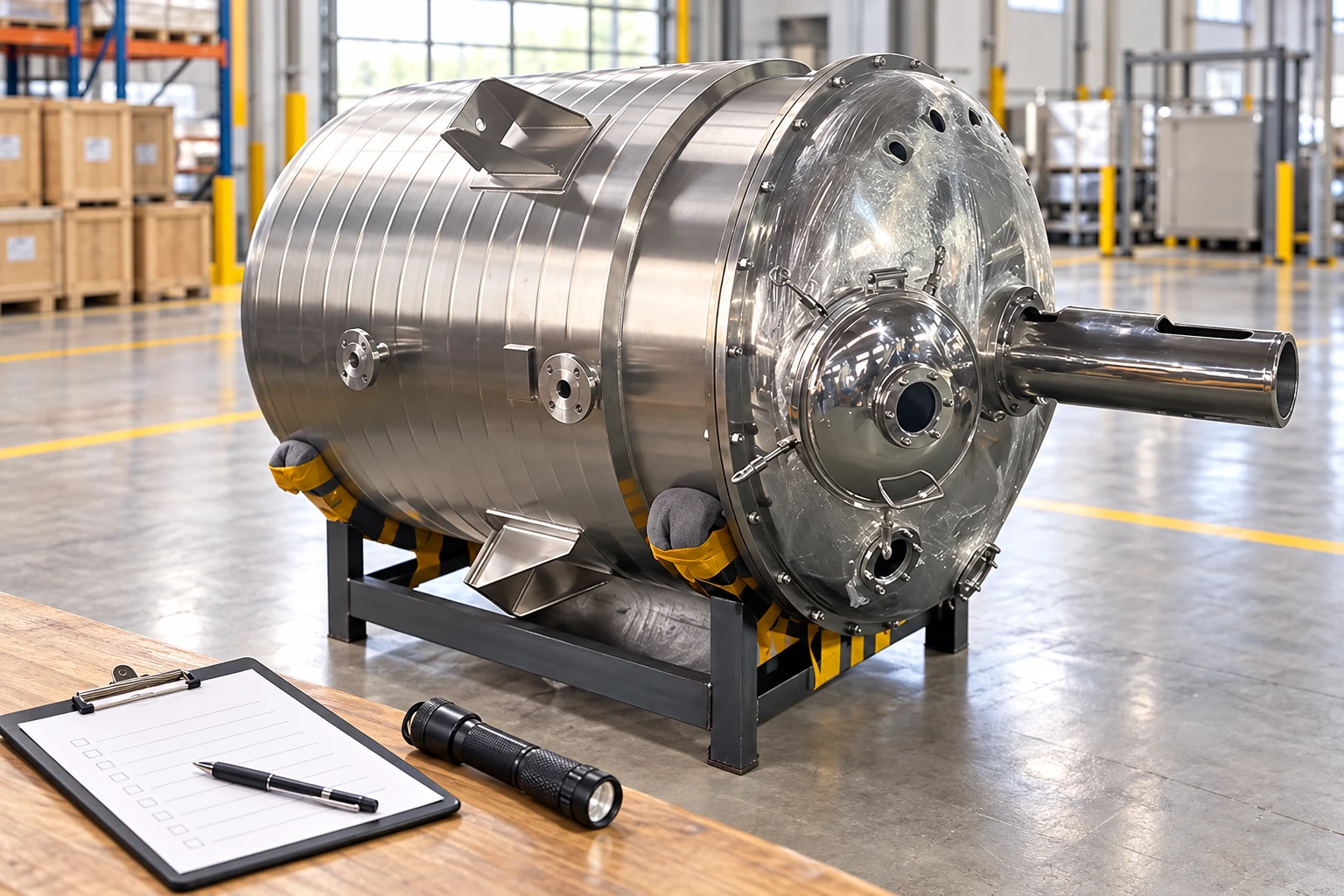
For a fermenter, provide the donor and receiver arrangement, organism and containment requirements, transfer quantity, preparation method, pressure limits, and required documentation. Ask which connections and components are included and which remain the responsibility of the process integrator. A vessel photograph does not establish a validated aseptic transfer system.
Request drawings, component specifications, preparation procedures, hold-up estimates where relevant, and a defined acceptance method. Include the transfer sequence in commissioning and operator training. Reassess it after changing hoses, connectors, filters, vessel configuration, culture, or batch size rather than assuming the original evidence applies indefinitely.
Further learning: criteria for inoculum transfer
Virtual University of Pakistan explains criteria for the transfer of inoculum in its Fermentation Technology course. Use this lecture to review culture readiness and process context. It is not a validated connection, pressure, or sterilization procedure for the installed production equipment.
Watch BT603_Topic072 by Virtual University of Pakistan
FAQ
Does a closed transfer line guarantee aseptic transfer?
No. Every relevant component must have the required preparation status, the connection method must preserve the boundary, and the procedure needs appropriate verification.
Should inoculum quantity be measured at the donor or receiver?
Define the basis explicitly. Donor withdrawal can differ from received quantity because of line hold-up, samples, losses, or an approved flush. Account for those differences.
Can one transfer method serve every fermentation process?
No. Culture sensitivity, containment, materials, pressure, preparation method, and quality requirements can differ. Review the method for the actual organism and equipment.