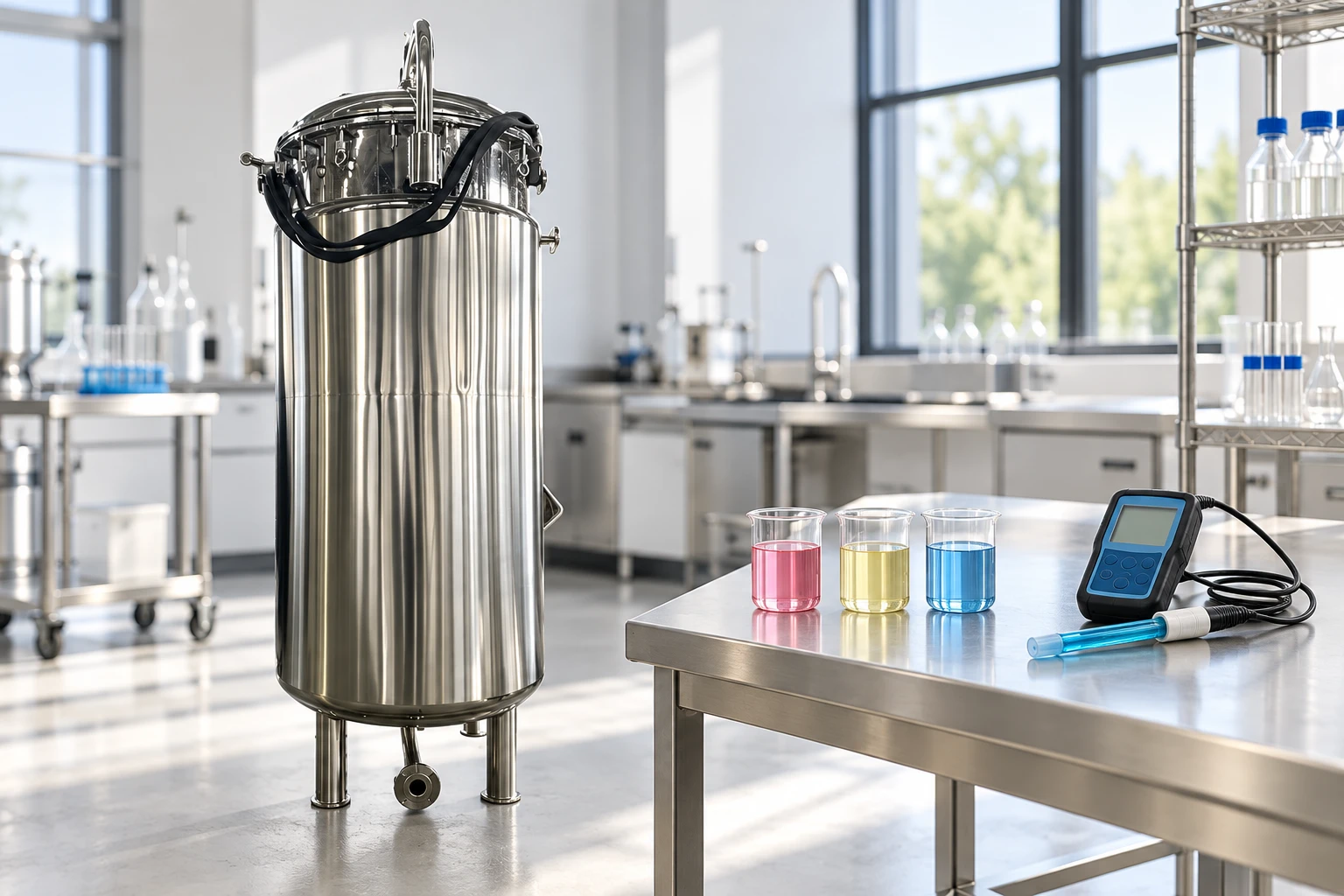
Dissolved oxygen probe calibration establishes the measurement response against a defined reference condition; it does not independently prove that a fermenter has adequate oxygen transfer or a representative sensor location. For a useful result, identify the sensor technology, follow its specific instructions, stabilize temperature, define the gas and pressure reference, and record whether the display reports concentration or a percentage of a stated saturation basis. Zero checks and span adjustments have different roles, and not every optical sensor should receive the same two-point procedure. Verify the probe and transmitter together before using the reading to control a batch.
Separate calibration, verification, and process response
Calibration adjusts or establishes the relationship between a measurement and its reference. A verification check asks whether the instrument remains within an agreed tolerance. A process response test examines how the installed measurement behaves when conditions change. These activities support each other but do not answer the same question. Record which one was performed rather than labelling every inspection calibration.
The USGS dissolved oxygen field manual describes measurement principles, equipment selection, calibration, and troubleshooting for water-quality work. It is a useful scientific reference, but a hygienic or pressurized fermenter requires the selected probe’s instructions and process-specific preparation procedure. Environmental-water guidance is not a substitute for bioprocess validation.
Identify the sensor and its maintenance requirements
Optical and electrochemical sensors can require different preparation, inspection, and stabilization. Depending on the design, relevant parts can include an optical cap, membrane, electrolyte, temperature element, cable, connector, and transmitter configuration. Confirm part identity and service history. A replacement sensing component may need its own initialization or configuration step.
Inspect for deposits, damage, trapped bubbles, unsuitable cleaning, and connection problems using the approved method. Do not polish, scrape, or expose a sensing surface to chemicals unless the instructions permit it. A physically clean-looking probe can still have a degraded sensing element or an incorrect compensation setting. Keep the manufacturer’s acceptance criteria with the equipment record.
Define the reference environment precisely
A statement such as calibrated to 100 percent is incomplete without the reference basis. Specify the calibration medium, gas composition, temperature, pressure treatment, and the instrument’s convention. Percentage saturation and milligrams per litre are different outputs. A displayed percentage cannot be converted to a concentration without the appropriate solubility relationship and conditions.
The USGS DOTABLES resource explains dissolved oxygen solubility calculations for water using temperature, pressure, and salinity inputs. Fermentation broth can differ from water, and process pressure or enriched oxygen can change interpretation. Use a justified method for the actual application rather than assigning a universal concentration to a percentage reading.
Stabilize temperature before adjusting the span
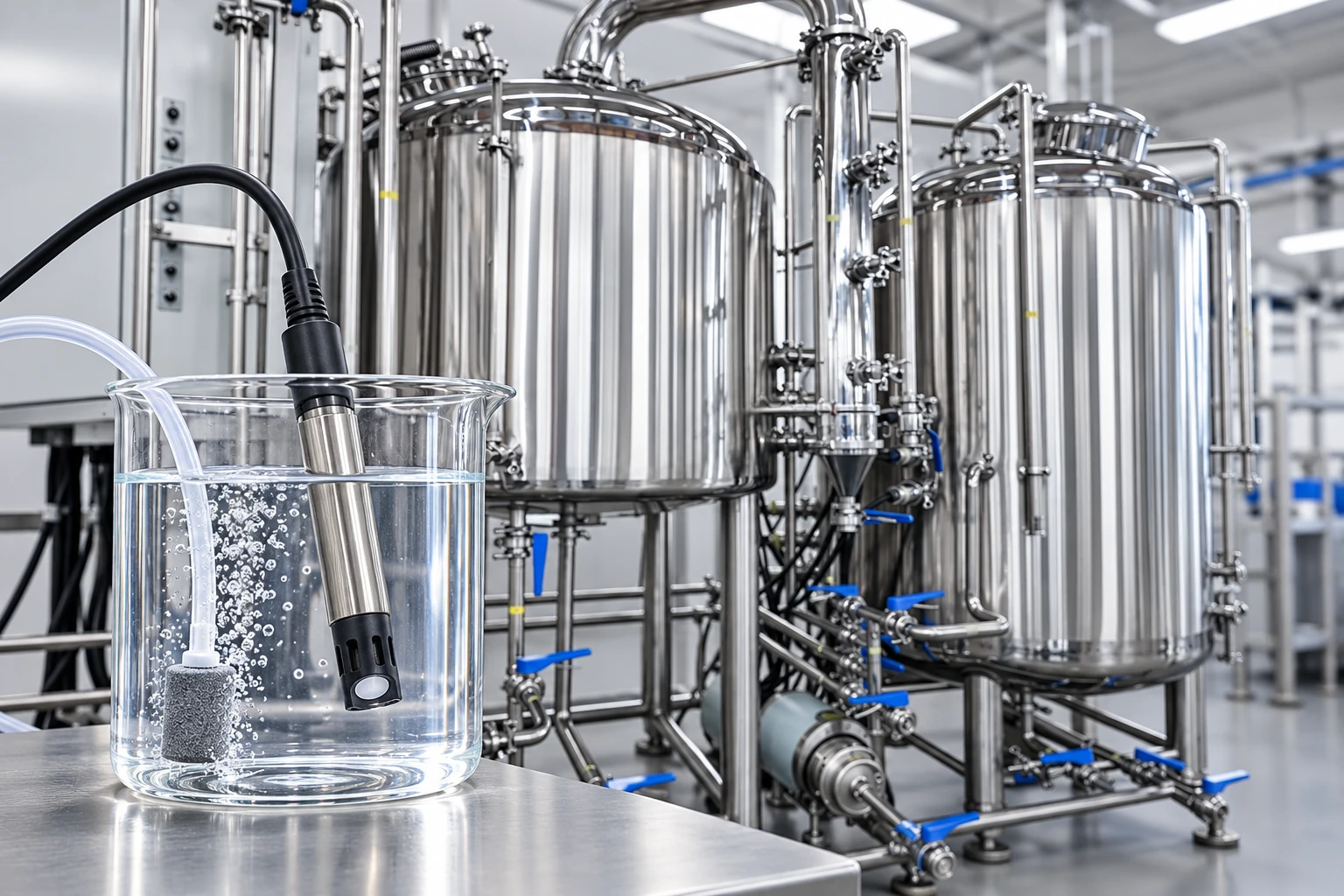
Allow the sensor and reference environment to reach the required stable condition. Temperature influences oxygen solubility and sensor response, and compensation cannot correct an undefined or changing calibration setup. Record the measured temperature and the stability criterion. A reading that drifts slowly can look acceptable at one moment while still being unsuitable for adjustment.
Avoid bubbles attached to the sensing surface and other conditions excluded by the approved method. A calibration in air, water-saturated air, or air-saturated water has different practical requirements. Select the method supported by the sensor documentation. Do not combine preparation steps from different sensor manuals simply because each describes a 100-percent reference.
Treat a zero check as a specific decision
A zero check can help assess low-end performance where the method is appropriate. Whether to adjust zero depends on the technology and instructions. The USGS technical chapter PDF discusses the distinction and notes that two-point adjustment is not recommended by every optical-sensor manufacturer. Do not overwrite a factory zero merely to make a poorly prepared check look correct.
If a chemical zero solution or a gas-based method is permitted, manage compatibility, preparation, exposure, and removal according to the approved procedure. Keep calibration chemicals out of a production vessel unless their use is explicitly authorized and validated. Record the observed response, stabilization, and final decision, including a failed check and subsequent repair.
| Check or input | What must be defined | Error it helps prevent |
|---|---|---|
| Sensor identity | Technology, sensing part and transmitter setup | Applying another model’s procedure |
| Span reference | Medium, gas, temperature and pressure basis | An undefined 100-percent adjustment |
| Zero performance | Permitted method and acceptance criterion | Unnecessary or damaging zero adjustment |
| Temperature | Sensor agreement and stability | Compensating an unstable reference |
| Installed location | Immersion and representative circulation | Correct calibration with biased process sampling |
| Preparation cycle | Cleaning or sterilization compatibility | Assuming the pre-cycle result remains valid |
| Control connection | Display, transmitted value and scaling | A correct local reading with wrong controller input |
The table is a planning framework rather than a universal calibration protocol. Numerical tolerances and timing must come from the applicable instrument and process requirements.
Verify the complete measurement chain
Compare the probe’s local indication with the value received by the process control system. Check units, scaling, range, temperature compensation, and the treatment of missing or invalid signals. A transmitter can be calibrated correctly while the controller interprets the output on a different scale. Record the configuration and verify representative points using an approved method.
Confirm how alarms and automatic control respond to a sensor fault, maintenance state, or out-of-range value. A controller that continues to adjust air or agitation from an invalid signal can create a process deviation. Testing should verify the intended response without exposing the culture or equipment to an uncontrolled operating condition.
Review the effect of cleaning and sterilization
A probe can be calibrated before installation and then experience cleaning, thermal cycling, pressure changes, or mechanical handling. Follow the permitted sequence for the selected sensor. Define any allowed post-preparation check and the criteria for accepting the instrument before inoculation. Do not remove or reconnect a prepared probe in a way that invalidates the contamination-control boundary.
The fermenter SIP temperature-mapping guide addresses a complementary preparation question. Temperature mapping does not calibrate the oxygen sensor, and oxygen calibration does not validate sterilization. Keep the evidence for both activities separate while coordinating them in the batch readiness checklist.
The separation between a prepared boundary and a measurement check also applies to closed-transfer readiness; do not reopen or reconnect a prepared system simply to repeat a check without reviewing its status.
Distinguish low oxygen from a measurement problem
A low reading can reflect increased oxygen demand, inadequate transfer, changed gas composition, poor mixing, a fouled sensor, or an incorrect reference. Review the trend with agitation, airflow, pressure, temperature, and batch stage before deciding that the probe is faulty. A second appropriately maintained measurement or an approved independent method can help, but its own representativeness must also be assessed.
The fermenter oxygen-transfer guide explains the process balance between demand and transfer. The fermenter airflow-control guide addresses gas-management inputs. Calibration supports those decisions by improving confidence in the measurement; it does not establish the required dissolved oxygen setpoint for every organism.
Account for sensor location and response time
The installed probe measures a local condition with a finite response time. A position close to a gas entry, stagnant pocket, wall, or poorly mixed region can differ from the bulk condition. Review insertion depth, nearby obstructions, and the actual operating fill range. A laboratory calibration cannot correct a location that does not represent the process question.
During a dynamic test, distinguish sensor delay from real oxygen-transfer behavior. Do not infer a process time constant from a probe response without considering both. Record the sampling interval and any filtering in the control system. Heavy filtering can make a noisy trend look smooth while delaying recognition of a real process change.
Specify calibration evidence when buying a fermenter
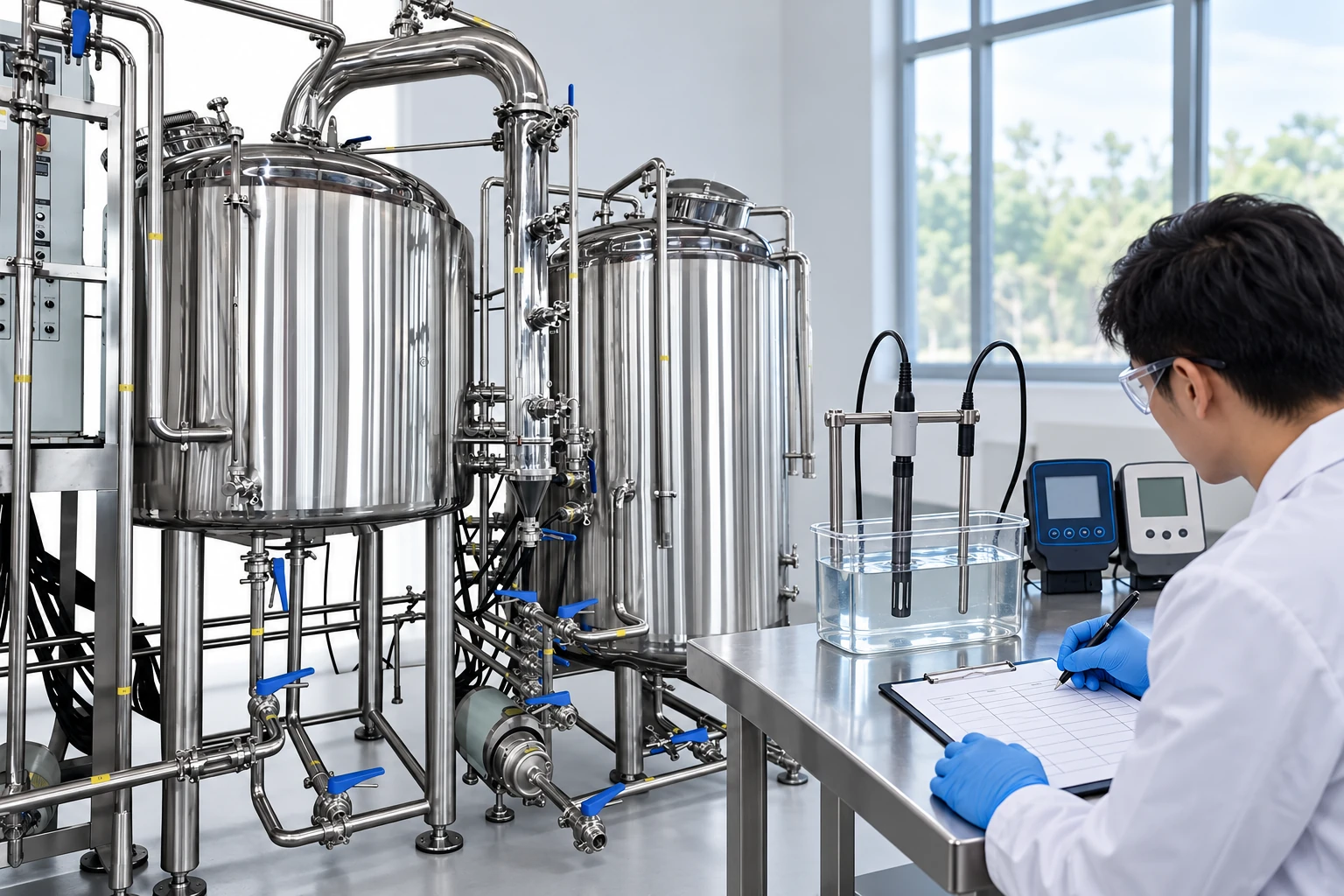
For a 2000-litre fermenter system, provide the process range, preparation cycle, pressure, gas composition, required measurement output, and documentation expectations. Ask which probe and transmitter are included and who verifies installation, calibration, control scaling, and post-preparation readiness. The website photograph does not establish the instrument model or a validated oxygen-control capability.
Request a record containing equipment identifiers, method, reference conditions, as-found result, action taken, as-left result, configuration, and acceptance. Retain failures and replacements rather than only the final passing value. NIST calibration guidance provides the broader measurement-traceability context, while the exact acceptance method remains specific to the probe and process.
Further learning: a probe-specific dissolved oxygen calibration
This university-extension demonstration explains calibration of a particular dissolved oxygen meter. It supports reference preparation and measurement checks; follow the actual probe instructions, especially for optical sensors and sterilized fermenter installations.
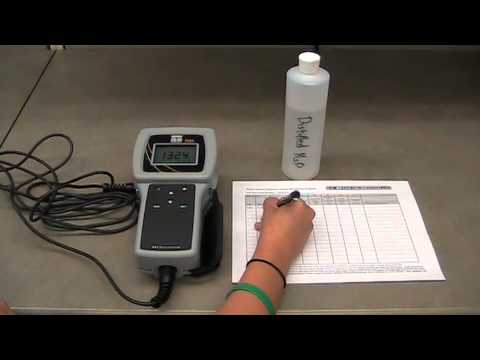
Watch Dissolved Oxygen Meter Calibration by University of Wisconsin Extension
FAQ
Does 100 percent dissolved oxygen always mean the same concentration?
No. The reference convention and conditions matter, including temperature, pressure, gas composition, and solution properties. State the basis before converting a percentage to concentration.
Should every optical probe receive a two-point adjustment?
No. Follow its specific instructions. A zero performance check can have a different purpose from a zero adjustment, and some designs retain a factory-defined zero.
Can calibration prove that oxygen transfer is adequate?
No. Calibration supports the measurement. Oxygen demand, gas delivery, mixing, pressure, and the biological process must be assessed separately to establish adequate transfer.