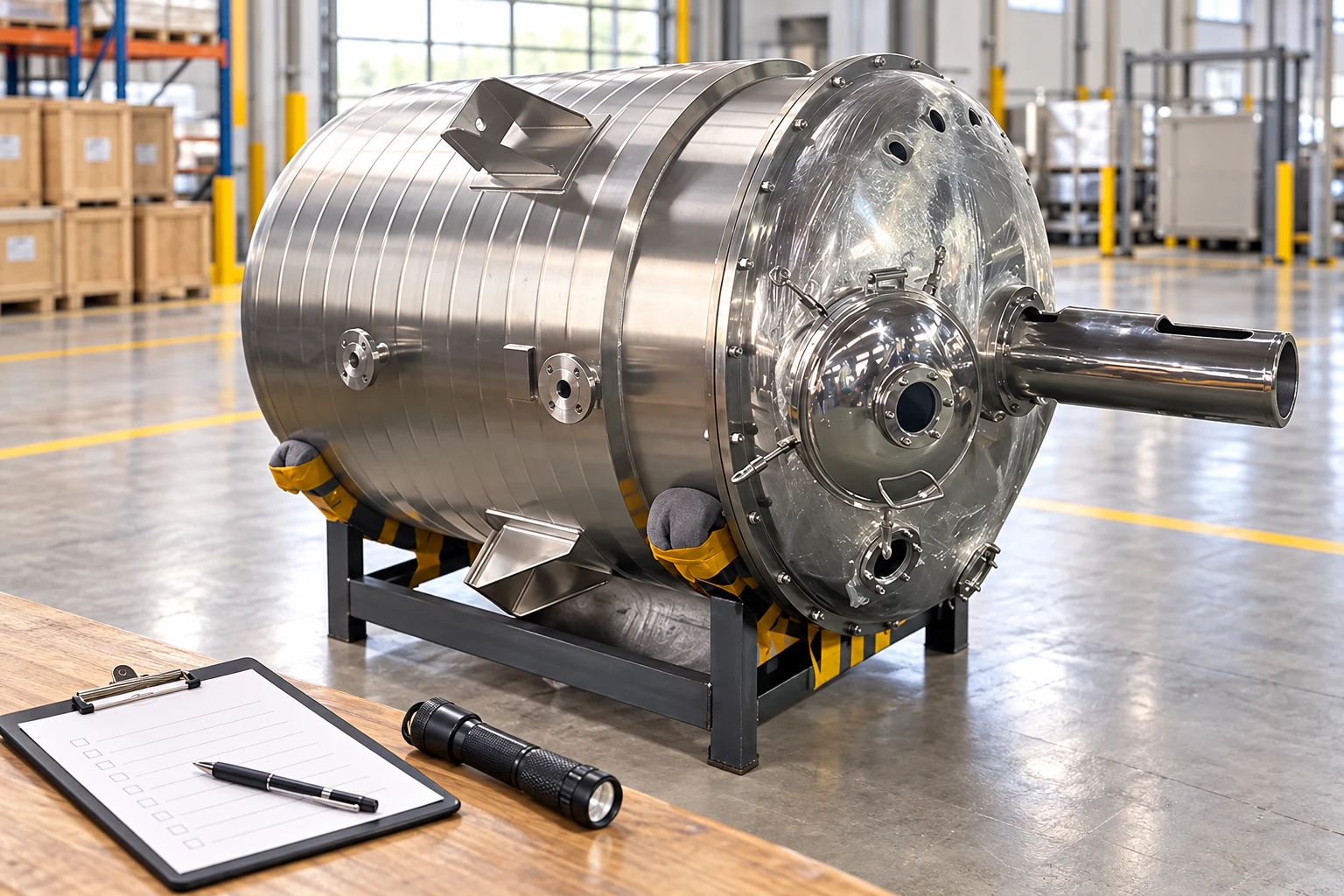
A low-pressure reaction vessel occupies the practical middle ground of reactor buying: more capable than an open atmospheric tank, less demanding than high-pressure equipment. Many stirring, dissolving, neutralizing, and condensation duties live exactly here, held at a modest positive pressure or under a gentle inert blanket.
The phrase “low pressure” quotes nothing by itself. A fabricator needs numbers: the design pressure, the design temperature, and the duty behind them. This guide walks through the scope decisions, material questions, and seal options that turn the phrase into a complete RFQ.

Part 1. Define What Low Pressure Means for Your Duty
Start from the process reason. A vessel may hold slight pressure to keep an inert blanket over an oxygen-sensitive batch, to suppress solvent evaporation, to push transfer without a pump, or simply to contain vapor during heating. Each reason implies a different pressure level and control approach.
Contrast the neighboring classes. An open or atmospheric pressure reaction vessel avoids pressure design almost entirely, while genuinely high-pressure chemistry moves into a different equipment class; a general orientation to containment classes appears in Wikipedia: Pressure vessel.
Write the duty in reactor language. Batch size, the conversion step performed, heating and cooling swings, and the reason pressure exists belong in one short duty statement, as background such as Wikipedia: Chemical reactor frames it.
| Scope input | What to record | Why it matters |
|---|---|---|
| Pressure reason | blanket, vapor, transfer, containment | Sets level and controls |
| Batch size | working and total volume | Fixes geometry class |
| Thermal duty | heat-up, hold, cool-down | Drives jacket scope |
| Media | reactants, solvents, cleaning agents | Drives materials and seals |
| Neighbors | upstream and downstream steps | Defines interfaces |
Part 2. State Design Conditions Explicitly
Give numbers, not adjectives. State the maximum operating pressure, the requested design pressure above it, and the design temperature range, including vacuum tolerance if the process ever pulls the vessel down during cooling or emptying.
Vacuum sneaks in uninvited. A sealed vessel that cools after a hot batch can pull below atmospheric on its own, so say whether the design must tolerate full or partial vacuum. This single line prevents a common and expensive surprise.
Keep classification with the reviewers. Which code and category the vessel falls under depends on the jurisdiction and the stated conditions; the buyer’s job is to state those conditions clearly and route the classification to the responsible engineer.
Part 3. Select Materials Against the Media

List everything the wall will see. Reactants, intermediates, solvents, additives, and the cleaning chemistry all belong on the media list, with temperatures and concentrations. A vessel compatible with the product but not the cleaning acid is still a failure.
Stainless grades are the usual starting point. Ask bidders to state the proposed grade, weld treatment, and internal finish, with the basis against your media list; where chlorides, strong acids, or unusual temperatures appear, expect the discussion to move beyond the standard grades.
Consider the vapor space and gaskets. Condensing vapors can attack roof and nozzle regions differently from the liquid zone, and every gasket, sight glass seal, and instrument wetted part needs a stated material. Broader stainless-vessel context sits in learn about stainless steel reaction vessels.
Part 4. Choose the Agitator Seal Option
The shaft penetration is the pressure boundary’s weak point. Common options are gland packing, a single mechanical seal, and a double mechanical seal with a barrier system, and general agitation background appears in Wikipedia: Agitator (device).
Match the seal to the consequence of leakage. Packing tolerates simple duties where slight weeping is acceptable; single mechanical seals suit many closed low-pressure batches; double seals with barrier fluid answer toxic, flammable, or high-value contents. State the media hazard and let bidders justify their proposal.
Magnetic coupling removes the penetration entirely. Sealed magnetic drives eliminate the dynamic seal at the cost of torque limits and price, a trade-off explored in the magnetic stirring reaction vessel guide. Include maintenance expectations: seal service intervals and barrier-system monitoring belong in the operating plan.
| Seal option | Typical fit | Watch-out |
|---|---|---|
| Gland packing | simple, tolerant duties | slight weeping, adjustment |
| Single mechanical seal | closed low-pressure batches | media lubricity limits |
| Double mechanical seal | hazardous or high-value media | barrier system upkeep |
| Magnetic coupling | leak-free requirement | torque and cost limits |
Part 5. Separate Jacket Duty from Vessel Duty
A jacketed reactor is two pressure systems. The vessel side holds the batch at its conditions; the jacket side holds steam, hot water, thermal fluid, or coolant at completely different conditions, and each side needs its own stated design pressure and temperature.
Describe the utilities honestly. Steam pressure, thermal-fluid temperature range, cooling supply, and the required heat-up or cool-down times let bidders propose jacket type and area; a duty statement beats a copied jacket specification.
Think about thermal cycling. Repeated heat-and-cool batches stress jacket welds and influence design details, so state the expected cycle pattern per week rather than only the extreme temperatures.
Part 6. Plan Nozzles, Instruments, and Documentation
Draw up the nozzle schedule early. Feed points, vapor or reflux connection, pressure and temperature instruments, sampling, sight glass, manhole, drain, and spares each need size and orientation, and late nozzle additions on a pressure boundary are costly.
Instrumentation follows the duty statement. Pressure indication with a defined response, temperature in a representative location, and level or weight where recipes need it form the baseline; state what connects to the plant control system.
Documentation is part of the product. Request material certificates, weld and test records, dimensional drawings, and the data needed for the site’s registration process, and name the required language and format. The relief device interface (nozzle size and location) belongs on the vessel even though sizing stays with the responsible reviewer.
Part 7. Compare Configurable Reactors and Prepare the RFQ
Published equipment anchors the size and configuration classes. The 3500L reactor configuration shows a large agitated jacketed class, and the configurable reactor range covers other volumes, heating methods, and layouts. Product pages provide configuration context; they do not certify a code class or a compatibility claim for your chemistry.
Send one identical package to each bidder: duty statement, batch size, vessel design conditions including vacuum tolerance, jacket media and conditions, full media list, material and finish expectations, seal option and its justification, nozzle schedule, instrumentation, documentation list, and installation constraints.
Require stated assumptions, exclusions, and the split between supplier scope and site responsibilities. When the package is ready, share your reaction duty for a configuration discussion and compare bidders on the same stated conditions.

FAQs
What is a low-pressure reaction vessel?
It is an agitated, usually jacketed reactor designed for modest positive pressure — enough for inert blanketing, vapor containment, or pressure transfer — stated as an explicit design pressure and temperature.
How is a low-pressure reactor different from an atmospheric vessel?
An atmospheric vessel operates essentially open to ambient pressure, while a low-pressure reactor has a designed pressure boundary, sealed penetrations, and a stated design condition, often with vacuum tolerance.
What seals are used on agitated reaction vessels?
Gland packing, single mechanical seals, and double mechanical seals with barrier systems are the common options; magnetic couplings remove the dynamic seal entirely. The media hazard drives the choice.
What materials suit a low-pressure reactor?
Stainless grades are the usual baseline, checked against the full media list including cleaning chemistry. Vapor-space corrosion and gasket materials deserve their own review.
Are jacket pressure and vessel pressure the same thing?
No. The jacket carries utility media at its own design pressure and temperature, stated separately from the vessel side; the two systems are designed and tested as distinct boundaries.
What documentation should a reactor RFQ request?
Request material certificates, weld and test records, drawings, and the data the site’s registration process needs, with the required language and format named in the RFQ.
What should a low-pressure reaction vessel RFQ include?
Include the duty statement, batch size, vessel and jacket design conditions, media list, materials and finish, seal option, nozzle schedule, instrumentation, documentation, and installation constraints.