An ingredient tank should be sized around the real batch and the time it must stay available to the line, not around a convenient catalog number. A vessel that holds the recipe on paper can still interrupt production when foam, transfer residue, minimum agitator level, or cleaning time consume the operating margin.
The practical target is a defined working range: enough usable volume for the largest planned charge, enough freeboard for the process, and a low-level condition that does not compromise transfer or agitation. That range gives engineering, production, and purchasing one common basis for comparing alternatives.
Part 1. Start with the Operating Job
Begin with a simple production story. Identify what enters the tank, how the ingredients arrive, whether they are blended or only held, and where the batch goes next. A powdered premix, a liquid sweetener, and a temperature-sensitive concentrate can all use a vessel called an ingredient tank, yet they impose different requirements on inlet design, agitation, cleanability, and discharge.
Record the largest normal batch, the smallest planned batch, and the expected batches per shift. Then list the time spent filling, blending, holding, transferring, and cleaning. This exposes whether the vessel is a batch maker, a short-term staging point, or a buffer between two operations. Capacity decisions become clearer once its role is explicit.
Do not assume that a recipe quantity equals the equipment volume. Product can foam during addition, an agitator may need a minimum liquid level, and a bottom outlet leaves a residual heel unless the process and piping are designed to recover it. Those factors define working volume more accurately than the nominal nameplate.
Part 2. Convert Batch Demand into Working Volume
Working volume is the liquid or mixture volume that can be used repeatedly without overflow, poor agitation, or an impractical transfer. A useful preliminary calculation starts with the maximum batch volume and adds allowances that are visible to every reviewer:
Required nominal volume = maximum working batch + headspace allowance + retained volume allowance
The equation is deliberately simple. It is a screening tool, not a substitute for process design. Headspace should be chosen from observed or expected behavior: gentle liquid holding may need little freeboard, while powder charging, aeration, foaming, or vigorous mixing may require more. Retained volume includes the discharge heel, material left in valves or lines, and any minimum level needed to protect the process.
| Sizing input | Why it matters | RFQ entry |
|---|---|---|
| Maximum batch volume | Establishes the minimum usable capacity | litres per batch |
| Minimum batch volume | Checks low-level transfer and mixing | litres per batch |
| Density and temperature | Converts mass to volume and affects duty | kg/m³ and operating range |
| Foam or entrained air | Determines freeboard requirement | observed, expected, or unknown |
| Discharge heel | Prevents an overstated usable volume | litres or percent |
For example, a line that normally prepares 650 litres should not automatically request a 650-litre vessel. The buyer should decide the permitted fill level, document the expected foam behavior, and ask the supplier to state the proposed nominal and working-volume range. That makes quotations comparable even when vessel dimensions differ.
If several recipes use one tank, size to the most demanding credible operating case rather than the average recipe. The deciding case may be the largest liquid batch, the lowest-viscosity material that splashes, or the smallest batch that still needs reliable agitation. Capture all three where they are relevant.
| Capacity term | Meaning | Decision use |
|---|---|---|
| Nominal volume | Geometric vessel capacity | Initial equipment comparison |
| Working volume | Repeatable operating fill range | Daily production planning |
| Maximum fill level | Highest permitted process level | Overflow and foam control |
| Minimum operating level | Lowest level for transfer or agitation | Small-batch feasibility |
Part 3. Allow for Time, Transfers, and Line Variation
A correctly sized tank can still become a bottleneck when its occupied time is longer than the rest of the formulation line expects. The occupied time includes filling, ingredient addition, any blend or hold period, discharge, rinsing, and release for the next batch. Compare that total with the required batch interval rather than viewing capacity in isolation.
Consider a line where upstream preparation provides a new batch every hour but the ingredient tank is occupied for seventy-five minutes. Adding a larger vessel may create more stored volume, yet it does not fix the release-time mismatch. A revised schedule, faster transfer, parallel staging, or a second vessel may be more effective. This is why a sizing review must include time as well as litres.
Variation deserves the same attention. Ingredient deliveries may arrive in different package sizes, a downstream filler can pause, and recipe changes can alter hold time. State whether the vessel must absorb those normal variations or whether the line stops when they occur. The answer determines whether additional usable volume is justified.
Part 4. Check the Vessel Features That Affect Capacity
Geometry and fittings influence the usable range. A tall, narrow vessel may offer a different liquid depth at the same volume than a wider vessel, which changes agitator immersion and footprint. Bottom shape, outlet position, and nozzle layout also affect how much product remains after transfer and how easily the tank is cleaned.
Agitation should be evaluated against the actual liquid levels and materials. Some duties need only homogeneous holding; others need powder wet-out, suspension, or controlled shear. Tell the supplier the viscosity range, solids addition method, temperature range, and minimum batch. Avoid treating an agitator as an automatic feature that solves every blending problem.
Cleaning access is another capacity consideration because it controls turnaround. Confirm the cleaning method, required access openings, spray-device arrangement where applicable, and the need to inspect or manually clean internal surfaces. Hygienic expectations should be confirmed for the product and plant, not inferred from a general tank description. The 3-A Sanitary Standards provide useful context for sanitary equipment discussions, while the project team remains responsible for the final requirement.
Part 5. Select a Configuration Within Its Fit Boundary
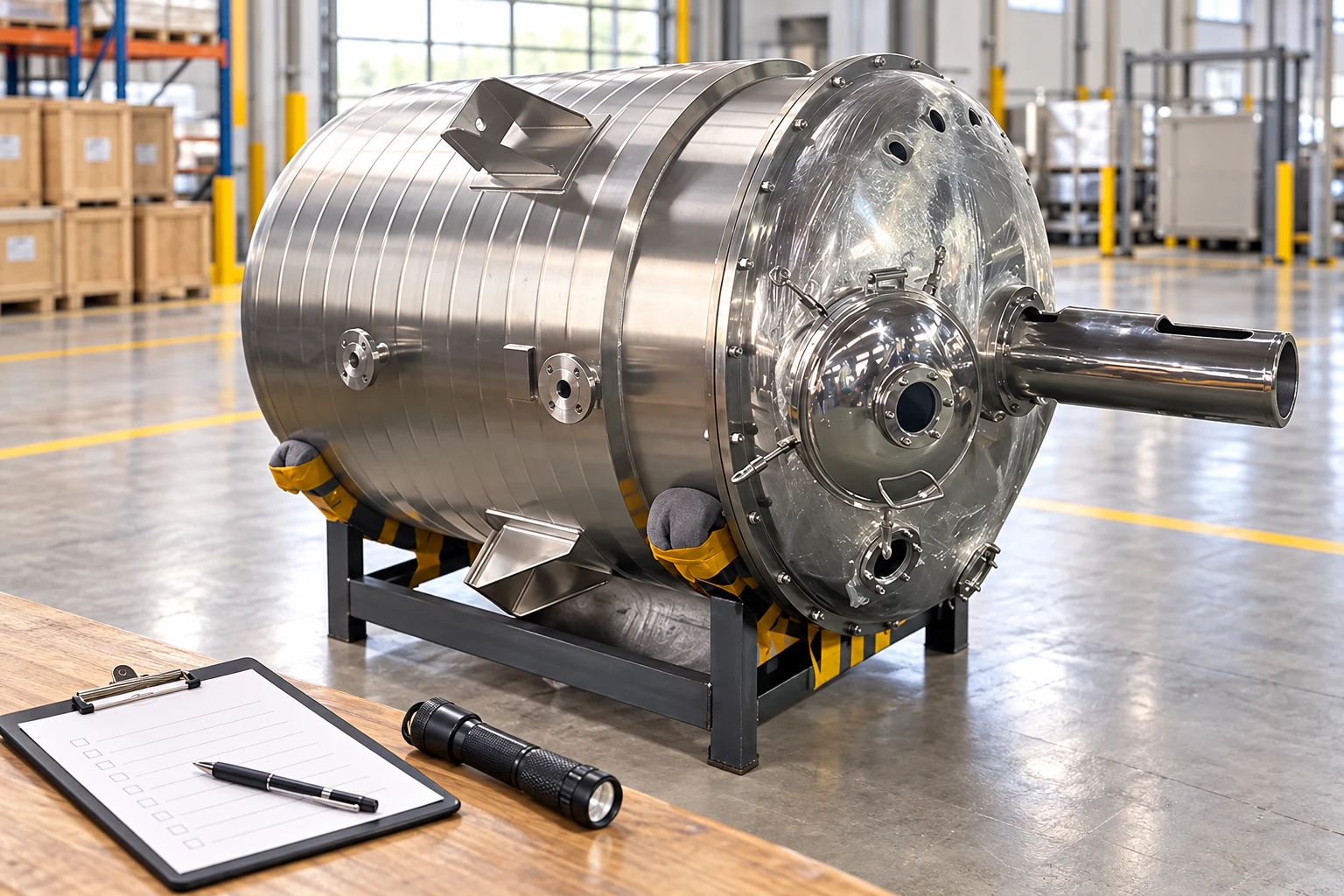
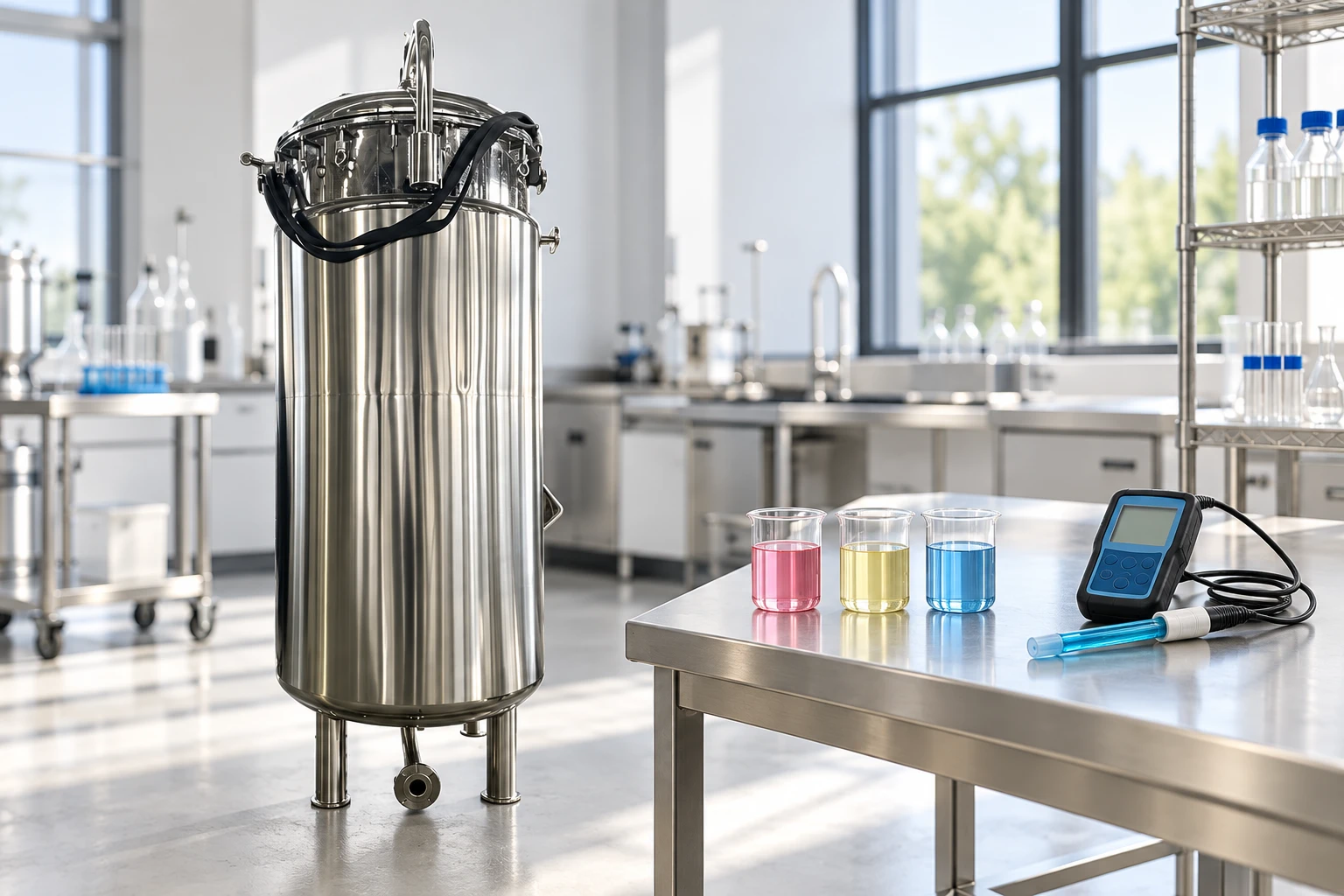
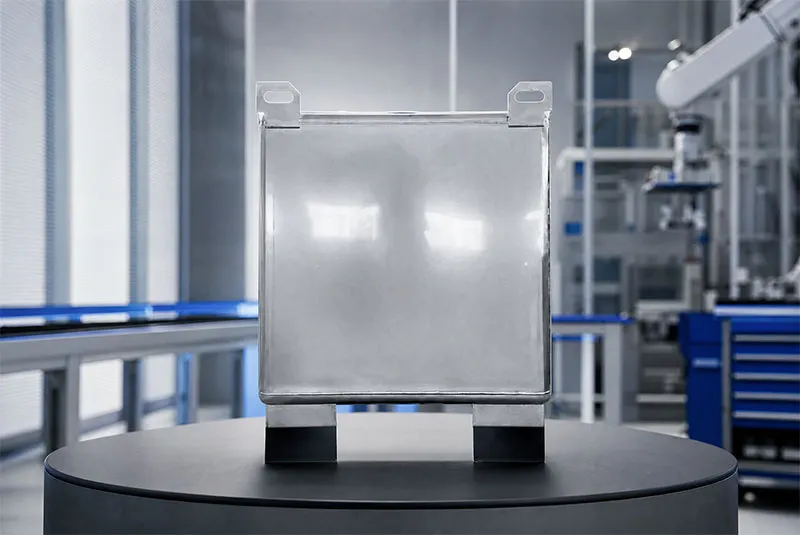
YIYI’s Mixing Tank category is a useful starting point when the ingredient vessel also needs mixing. A published 800L mixing tank can help a buyer discuss approximate capacity and layout, but it should not be treated as proof that an 800-litre model fits every 800-litre recipe.
For duties that require a defined mixing arrangement, review a mixing tank with agitator against the minimum and maximum levels, viscosity, solids, and cleaning routine. This is the product recommendation for a configurable starting point, not a universal selection.
The fit boundary is important. This guide does not select equipment for pressurized or vacuum operation, explosive atmospheres, hazardous chemistry, validated aseptic service, or recipes with uncertain foaming and rheology. Those cases need an engineering review with complete material and operating data.
Related reading can help frame the decision: what is a stainless steel mixing tank explains common equipment context, while the chemical mixing tank guide for industrial buyers highlights the value of defining the duty before comparison.
Part 6. Build an RFQ That Can Be Quoted Consistently
A useful RFQ replaces vague requests such as “one ingredient tank for a batch line” with a measurable operating envelope. State the product name or product family, maximum and minimum batches, density, viscosity range, solids content, temperature, fill and discharge times, and required batches per shift. Include whether the tank is for receiving, blending, holding, or all three.
Add the desired material, surface and hygienic scope, cleaning approach, available utilities, installation limits, controls, and documentation needs. If load cells, a level instrument, a jacket, or a particular outlet valve are required, name the duty behind each item. Requirements tied to a purpose are less likely to be missed during quotation.
Ask every bidder to identify nominal capacity, guaranteed working range, minimum recommended operating level, estimated discharge heel, and assumptions about foam or mixing. Request a general arrangement drawing and a list of exclusions. The inquiry can then move to contact YIYI with a clear basis for engineering discussion.
FAQs
How is an ingredient tank sized for a batch line?
Start with the maximum working batch, then document allowances for headspace, retained product, mixing level, and the time the vessel is occupied. Choose nominal volume only after those factors are reviewed.
What working volume should an ingredient tank have?
The working range must cover the largest normal batch without exceeding the permitted fill level and must also support the smallest required batch. The supplier should state that range in the quotation.
How much headspace is needed in an ingredient tank?
There is no universal percentage. Use observed or expected foam, powder addition, agitation intensity, and operating procedure to define the allowance for the specific product.
Does an ingredient tank need an agitator?
Not always. Holding a stable liquid is different from dissolving powders, preventing settling, or maintaining a blend. Define the required result and the minimum operating level before specifying agitation.
Can one ingredient tank serve several formulas?
It can when the capacity range, cleaning method, material compatibility, and turnaround time fit every planned formula. Size the equipment for the most demanding credible case, not the average one.
What information should be included in an RFQ?
Include batch sizes, product properties, operating temperatures, fill and discharge times, cleaning needs, utilities, layout limits, controls, documentation, and the proposed working-volume range.