

Tank nameplate drawing reconciliation establishes whether a delivered vessel, its identification, and its controlled documents refer to the same equipment and approved configuration. Start with the physical serial number and equipment tag, then compare the nameplate information with the applicable drawing, order, and manufacturer records. Log discrepancies without altering markings or assuming the latest-looking document is correct. Resolve identity and revision questions before using the equipment for its intended service. This process supports acceptance and maintenance planning; it does not authorize a pressure rating, replace a required examination, or turn an atmospheric vessel into pressure equipment.
Establish which vessel the documents describe
Receiving inspection often starts with a packing list and a photograph. Those are useful, but they may identify a shipment rather than a unique vessel. A purchase order can contain several similar tanks, and project equipment tags may have changed between design and delivery. Build a traceable connection between the installed item and the manufacturer’s serial identification before comparing individual specifications.
Record the tag, serial number, manufacturer, physical location, and the documents presented for that unit. Where a marking is obscured or inaccessible, arrange safe access through the site’s procedure. Do not climb on pipework, remove insulation, or disturb connected equipment simply to obtain a photograph. An unreadable identifier should remain an open item until the responsible parties establish an acceptable evidence route.
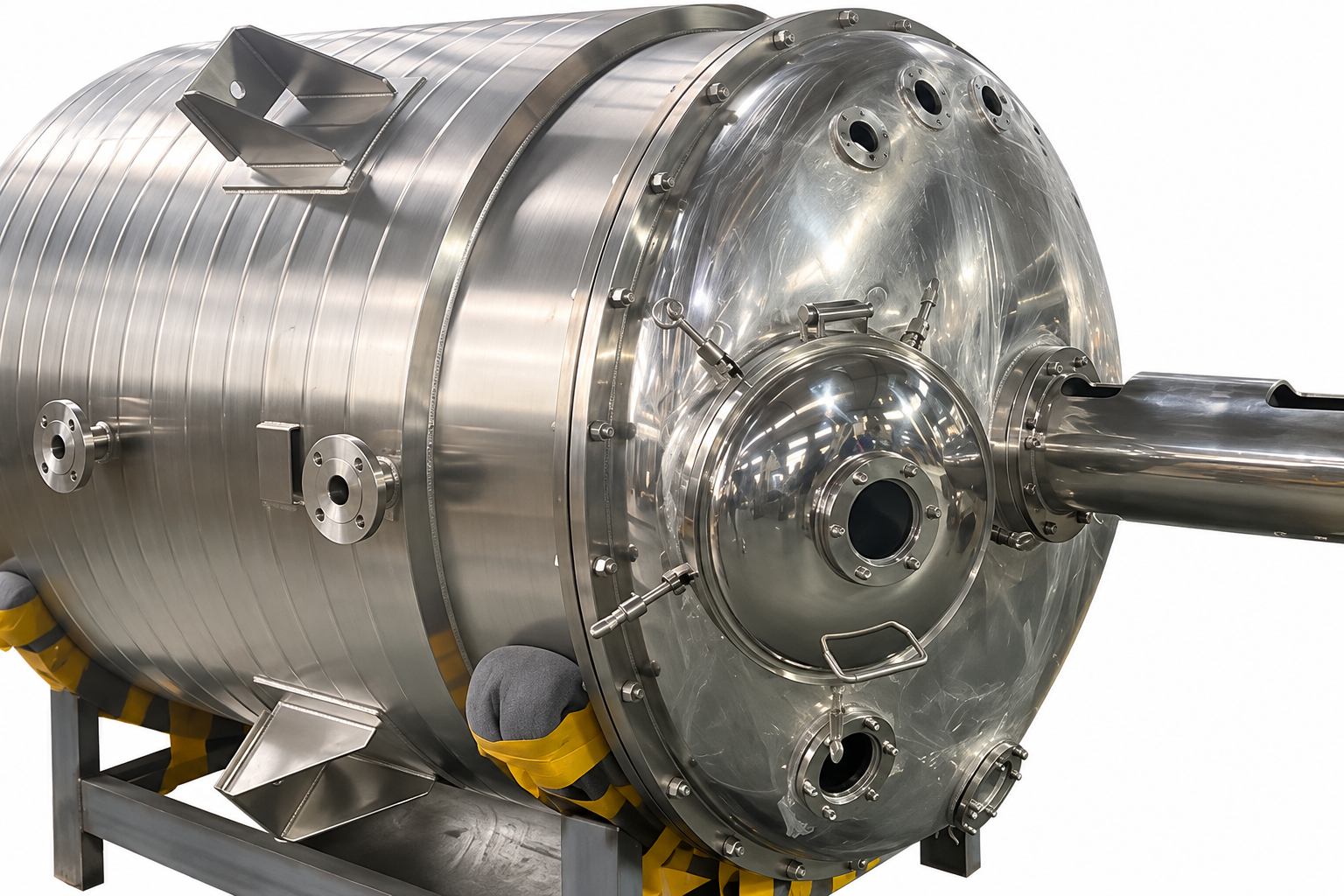
The website vessel photograph supplies equipment context only. It does not prove the rating, internal construction, certification, orientation in service, or identification of a customer’s vessel. An enquiry should use the actual delivered unit’s records, not a catalogue image as a substitute for its nameplate.
Build a document hierarchy before comparing values
Collect the purchase specification, approved equipment drawing, relevant manufacturing record, nameplate transcription, and any authorized change notices. List the document number and revision for each. Distinguish preliminary, approved-for-manufacture, and as-built documents where those states are used by the project. A later date alone does not establish approval or applicability.
Ask the manufacturer or responsible engineer which document controls each disputed field. The nameplate may contain a compact subset of information, while the drawing contains geometry and connection details. A general arrangement may not be the design calculation record. A material certificate identifies a material item only through the documented traceability system; it does not automatically prove that every visible component has that grade.
Preserve superseded documents in the history while making their status unmistakable. If an emailed sketch changed a nozzle location, locate the approved change and determine whether the final drawing incorporates it. Do not silently edit the receiving checklist to make contradictory documents appear consistent. A good reconciliation shows both the original discrepancy and the authority for its resolution.
Compare identity first, configuration second
Begin with fields that connect the records to the physical item: manufacturer identification, serial number, equipment tag, order reference, and drawing applicability. Once identity is established, compare the configuration relevant to the purchase: connection schedule, support arrangement, orientation, access openings, and supplied accessories. Use safe observations and appropriate records rather than assumptions about hidden construction.
Treat materials, pressure-related information, and temperature-related information as separate controlled questions. Do not infer allowable service from shell thickness, a flange’s appearance, or an internet product description. Where pressure equipment rules apply, the responsible organization must establish which requirements and examination arrangements cover the actual system. Atmospheric service also requires appropriate venting and consideration of foreseeable conditions; an absence of a pressure rating is not permission to apply pressure.
The HSE introduction to pressure systems explains the safety context within its jurisdiction. Its written schemes of examination guidance describes a specific control framework where applicable. These sources do not classify the vessel in your project or supply a missing manufacturer rating. Obtain an equipment-specific determination from the responsible competent parties.
| Comparison area | Useful evidence | Discrepancy response |
|---|---|---|
| Identity | Serial marking linked to order and manufacturer records | Hold acceptance of identity until the connection is established |
| Drawing applicability | Document number, revision, approval state, and unit reference | Request the correct controlled issue |
| Connections and orientation | Approved schedule and safely observed installed arrangement | Assess changes before connecting services |
| Service-related markings | Actual nameplate transcription and applicable design records | Obtain manufacturer and responsible-engineer clarification |
| Material traceability | Certificates connected through the manufacturing record | Resolve missing links rather than assigning a grade by appearance |
| Change history | Authorized modification and final documentation | Update the controlled record through its approval process |
The table is an evidence workflow, not a regulatory acceptance certificate. Your contract, local rules, and the responsible engineering assessment determine the actual release criteria and any mandatory hold points.
Write discrepancies so they can be resolved
A useful discrepancy record states the expected information, the observed information, the evidence source for each, and the affected decision. For example, a drawing revision mismatch may prevent connection work until orientation is confirmed. A serial-number mismatch may affect the entire document package. Avoid vague statements such as “documents incorrect” that require the next reviewer to repeat the investigation.
Keep transcription separate from interpretation. Preserve the exact text of a marking in a photograph or controlled record, then add the engineer’s explanation in a different field. If units differ, compare them using a documented conversion only after confirming that the values describe the same quantity and basis. Do not treat design, operating, and test conditions as interchangeable labels.
Assign each issue an owner and required response. A supplier clarification, a corrected document, a physical modification, and a further examination are different actions. Identify which must happen before installation, which before commissioning, and which before final handover. Do not allow an administrative status such as “response received” to imply that the technical concern has been accepted.
Do not correct a plate informally
An apparent typographical error still requires an authorized resolution. Do not stamp a new value, attach a replacement label, or modify a serial marking on the basis of a phone conversation. Establish the responsible authority, the evidence supporting the correction, and the process for maintaining traceability. Requirements vary with equipment type and jurisdiction, so obtain specific instructions rather than using a universal repair method.
If the discrepancy concerns supplied configuration, inspect the actual item within the safe receiving scope. The broader mixing tank receiving inspection guide helps organize photographs and outstanding items. The reconciliation task remains focused on identity and documents, rather than repeating every mechanical acceptance check.
If a physical change affects a sealed boundary or connection, keep any required leak-testing record linked to the change. A successful leak test does not establish the correct design rating or erase a document mismatch. Likewise, a corrected drawing does not prove that a physical modification has been examined and accepted.
Explain why pressure information needs careful handling
Pressure differences can load a vessel even when an operator does not intend to pressurize it. The following science-museum demonstration illustrates the effect of external air pressure on a drum. It is included to explain why equipment-specific service limits and protective arrangements matter; it is not a vessel test procedure, a rating calculation, or an instruction to reproduce the demonstration on production equipment.

Imagination Station Toledo: Crush a steel drum with air pressure.
For the delivered vessel, identify the approved service conditions and the arrangements that keep the system within them. Do not choose a relief or vacuum-protection device by copying another installation’s nameplate. The pressure versus atmospheric tank manway guide discusses how the service basis affects access-opening decisions, while this article addresses the identification and documentation that make those decisions traceable.
Close the reconciliation with a controlled record
The closeout pack should contain the verified equipment identity, the applicable document list, the discrepancy log, approved responses, and evidence that required actions are complete. Identify remaining restrictions explicitly. Record who accepted each resolution and under what authority. Keep the original plate photographs and earlier document issues accessible so future maintenance teams can reconstruct the decision.
Check that the final drawing actually represents the delivered and accepted configuration. If the manufacturer has promised a corrected document but has not supplied it, retain the corresponding open item. Avoid replacing an unresolved issue with a statement that a document is “to follow” unless the project’s authorized release process expressly permits that arrangement and records the associated limits.
For a YIYI enquiry, send the equipment tag, serial identification, relevant drawing numbers and revisions, safe photographs, intended service, and the exact discrepancy. Ask which supplied records apply to that unit and what approved clarification is available. This focused request is more actionable than asking whether a tank is generally suitable based on an exterior photograph.
FAQ
Is the newest drawing always the correct drawing?
No. Confirm its approval state, applicability to the specific vessel, and incorporation of authorized changes. A newer preliminary drawing may not replace an approved as-built record.
Can a pressure rating be inferred from a vessel photograph?
No. Appearance does not establish design limits, material traceability, certification, or suitability for a service. Use the actual equipment’s controlled records and responsible technical assessment.
What should happen when a nameplate and drawing disagree?
Preserve both records, describe the discrepancy, identify the affected release decision, and obtain an authorized resolution. Do not informally alter markings or assume one source is correct without evidence.


