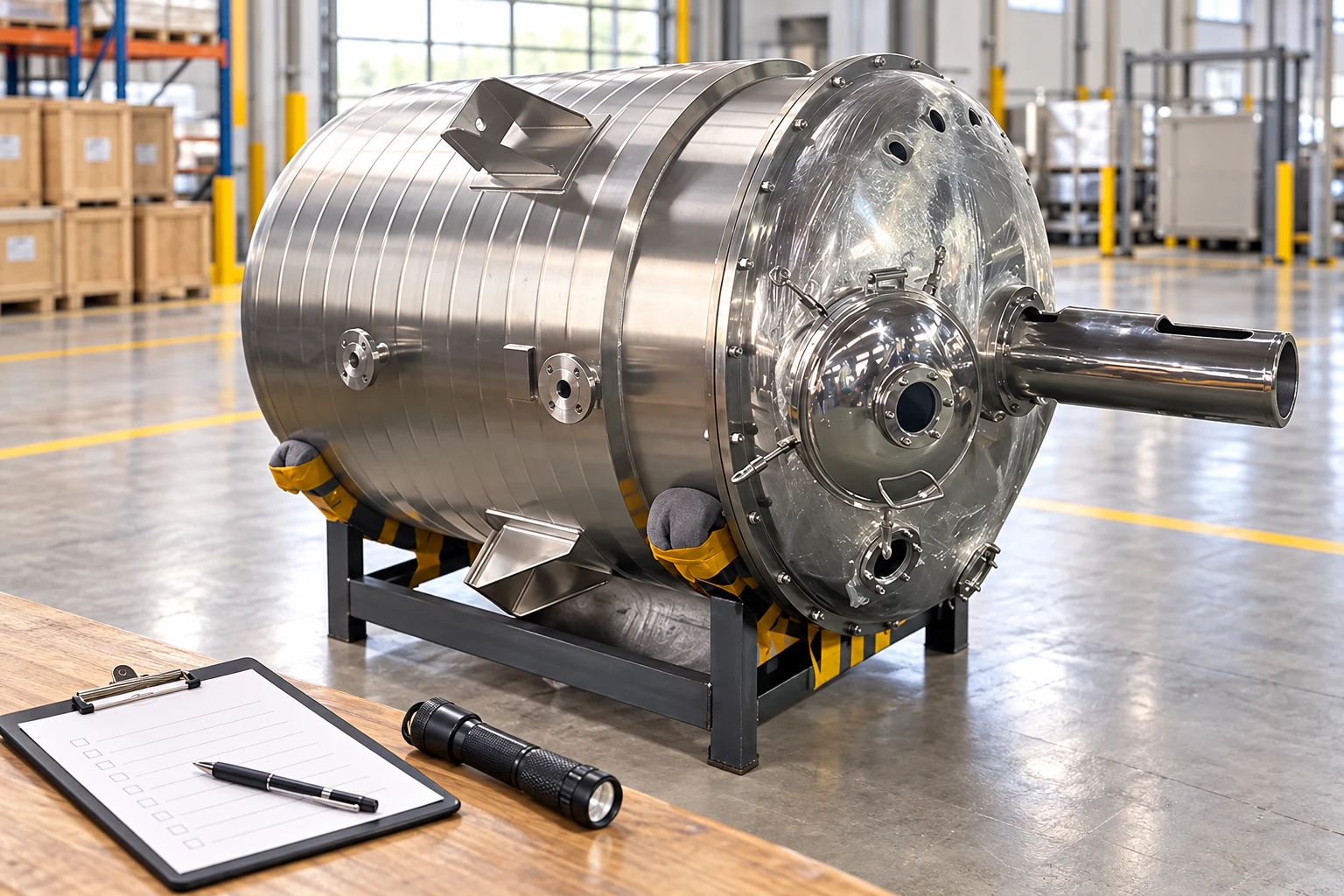
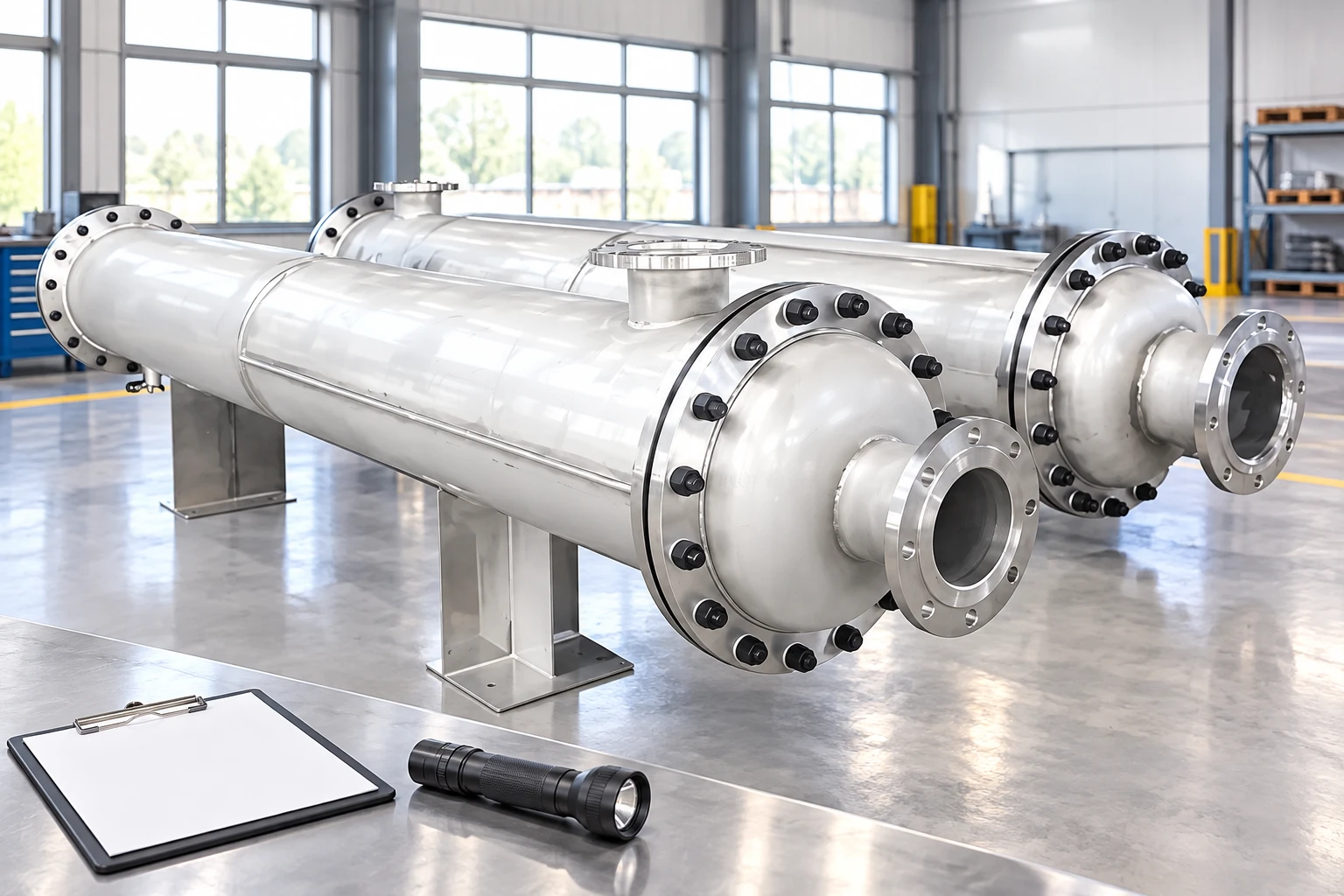
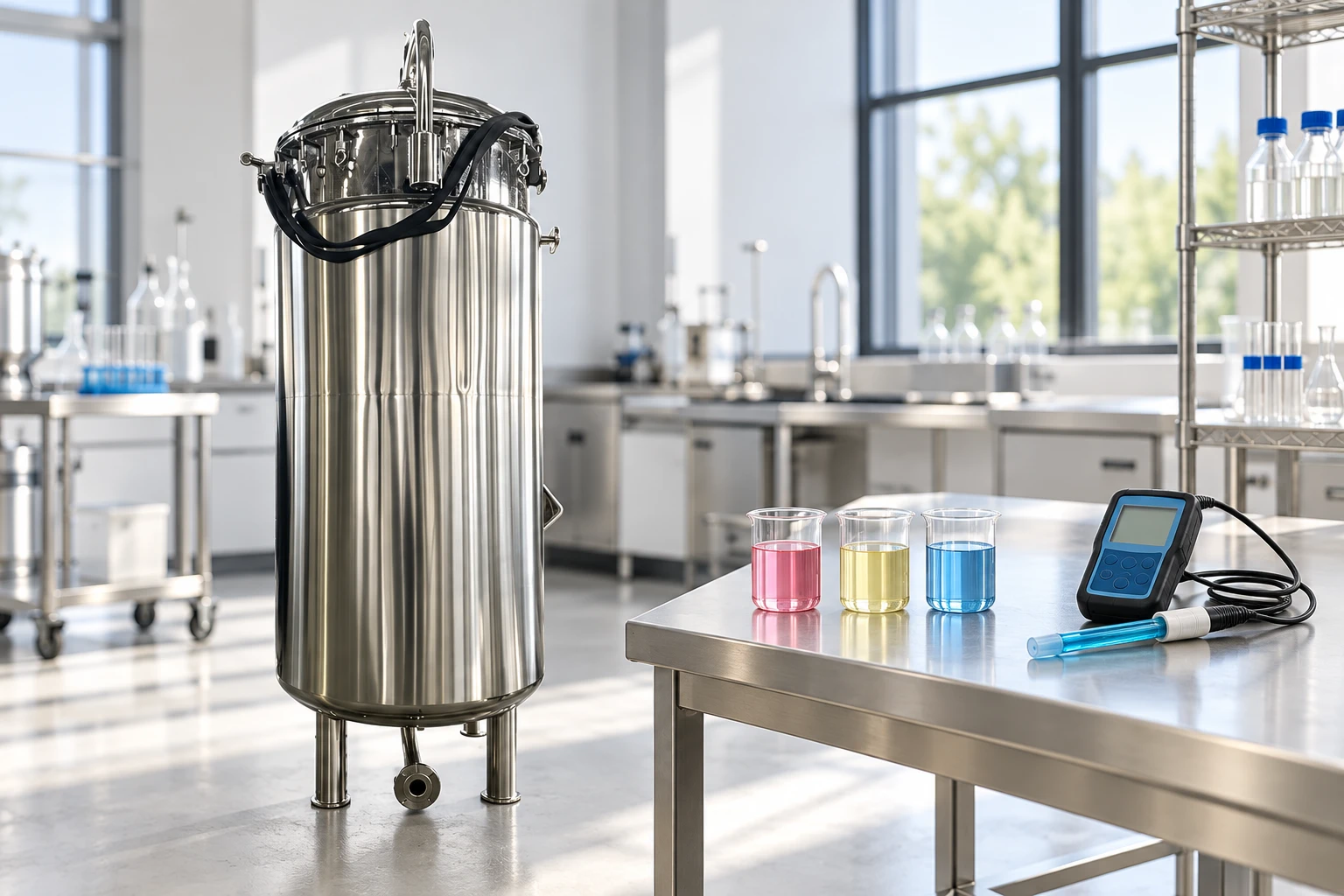
A mechanically stirred fermenter is the right starting point when your culture needs motor-driven mixing and adjustable aeration at working volume; static or pneumatic fermentation fits when gas circulation or a low-shear, agitator-optional duty is enough. This guide compares mixing, oxygen transfer, CIP footprint, and culture type so you can RFQ the correct vessel class before detailed aeration planning.

What Counts as a Mechanically Stirred Fermenter vs Static Fermentation
A mechanically stirred fermenter—also called a stirred tank fermenter or stirred tank bioreactor—uses a motor-driven shaft, impeller, and wall baffles to circulate broth, break up gas bubbles, and keep temperature and nutrients uniform through the working volume.
Static fermentation, in procurement language, means the batch runs without that mechanical agitator. The vessel may still be actively aerated: airlift and bubble-column designs circulate liquid with rising gas and a draft tube, and some brewery tanks run primary fermentation with cooling and ports only while listing the agitator as optional. The contrast is whether you are buying and maintaining a mixer train, not whether the tank is completely motionless.
| Term | What moves the broth | Typical hardware | Buyer signal |
|---|---|---|---|
| Mechanically stirred fermenter | Motor impeller + baffles | Shaft seal or magnetic drive, sparger, DO probes | High O₂ demand, viscous broth, solids suspension |
| Pneumatic “static” fermentation | Gas lift / bubble circulation | Draft tube, bottom air, no impeller | Lower shear, simpler mechanics, moderate OTR duty |
| Agitator-optional fermentation tank | Natural convection ± jacket cooling | Manway, sample valve, optional mixer | Beer/wine-style duty where yeast management tolerates low agitation |
When Mechanical Mixing Becomes the Limiting Factor
Choose mechanical stirring when passive or gas-only circulation cannot keep the broth homogeneous as viscosity rises, biomass accumulates, or additions must disperse quickly.
Industrial stirred fermenters rely on baffles—often four to eight around the wall—to stop a central vortex and force axial/radial flow past heat-transfer surfaces. The impeller and agitator shaft create the forced circulation that static fermentation layouts omit.
If the duty is a thin, low-biomass hold step or a brewery primary where convection and CO₂ evolution provide enough motion, an agitator-optional tank may be the economical match. The question is not “stirring is always better,” but whether your acceptance tests require proof of bulk uniformity at peak cell density.

Oxygen Transfer: Stirred Agitation vs Gas-Only Circulation
Stirred tanks win oxygen duty when dissolved oxygen must track a rising uptake rate as biomass grows, because mechanical agitation shatters bubbles and renews the gas–liquid interface while sterile air enters through a bottom sparger.
Improving volumetric oxygen transfer (kLa / oxygen transfer rate) is the usual reason buyers specify a stirred tank bioreactor instead of a static fermentation path when peak dissolved oxygen (DO) demand is high.
Aerobic submerged fermentation depends on continuous gas supply: oxygen is poorly soluble in water, so the vessel must both deliver sterile air and keep it in contact with the culture. In a mechanically stirred fermenter, impeller shear and baffle turbulence reduce bubble size and improve mass transfer compared with gas-only circulation at similar superficial gas rates in published yeast comparisons. That does not guarantee a higher titer—it means you have separate levers for airflow and agitation when the process owner documents oxygen demand.
Static or pneumatic alternatives still transfer oxygen, but control is coarser.
Airlift bioreactors move broth with a draft tube and rising bubbles. Bubble column vessels rely on gas buoyancy without a mechanical impeller / agitator shaft.
University course notes on air-lift design emphasize circulation without a motor impeller and cite very short mixing times in specific flocculating-yeast cases.
The trade-off is flexibility: in stirred tanks you can raise agitation to handle rheology changes during growth, while airlift performance is tied tightly to geometry and aeration rate.
For readers who already selected mechanical stirring and need sparger and RPM planning, use the dedicated mechanical stirring fermentation tank aeration and RPM guide rather than duplicating those tables here.
| Oxygen / mixing lever | Mechanically stirred fermenter | Static / pneumatic fermentation |
|---|---|---|
| Primary control knobs | Impeller speed, sparger rate, pressure | Aeration rate, vessel geometry, draft tube |
| Typical strength | Tunable kLa across growth phases | Lower mechanical complexity, gentler shear |
| Watch-outs | Flooding, foam, seal wear | DO gradients at very high demand or viscosity |
| Planning depth | Aeration + RPM article for stirred duty | Confirm circulation pattern with process data |

CIP Footprint, Seals, and Mechanical Complexity
Mechanical stirring adds parts that must be cleaned, sealed, and inspected—shaft penetrations, drive couplings, impeller hubs, and sometimes bottom-entry agitators—so CIP / SIP scope grows with every moving interface.
Stirred fermenter listings commonly pair online CIP cleaning and SIP sterilization with sanitary fittings because the impeller zone, seal gap, and sparger holes are product-contact surfaces. A static or agitator-optional tank may still need spray balls and drainability review, but there is no drive seal to flush or magnetic coupling to verify after each campaign. Procurement teams should ask vendors to show spray coverage past baffles and whether the seal type is lip, mechanical, or magnetically coupled, because maintenance intervals follow that choice.
Cooling and cleaning interfaces also interact. A beer fermentation tank capacity, cooling, and CIP guide helps when jacket duty dominates, while stirred bioreactor RFQs must list CIP supply/return, foam management, and exhaust treatment in the same package as agitation.
Culture Type, Shear, and Morphology
Match the vessel class to how the organism tolerates hydrodynamic stress and which morphology you must preserve.
Robust bacteria and many yeasts tolerate stirred-tank shear when impeller type and tip speed are chosen for the broth. Filamentous fungi, some plant cells, and shear-sensitive mammalian lines may show lower viability or altered morphology under aggressive disk turbines—selection guides for stirred versus airlift systems consistently list high shear sensitivity as a strike against classical STRs. That is not an automatic vote for static fermentation: it may mean lower-speed axial impellers, pneumatic circulation, or a smaller stirred pilot before scale-up.
Important: Independent bioprocess reviews note that stirred tanks deliver strong mixing but can foam and damage shear-sensitive morphologies; pneumatic designs reduce mechanical stress yet may not meet peak oxygen demand without careful geometry. Match the vessel to documented oxygen uptake and shear limits—not to a generic “microbial equals stirred” rule. Source: GFI upstream bioprocess design.
Application notes comparing shake-flask screening with instrumented bioreactors also show why low-control static paths fail when pH and dissolved oxygen are uncontrolled at higher cell density—oxygen becomes limiting long before the vessel material is the bottleneck.
Decision Matrix: Stirred, Pneumatic, or Agitator-Optional
Use the matrix as an RFQ filter, then confirm with heat removal, foam behavior, and site utilities.
| Process signal | Favor mechanically stirred fermenter | Favor static / pneumatic / optional agitation |
|---|---|---|
| Peak oxygen demand | High and tracked with DO control | Low to moderate; tolerance for gradients |
| Broth rheology | Viscous or solids-laden | Thin, Newtonian |
| Shear sensitivity | Low or mitigated impeller choice | High; morphology must stay intact |
| Scale-up path | Established STR ranges on published SKUs | Brewery or hold duty; agitator optional |
| Mechanical maintenance appetite | Accept seals, drives, CIP validation | Minimize moving parts in product zone |
| Control instrumentation | pH, DO, foam, feed profiles | Temperature and pressure often enough |
When geometry is the main question instead of agitation—vertical cylinder versus conical cone—read the vertical fermentation tank vs conical fermenter comparison separately so vessel shape decisions do not override mixing class.

Choose Stirred or Static-Compatible Fermentation Equipment
YIYI’s biological fermentation tank hub groups stirred bioreactor SKUs and modular brewery tanks so you can align mechanical scope with the duty matrix above.
For mechanically stirred duty, the Fermenter range publishes impeller, bottom sparger, and mixer-speed tables from 500 L to 10 000 L models, with online CIP/SIP listed on the page.
The 2000L fermenter SKU adds detail on bottom gas distribution, sensor interfaces, and optional impeller types for RFQ discussions.
When the process fits agitator-optional brewery fermentation, the vertical modular fermenter documents jacket cooling and optional agitation across published capacity bands.
The 1000 fermentation tank remains a compact reference point for cluster comparisons.
Send organism class, working-volume range, oxygen and shear limits, cleaning method, and utility interfaces with your inquiry. Request a configuration review once the stirred-vs-static decision is documented so quotations stay comparable.

FAQ
What is a mechanically stirred fermenter?
It is a sealed fermentation vessel with a motor-driven impeller and baffles that mix the broth, disperse sparged gas, and support temperature and nutrient uniformity.
How is that different from static fermentation?
Static fermentation runs without a mechanical agitator. Broth may still move through gas lift or natural convection, but there is no motor-driven mixing train.
When do I need mechanical agitation?
Specify stirring when oxygen demand, viscosity, or solids suspension require forced circulation that pneumatic or passive mixing cannot maintain through peak growth.
How does oxygen transfer compare?
Stirred tanks combine sparging with impeller shear to increase gas–liquid contact. Pneumatic designs depend more on aeration rate and vessel geometry; published comparisons often show higher volumetric oxygen transfer coefficients in stirred tanks at similar air flows under tested conditions.
What are the main drawbacks of stirred fermenters?
Higher shear, foam, seal maintenance, and broader CIP validation compared with static or pneumatic vessels.
Is a fermenter the same as a bioreactor?
In buyer language the terms overlap: a fermenter usually implies microbial or fungal culture, while bioreactor is the wider term for any vessel hosting a biological process. Mechanical stirring is common to both when submerged mixing is required.
Can brewery tanks qualify as static fermentation?
Many brewery primary duties use agitator-optional modular tanks with jacket cooling. That is static in the mechanical sense until you add a mixer for a different recipe.
Where should I plan aeration RPM after choosing a stirred tank?
Use the mechanical stirring fermentation tank aeration and RPM planning article for sparger and speed work—not this comparison guide.