

Fermenter exhaust filter wetting should be investigated as a gas-path, condensate, and process-carryover problem. Check whether liquid reached the filter from cooling gas, a cleaning or sterilization sequence, excessive foam, or an incorrectly drained section. Compare the event with pressure and gas-flow records, then use the filter manufacturer’s approved inspection and integrity procedures. A wet element can restrict gas passage, but a pressure increase alone does not prove wetting. Keep the pressure-protection and contamination-control questions separate, and never bypass the exhaust filter or a protective device to maintain production.
Draw the complete exhaust path
Start at the fermenter gas outlet and trace every installed component to the final discharge boundary. Include condensers, low points, valves, hoses, filter housings, condensate collection points, pressure measurement locations, and any shared downstream equipment. Use the as-installed arrangement rather than a standard process sketch. A small elevation change or an added hose can create a liquid collection point that the original drawing does not show.
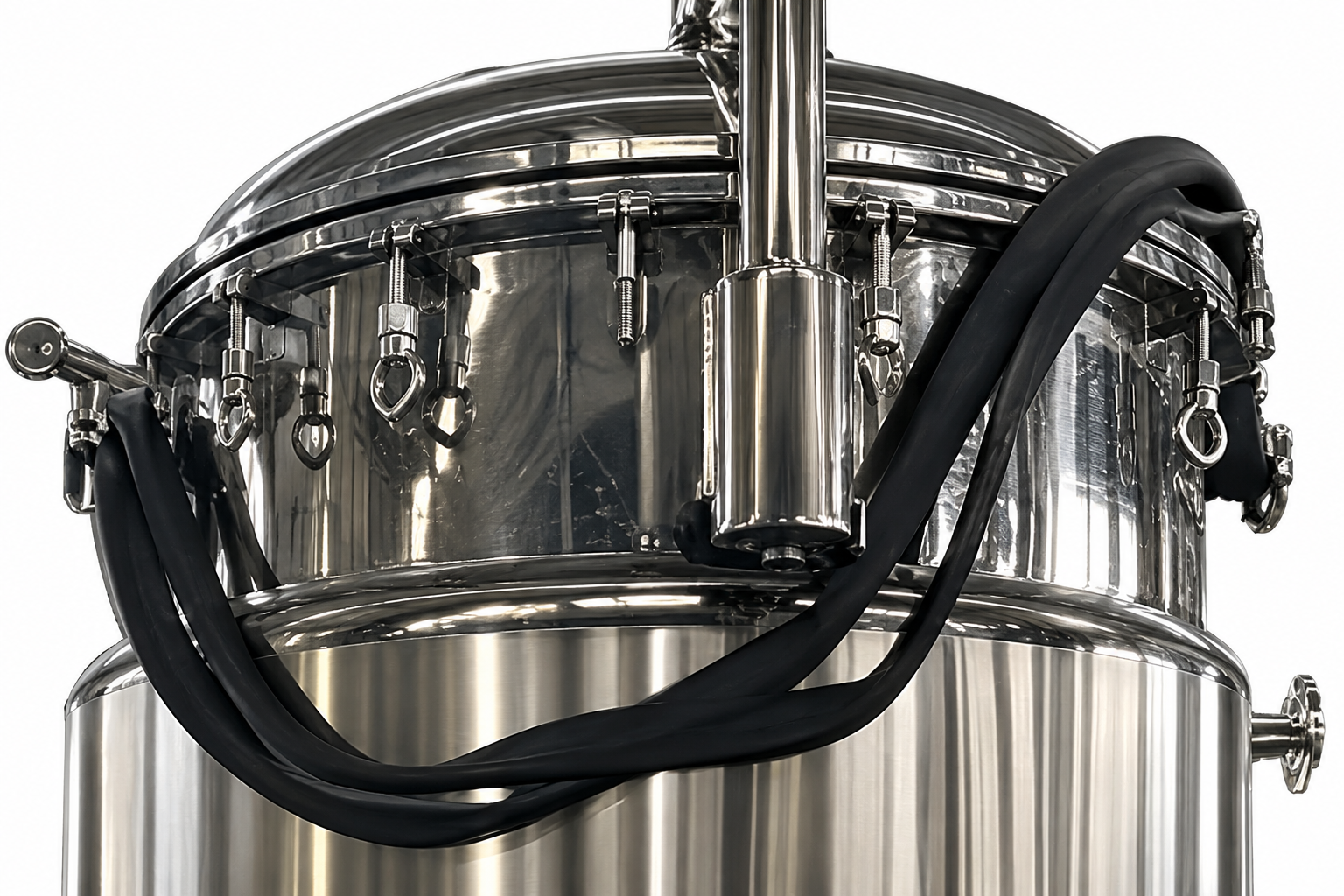
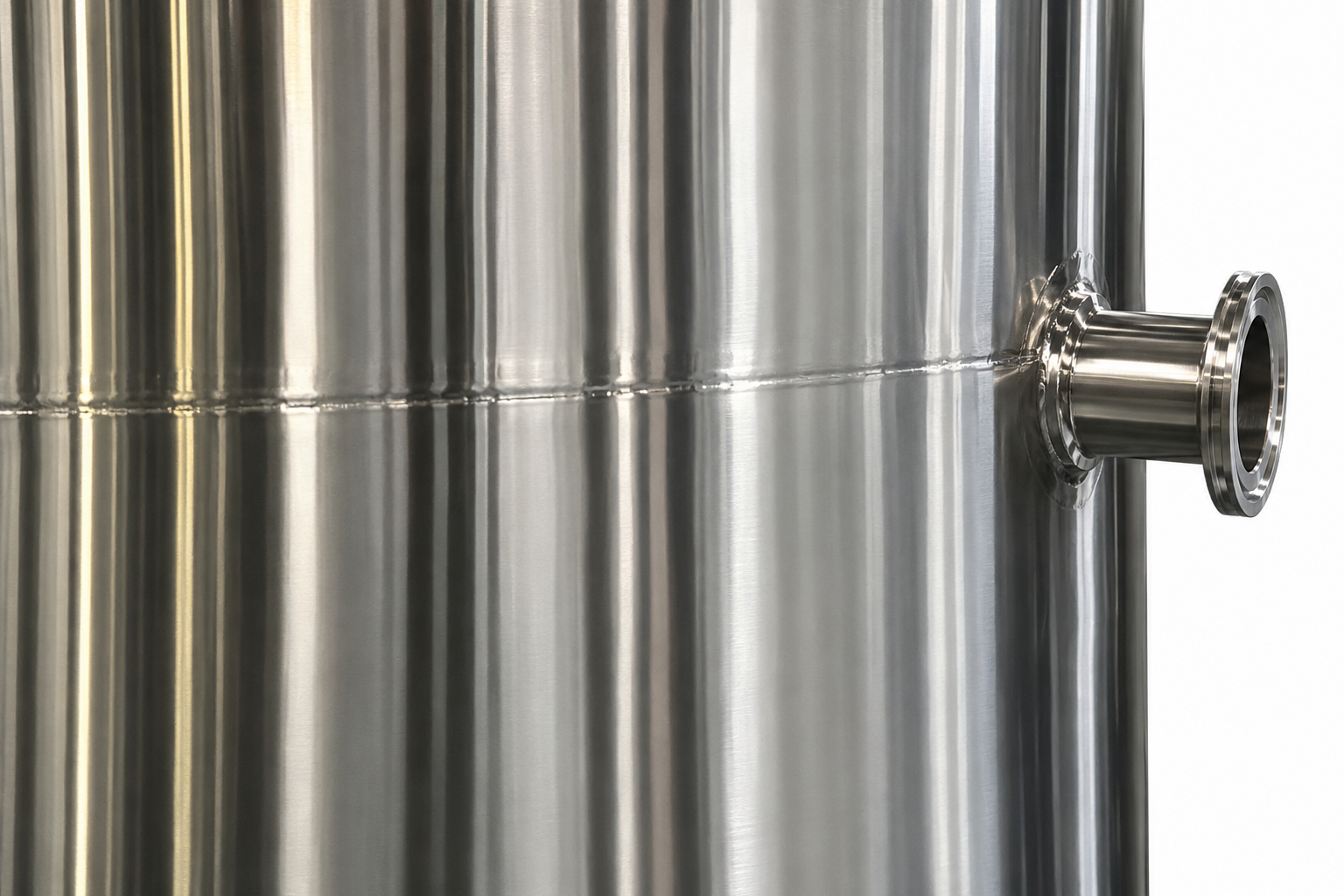
The fermenter product page identifies the equipment family, not the installed exhaust configuration. Do not infer a sterile filter, condenser, or heating arrangement from the vessel photograph. Obtain the approved process diagram, filter model, housing orientation, and operating instructions before proposing changes. The validation document guide explains the broader equipment-record context needed to keep those details traceable.
Distinguish condensation from broth carryover
Warm moist exhaust can cool as it travels through an exposed line or housing. Depending on the actual gas conditions, that cooling can produce condensate. Broth or foam can also be carried into the exhaust path. These mechanisms may occur together, but they suggest different corrective questions. A clear liquid does not automatically establish harmless condensate, and a colored deposit does not independently identify its original source.
Preserve observations before cleaning the system. Record where liquid was found, whether there was visible residue, the batch phase, recent cleaning or sterilization steps, and any unusual foam event. If sampling is needed, use an approved method that protects people and the process boundary. Do not disconnect a filter from an operating or pressurized system simply to see whether it looks wet.
Read pressure and flow trends in context
A rising upstream pressure at a comparable gas flow can indicate increasing resistance somewhere downstream, but it does not locate the restriction by itself. Check the pressure instrument’s location and measurement reference. Compare commanded flow with verified flow and identify whether a control valve or other part of the system has changed state.
A pressure difference across a filter is more informative only when the measurement arrangement and gas conditions are understood. Do not compare a hot operating trace directly with a cool startup trace and conclude that the filter changed. Record the batch phase, gas composition where relevant, temperature, and flow conditions used for comparison. If the approved operating limits are approached, follow the site’s response procedure. An investigation should never depend on intentionally operating a vessel near a protection limit.
Use regulatory guidance within its stated scope
The Health Canada guidance for sterile drug production discusses avoiding unintended moisture at gas filters and documenting relevant integrity testing. Its sterile drug scope must remain clear; it does not qualify a general fermentation installation or prescribe a housing temperature for this vessel.
The PMDA guidance on aseptic pharmaceutical manufacturing also addresses gas filtration and distinguishes applications by their relationship to the process. Use these sources to frame questions for the process owner. The actual element, sterilization conditions, test method, and acceptance criteria must come from the qualified process and equipment requirements. General regulatory guidance is not a substitute for application-specific filter instructions.
| Observation | Question to investigate | Useful record |
|---|---|---|
| Liquid appears after cooldown | Where can moist gas cool and collect liquid? | Temperature sequence and installed line elevations |
| Wetness follows a foam event | Did broth or foam enter the exhaust route? | Foam signal, dosing history and deposit observations |
| Problem begins after sterilization | Was the approved drying and restoration sequence completed? | Cycle record, valve lineup and housing instructions |
| Resistance rises during a batch | Is the restriction at the filter or elsewhere? | Comparable pressure and verified gas-flow trends |
| Problem repeats after replacement | Does the root cause remain in the installed gas path? | Replacement history linked to process conditions |
Review drainage without creating a contamination path
Identify low points, slopes, and collection arrangements from drawings and safe external observations. Ask whether collected liquid has an approved removal route and whether that route is compatible with the sterile or contained boundary. A drain that empties a low point but creates an uncontrolled opening is not an acceptable improvement.
Do not add a drain, reroute a hose, or change housing orientation without review. The effect can extend to cleanability, pressure protection, filter performance, and operator exposure. Ask the filter and process-equipment suppliers to review the complete arrangement together. If a proposed change depends on a particular operating sequence, make that assumption explicit in both the drawing and the procedure so it is not lost during a future shift handoff.
Consider foam and liquid level as separate contributors
Review whether the event coincided with increased working volume, agitation changes, feed addition, or a known foam excursion. The fermenter foam control guide provides the broader process background. Correcting a foam problem can reduce carryover, but it does not resolve a gas line that still traps condensate after normal operation.
Likewise, changing antifoam dose can affect the process and should not be used as a substitute for identifying the exhaust mechanism. Keep a record of what actually entered the vessel and when. A pump command without verified delivery is insufficient. If a foam alarm is questioned, investigate its signal separately rather than assuming that either the filter or the probe is necessarily wrong.
Verify filter condition using the approved method
A visual check can establish that liquid or deposits were observed; it cannot establish microbiological retention, integrity, or remaining service life. Follow the filter manufacturer’s specified conditioning and test procedure for the actual element. A test performed under the wrong wetting or drying condition can be difficult to interpret. Record the element identity, housing, method, test conditions, result, and acceptance basis.
If a filter is replaced, retain its identity and the reason for removal. Link the replacement to the batch record and any quality investigation. Use the contamination investigation guide where the event may have affected process protection. Passing a later test or installing a new element does not by itself establish that the preceding batch remained acceptable throughout the event.
Evaluate prevention options as a system
Possible design reviews may examine condensate removal, suitable housing arrangements, insulation, appropriately controlled heating, gas-path geometry, and upstream carryover management. These are engineering options rather than universal fixes. A heating change needs compatibility with the element, housing, process, and hazardous-area requirements where applicable. A hydrophobic membrane should not be described as immune to all wetting or blockage under all process conditions.
Compare any proposal with normal operation, startup, shutdown, cleaning, and sterilization. Ask what happens if power or gas supply changes unexpectedly. Keep pressure protection independent of assumptions about routine filter maintenance. The review should identify who supplies the process limits, who confirms component compatibility, and how the completed arrangement will be verified before use.
Prepare the next service or procurement request
Provide the gas-path drawing, element and housing models, operating gas-flow range if verified, temperature history, sterilization sequence, observed liquid location, pressure trends, and filter replacement history. Include photographs that identify the installed arrangement without presenting them as evidence of internal condition. State whether the immediate question is a recurring operating restriction, a contamination-control deviation, or a new exhaust-system specification.
Ask the supplier to identify missing information and distinguish component recommendations from system approval. Request an explicit maintenance and testing basis for the proposed arrangement. A useful response should explain what condition it addresses and which operating assumptions it relies on. Keep the final drawings, procedure changes, and verification records together so the same wetting event does not restart an undocumented troubleshooting cycle.
Preserve evidence across shift changes
A recurring restriction may develop over several shifts while the conditions that initiated it occurred much earlier. Keep the filter event number with the batch handoff and record each intervention in sequence. Note whether any liquid was removed, which valve position changed, whether a housing temperature control was restored, and which signal improved afterward. Distinguish operator observations from assumptions about the element condition. If the system returns to normal without an identified mechanism, retain the event as unresolved and define the next monitoring opportunity. Otherwise the next team may discard useful evidence, replace another element, and repeat the same investigation without learning whether condensation or process carryover was responsible.
Educational background
The NPTEL filtration lecture below introduces filtration principles. It is general educational context; its example systems are not a qualification of a fermenter gas filter, and the manufacturer’s gas-filter procedures remain essential.
nptelhrd: Lecture 13 Filtration.
FAQ
Does a pressure rise prove the exhaust filter is wet?
No. It can indicate increased downstream resistance, but the location, gas conditions, instrument arrangement, and other possible restrictions must be checked before attributing it to wetting.
Is a hydrophobic element guaranteed to avoid wetting problems?
No. Suitability depends on the actual medium, process conditions, element, housing, and operating sequence. Use the manufacturer’s application guidance and an approved system review.
Can replacing the filter close the investigation?
Replacement can restore an approved equipment state, but recurring wetting also requires investigation of condensation, carryover, drainage, and cycle history. Product disposition and pressure-protection decisions remain separate responsibilities.


