A customized reactor RFQ works when you tell suppliers the process envelope, the pressure-class inputs, the agitation duty, and the documents you expect with the finished vessel. Use this reactor RFQ checklist to walk those fields in order, catch blurred terminology, and point to published reactor models as conversation starters—not as a substitute for your process data.

What a Customized Reactor RFQ Must Cover
A useful RFQ packages four blocks together: process chemistry and batch size, pressure and temperature envelopes, agitation and sealing preferences, and the documentation deliverables that QA will eventually ask for.
Think of the RFQ as the buyer-side half of an agitated reactor process data sheet—the practical agitated reactor datasheet suppliers expect. Independent process-engineering guides split that sheet into jacketed-vessel data and agitator data for a reason: fabricators cannot size a drive from volume alone, and they cannot quote a pressure-capable head from a mixing sketch alone.
At minimum, include:
- Process description in plain language (reaction family, batch vs semi-batch, known exotherm/endotherm behavior, solids or gas involvement).
- Total volume and planned working volume.
- Materials of construction preferences for wetted parts (for stainless lines, often SS304 or SS316L discussions).
- Structure preference where it matters to access and sealing (open flush cover, open welded flange, or closed construction on published YIYI families).
- Nozzle and instrument intents (vents, charges, drains, thermowells, sampling, CIP devices) even if sizes are still approximate.
- Site constraints that change motor or seal selection (hazardous area notes, indoor/outdoor, available utilities).
Incomplete technical packages force repeated clarification loops before a fabricator can freeze scope. Treat missing fields as schedule risk, not as “the supplier will figure it out.”
Pressure-Class Inputs Buyers Should State Clearly
State operating conditions and design conditions as separate numbers for the vessel side and, when a jacket or coil exists, for the utility side. Getting design pressure vs operating pressure right prevents most datasheet arguments later.
Procurement teams often collapse three different ideas into one blank on a spreadsheet:
- Operating pressure / temperature — what the process normally runs.
- Design pressure / temperature — the mechanical envelope used for design margins above normal operation.
- MAWP (maximum allowable working pressure) — a rating context tied to how the finished vessel is built and documented under applicable pressure-vessel practice.
Important: Do not enter normal operating pressure into a MAWP blank—engineering forums show buyers confuse operating, design, and MAWP terms on datasheets.
Also declare vacuum if cooldown, emptying, or condenser service can pull the vessel below atmospheric. List any expected pressure excursions you intentionally want included as design cases—without stacking arbitrary percentage “overdesign on overdesign” without a process reason.
When a project requires pressure-vessel code construction, name the code expectation in the RFQ (for example, stating that ASME BPVC Section VIII Division 1 framing applies to vessels designed for pressures above 15 psig). That statement is a project requirement, not a claim that any catalog page is already stamped.
| RFQ field | What to write | Why suppliers need it |
|---|---|---|
| Vessel operating P/T | Normal process values and units | Sets the everyday envelope |
| Vessel design P/T | Design values agreed with process/mechanical | Sets mechanical thickness and flange class discussions |
| Jacket/coil operating & design P/T | Utility-side values separately | Jacket is its own pressure chamber |
| Vacuum / external pressure | Yes/no and magnitude if relevant | Changes head and stiffener decisions |
| Code expectation | Named code/edition if required by project | Determines documentation and inspection path |
If your duty sits near atmospheric service, read the site’s atmospheric reaction-vessel buyer notes for containment language; if you are clarifying medium-pressure design inputs, use that deeper page after this RFQ skeleton is filled.
Agitation Options and Mixing Objectives for the RFQ
Suppliers size drives from duty language, not from a favorite agitator / impeller nickname alone. State what you are mixing and why before locking geometry.
An agitator RFQ block should answer:
- Phase system: liquid–liquid, liquid–solid, gas–liquid, or combinations.
- Fluid properties: density/specific gravity and viscosity ranges across the batch (including any thicken-up or slurry stages).
- Mixing objective: blend, suspend solids, disperse gas, scrape wall film for heat transfer, emulsify, or keep a catalyst suspended.
- Intensity language: low / medium / vigorous — even a qualitative scale helps more than “strong mixing.”
- Geometry cues: minimum stirred volume, baffle preference, and whether bottom clearance is critical.
- Seal preference: packing, single or double mechanical seal, or magnetic drive when the duty needs seal-free shaft containment.
- Drive notes: fixed vs variable speed, and any hazardous-area motor requirements.
From the field: Jacket heat removal depends on agitator wall wetting—forum engineers note impeller design strongly affects reactor heat transfer.
| Mixing situation | What to emphasize in the RFQ | Options often discussed |
|---|---|---|
| Low-viscosity blend | Turnover and blend time goals | Propeller / hydrofoil class |
| Solids suspension | Settling tendency, solids %, off-bottom criteria | Pitched blade / turbine class |
| Higher viscosity / wall film | Wall wiping and torque | Anchor / helical / scraper ideas |
| Sensitive or leak-averse media | Seal strategy and cleanability | Mechanical seal plans or magnetic drive |
| Variable recipes | Speed range and control | VFD / variable-speed drive |
When the open question is specifically magnetic stirring on a reaction vessel, or jacket duty combined with magnetic drive, use those dedicated guides after the RFQ states the mixing objective. This checklist keeps the agitation block general so suppliers can propose options against your duty—not against a single product nickname.

Heat-Transfer Surface and Utility Media Notes
List how the batch will be heated and cooled, and which utility fluids are available, without treating the jacket as a separate project from agitation.
Useful RFQ notes include:
- Heat-transfer approach: conventional jacket / limpet coil, half-pipe coil, internal coil, electric heating elements, or combinations.
- Utility media: steam, hot water, thermal oil, chilled water, brine, glycol mixes — with available supply temperatures and pressures. Community discussions often weigh steam conditions against hot oil or thermal fluid when steam becomes impractical for the duty.
- Duty description: heat-up ramp needs, exotherm control, hold temperature, or cooldown targets (even approximate).
- Whether the bottom head needs heat-transfer surface for your recipes.
- Insulation and cladding preferences if operators will touch the vessel or if outdoor service applies.
A jacketed reactor exists so utility fluid can heat or cool the batch through the wall without mixing into the product. That only works when agitator renewal of the inner film matches the duty. If you need a deeper jacket-type comparison later, keep this RFQ note short and accurate rather than pasting catalog U-values you cannot defend.
Documentation Package to Request with the Vessel
Ask for documents in the RFQ so they are scoped before purchase order, not discovered during receiving inspection. Keep this documentation package list next to your reactor RFQ checklist so QA and purchasing ask for the same deliverables.
A practical buyer list:
- General arrangement and nozzle orientation drawings for approval.
- Process/mechanical data sheet revision history.
- Material certificates / mill test reports for wetted plate and nozzle stock.
- Welding procedure and welder qualification records when welding quality is project-critical.
- Nondestructive examination reports where specified (radiography, PT, UT as applicable).
- Hydrostatic or pneumatic test records at the agreed test pressures.
- Nameplate data transcription (serial, design conditions, volumes as marked).
- Where code construction applies, manufacturer’s data report forms such as the fields illustrated on ASME Form U-1 (materials, MAWP, tests, nozzles, certification blocks).
| Document | Typical buyer use | RFQ tip |
|---|---|---|
| GA / nozzle drawing | Layout and piping tie-ins | Require approval cycle |
| Material certificates | Traceability and corrosion review | Match heat numbers to parts |
| WPS / PQR / welder quals | Weld integrity audits | Ask only if project requires |
| NDE reports | Defect screening evidence | State acceptance criteria |
| Pressure test records | Proof of integrity at test P | Align with design basis |
| Data report / dossier | Code or customer QA file | Name forms if code applies |
Pressure-vessel vocabulary and safety context are summarized in public references such as Wikipedia’s pressure vessel overview and OSHA’s pressure vessel topic page. Use them to align language—not to invent a certification for a supplier.

Choose a Customized Reactor Starting Point from Published Models
Choose a published reactor model family as a starting point while you finish process data, then send the full checklist with your inquiry.
On YIYI’s 3500L reactor page, public configuration language includes SS304 / SS316L body materials.
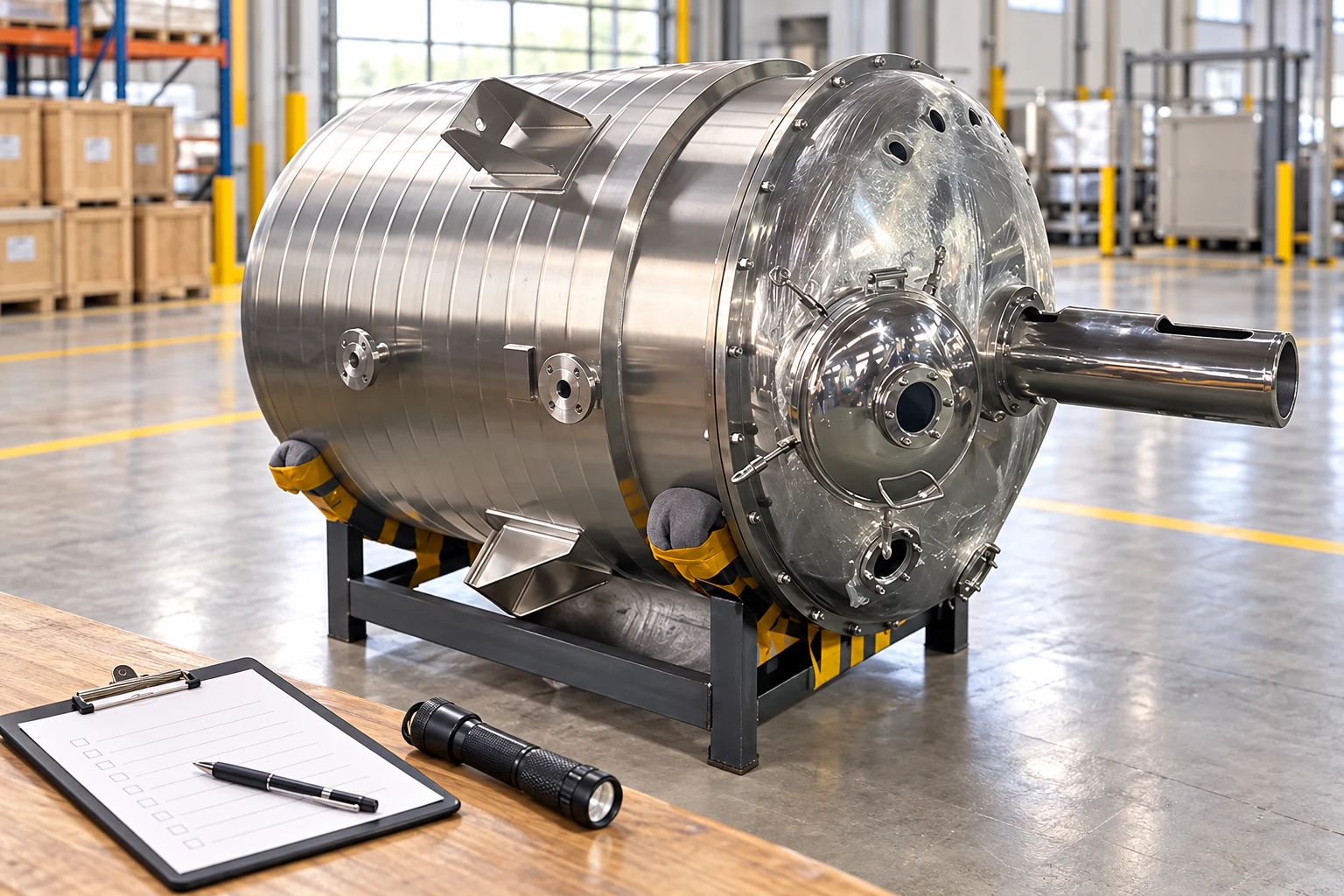
It also lists open flush cover, open welded flange, or closed structures, plus a composition of body, cover, jacket, agitator, transmission, shaft seal, and supports.
The same family publishes model rows (YRK series) with volume, pot sizes, motor power, and mixing speed ranges, and notes that material and size can be customized.
Use those rows while you refine impeller and documentation package choices.
Sibling pages such as the thermal reactor, chemical reactor, and 1000L stainless steel electric heating reactor follow the same configurable pattern. Browse the reactor hub when you need the family view.
Those pages are starting points for 3500L reactor configuration options, not a substitute for design pressure, viscosity, or documentation scope. When the RFQ is ready, send it through contact us so engineering can map your checklist to a fabricable proposal. If access/processing details dominate after pressure and agitation are settled, the open-top reaction vessel access guide is the better deep read for that narrow question.

Common RFQ Gaps That Force Requotes
Most requotes come from missing fluids data, blurred pressure terms, or documents that were never scoped.
Watch for these failure patterns:
- One pressure number for everything — operating, design, and MAWP collapsed into a single cell.
- Jacket utilities without agitation data — thermal duty stated, mixing objective blank.
- Volume without working volume — nameplate total listed, batch fill unknown (industry guidance often plans working volume as roughly 70–80% of total capacity, but your process may differ—state your number).
- Impeller nickname without viscosity — “use an anchor” with no rheology range.
- Documentation after the fact — MTRs and weld records requested at FAT though never listed in the RFQ.
- Site hazards omitted — motor and seal quoted for a general area, then upgraded late.
- Nozzle list empty — fabricator guesses ports; piping redesign follows.
A short internal review—process, mechanical, and QA each initialing their blocks—usually costs less than a second quotation cycle.

FAQs
What information should I send with a customized reactor RFQ?
Send process description, volumes, materials, pressure/temperature envelopes for vessel and jacket, agitation objectives with fluid properties, utility media, nozzle/instrument intents, site constraints, and the documentation list you expect.
What is the difference between operating pressure and design pressure?
Operating pressure is the normal process condition. Design pressure is the higher (or otherwise distinct) value used as the mechanical design basis. Keep both on the RFQ instead of merging them.
Who should specify MAWP on the datasheet?
Treat MAWP as a rating that belongs with fabrication and code documentation practice. Buyers should supply operating and design inputs; do not casually enter normal operating pressure into a MAWP blank.
How do I describe agitation needs if I do not know the exact impeller model?
State the phase system, viscosity/SG ranges, mixing objective, and any seal or speed constraints. Suppliers can propose impeller geometry against that duty.
Why does jacket performance depend on agitation?
Heat transfer through the wall relies on renewing the inner film. Weak or poorly matched agitation reduces effective cooling or heating even when utility flow looks adequate.
What working volume should I list versus total volume?
List both. Total volume is the vessel’s geometric capacity; working volume is the batch fill you plan to run. Many specifying guides discuss working fills around 70–80% of total capacity as a planning starting point—confirm what your process actually needs.
What documents should I request with a fabricated reactor?
At minimum plan for drawings, material certificates, pressure-test records, and nameplate data. Add weld/NDE packages and manufacturer’s data reports when your project or code path requires them.
When should I browse YIYI reactor models while preparing an RFQ?
Browse published models to align volume, material, and structure language early, then attach your completed pressure, agitation, and documentation checklist when you inquire.