A batch reactor material balance accounts for every species that enters, leaves, reacts, accumulates, or is lost during a defined batch boundary. For an ideal closed batch step, there is no continuous inlet or outlet, so component accumulation equals generation by reaction. Real production balances must also include staged charges, samples, vents, evaporation, transfer heel, washings, filter cake, and recovered solvent. Start on a molar basis for stoichiometry, retain a separate total-mass check, use consistent units, and reconcile each recipe stage. The balance supports reactor sizing and yield analysis, but kinetics, phase behavior, safety, and heat removal still require separate verified models.
Define the boundary and time period first
Draw a boundary around the reactor and state when the balance starts and ends. A charge-to-discharge balance differs from a campaign balance that includes cleaning and solvent recovery. List every physical connection: liquid feeds, powder additions, gas feeds, vent, condenser return, vacuum system, sampling point, bottom outlet, recirculation loop, and cleaning line.
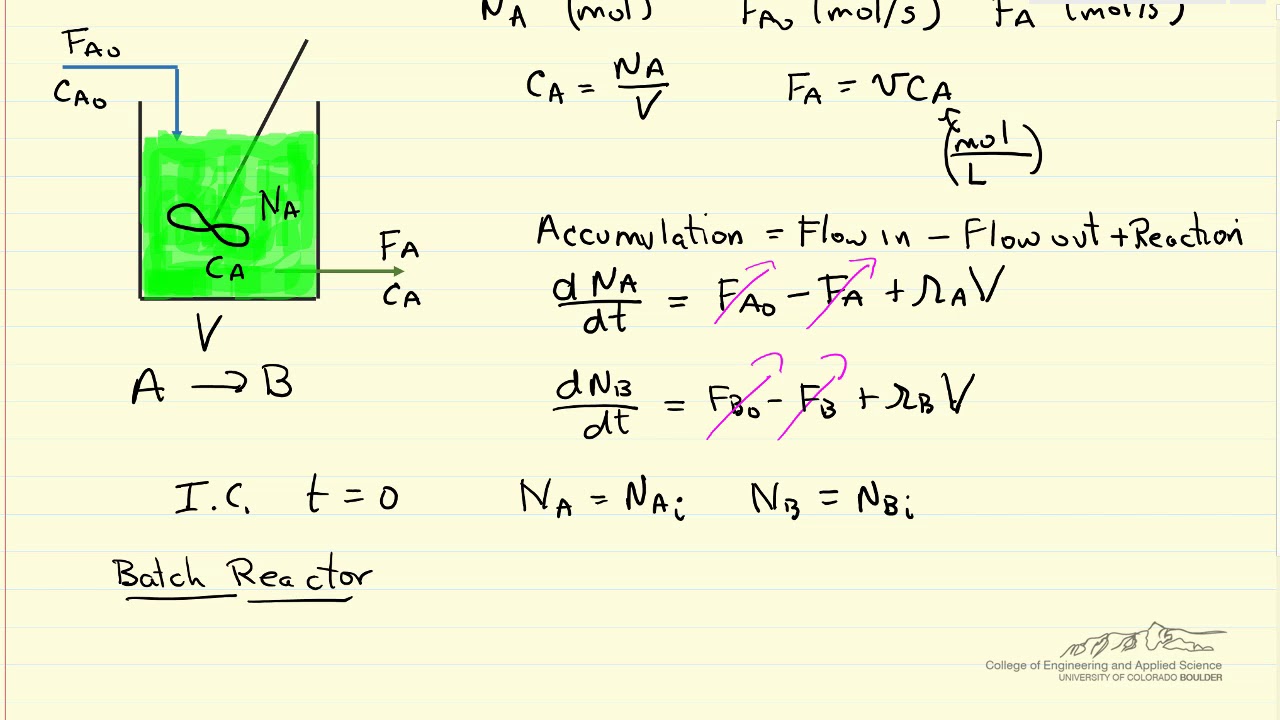
The general balance is input − output + generation − consumption = accumulation. For total mass, chemical reaction does not create or destroy mass, so generation and consumption cancel. For an individual component, reaction terms remain. For a closed constant-volume batch reaction, a common mole balance is dNi/dt = riV. If volume changes, track moles and volume separately rather than forcing a constant-concentration shortcut.
Build a species and stream table
Use one row per stream and one column per component. Enter mass, moles, concentration, temperature, and measurement source where applicable. Convert recipe quantities to moles using verified molecular weights, then apply a balanced reaction equation and limiting-reactant logic. Keep inert solvent and catalysts visible even when they do not appear in the net stoichiometry.
| Balance item | Required basis | Typical evidence | Frequent omission |
|---|---|---|---|
| Initial charge | Mass and composition at charge condition | Batch ticket, scale, certificate | Water or solvent already in vessel |
| Staged additions | Actual delivered quantity and assay | Flow totalizer or weigh system | Line flush and retained feed |
| Reaction | Balanced stoichiometry and conversion | Validated kinetic or analytical result | Side reactions and excess reactant |
| Vapor/vent | Condensed return and unrecovered loss | Condenser and receiver records | Noncondensables carrying vapor |
| Product transfer | Net delivered mass and composition | Receiving vessel or packaging weight | Reactor and line heel |
| Samples/waste | Quantity and destination | Laboratory and waste logs | Repeated small samples |
Separate stoichiometry from measured yield
Stoichiometric yield is the theoretical product amount from the limiting reactant. Conversion is the fraction of a reactant consumed. Selectivity describes how consumed reactant is distributed among desired and undesired products. Isolated yield includes downstream recovery. These terms are not interchangeable.
Calculate the theoretical product from actual charged moles and balanced coefficients. Then compare measured product, remaining reactants, identified by-products, and physical losses. If product assay is below 100%, report both gross stream mass and contained product mass. A heavy product stream can still represent low chemical yield when it contains solvent or unreacted material.
Handle changing volume and semibatch additions
Many industrial “batch” recipes are semibatch during part of the cycle. One feed enters while no product stream leaves, or vapor leaves through a condenser. The component balance then includes the feed molar rate and the reaction rate, while total volume changes with time. Density may depend on composition and temperature, so summing room-temperature feed volumes can be misleading.
Create stage boundaries at each charge, heat-up, reaction hold, venting period, quench, and transfer. The ending inventory of one stage becomes the starting inventory of the next. This makes it easier to locate a discrepancy and to calculate the maximum working volume used for batch reactor sizing.
Account for vapor, condensation, and gas
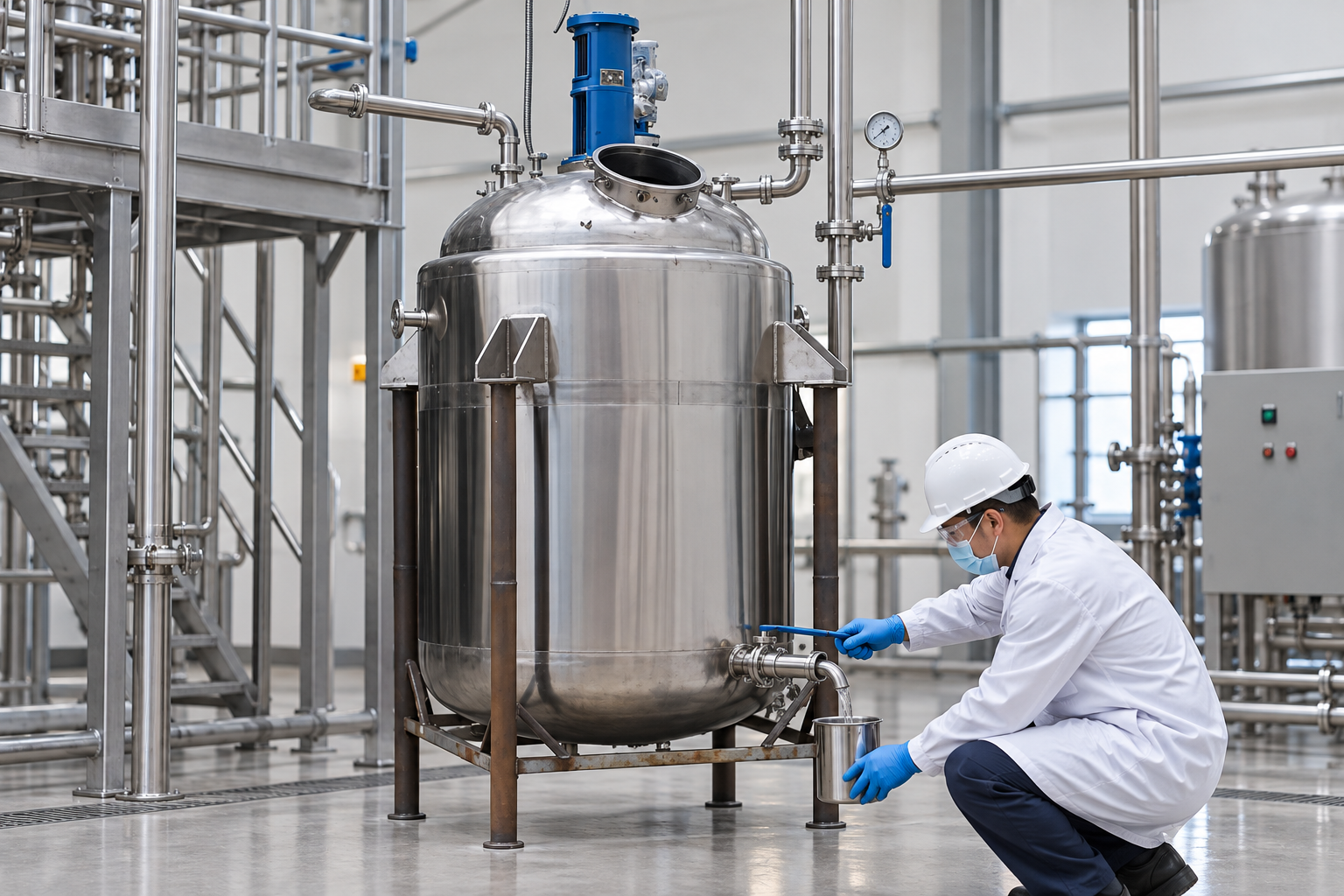
A closed-looking reactor may exchange mass through a vent, nitrogen blanket, vacuum system, relief path, or condenser. Estimate vapor generation using appropriate phase-equilibrium and heat-input data. Measure recovered condensate where possible and identify whether it returns to the reactor or goes to a receiver. Gas consumption or generation may need a molar balance corrected to stated pressure and temperature.
Do not infer a flammable or toxic vent rate from a simple material balance alone. Relief and vent systems require qualified analysis of credible scenarios, thermodynamics, two-phase flow, reaction runaway, and applicable codes.
Reconcile measurements and uncertainty
Calculate closure as accounted output plus ending inventory compared with accounted input plus starting inventory, using one clearly defined convention. A mismatch is not automatically a reaction loss. Check scale zero, flowmeter calibration, density conversion, sampling, moisture, assay basis, line holdup, evaporation, and transcription first.
Establish an action limit from measurement capability and process risk rather than demanding impossible perfect closure. Trend both the magnitude and direction. A repeated negative bias can indicate an unmeasured vent loss or transfer heel; a positive bias can indicate water ingress, tare error, or inconsistent assay basis. Document adjustments instead of forcing the spreadsheet to close.
Worked example
For reaction A → B with one-to-one stoichiometry, suppose 1,000 mol A and 2,000 mol inert solvent are charged. Analysis at the end finds 100 mol A remaining. Conversion of A is (1,000 − 100) ÷ 1,000 = 0.90, or 90%. If no side reaction occurs, theoretical B formed is 900 mol. If only 855 mol B is measured in transferred product and samples, the 45 mol difference requires investigation as heel, analytical uncertainty, degradation, side product, or other loss; it should not be silently labeled “yield loss.”
The University of Colorado Boulder’s LearnChemE batch-reactor module shows component mole balances and conversion. The U.S. National Institute of Standards and Technology provides an authoritative SI units reference for consistent quantities. Apply equations only with a validated reaction scheme and property basis.
Use the balance to specify equipment
The balance supplies maximum liquid inventory, feed quantities, vapor and condensate loads, discharge mass, line-flush needs, and expected heel. These values guide vessel working volume, nozzle sizing, feed metering, condenser duty, receiver capacity, load cells, sampling, and transfer equipment. They also clarify which measurements the control system must record.
Review the chemical reactor product family and the parent reactor category, then provide the completed stream table to the supplier. Related articles on epoxy reactor exotherm and discharge planning and reactor RFQ documentation cover complementary thermal and procurement inputs.
Educational video
Turn the balance into a controlled production record
A design balance predicts expected quantities; an operating balance should use actual charged, sampled, vented, transferred, and retained amounts. Link each measurement to an instrument or documented estimate and state its uncertainty. Use timestamps so the record can be aligned with level, temperature, pressure, condenser, and analytical trends. This creates evidence for deviation investigation rather than a spreadsheet completed after the batch.
Keep wet basis, dry basis, solvent-free basis, and active-ingredient basis clearly separated. A feed certificate may report assay on a dry basis while the batch ticket uses gross delivered mass. Water or solvent in that feed belongs in the total balance and can affect working volume, reaction concentration, and energy duty. The same discipline applies to recycled solvent and mother liquor, whose composition may vary from batch to batch.
For campaign operation, add opening and closing inventories in day tanks, receivers, filters, transfer lines, and waste containers. A single-reactor balance may appear to miss material that is temporarily held elsewhere. Reconcile both the equipment boundary and the campaign boundary; the two results should explain one another when timing and inventories are aligned.
Use deviations to improve measurement design. If condenser loss dominates uncertainty, add a receiver weight or temperature-corrected level measurement. If transfer heel varies, define a drain endpoint and verify line slope. If sampling is material for small batches, record every sample. Better instrumentation should target the largest decision-relevant uncertainty rather than collecting data that do not change the conclusion.
Review the balance before changing the recipe or scaling the batch. Confirm that every formula still points to the intended component, that molecular weights and assays match current specifications, and that recycled streams use representative composition. Have an independent reviewer trace one component from receipt to final disposition. Version-control the approved calculation and prevent operators from replacing formulas with unexplained values.
For equipment procurement, issue both the normal case and credible maximum case. The supplier needs to understand peak liquid inventory, maximum feed and discharge rates, vapor and gas loads, expected solids, and measurement requirements. Clearly distinguish process quantities from mechanical design conditions. A material balance informs the vessel specification, but it does not establish allowable pressure, relief capacity, metallurgy, or safe operating limits.
LearnChemE’s university-prepared lesson demonstrates how material balances are written for tank reactors.
Frequently asked questions
Does a batch reactor have zero input and output?
Only during a defined closed reaction step. The full production batch includes charges, samples, vents, and discharge, and semibatch stages may have continuous feeds.
Why can total mass close while component balance fails?
Total mass can be correct even when composition, conversion, side reactions, or assay data are wrong. Component balances provide the chemical detail.
Should material balance use mass or moles?
Use moles for reaction stoichiometry and maintain an independent mass balance for overall closure. Convert with verified molecular weights and compositions.