The choice between a batch reactor and a continuous stirred-tank reactor (CSTR) depends on production pattern, kinetics, heat removal, mixing, containment, cleaning, and control—not on a universal claim that one is more efficient. A batch reactor processes a defined charge through time and suits flexible, multi-product, lower-volume operation. An ideal CSTR receives and discharges continuously at steady state, with the outlet composition matching the well-mixed vessel contents; it suits stable, sustained production when feed and product handling can run continuously. Compare both using the same reaction model, quality targets, uptime, downstream constraints, safety basis, and total cost.
How the operating modes differ
In a batch reactor, composition and temperature can change throughout the run. Operators charge materials, execute additions and holds, then discharge. Production occurs in discrete lots and vessel occupancy includes charging, heating, cooling, sampling, transfer, and cleaning.
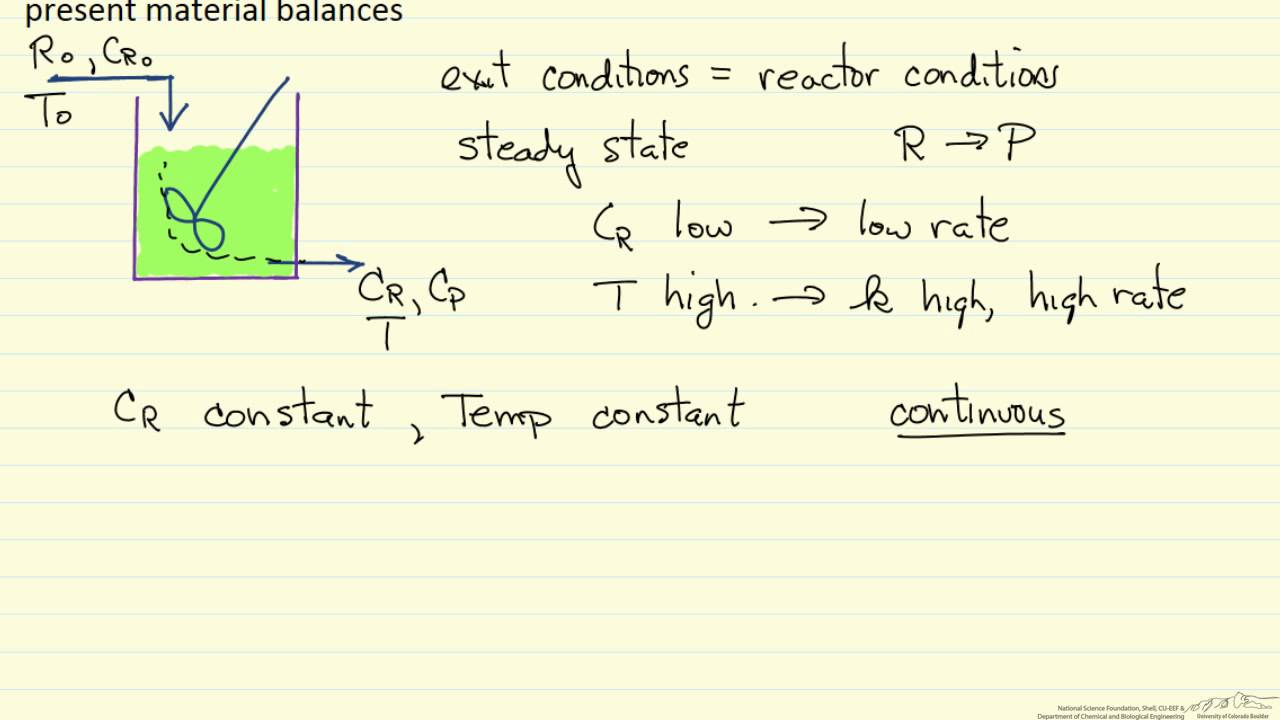
In an ideal steady-state CSTR, feed enters continuously and an equal volumetric flow normally leaves, keeping volume constant. Perfect mixing means the entire vessel is at the outlet composition and temperature. Real reactors deviate through dead zones, bypassing, imperfect mixing, and residence-time distribution, so commissioning evidence is needed.
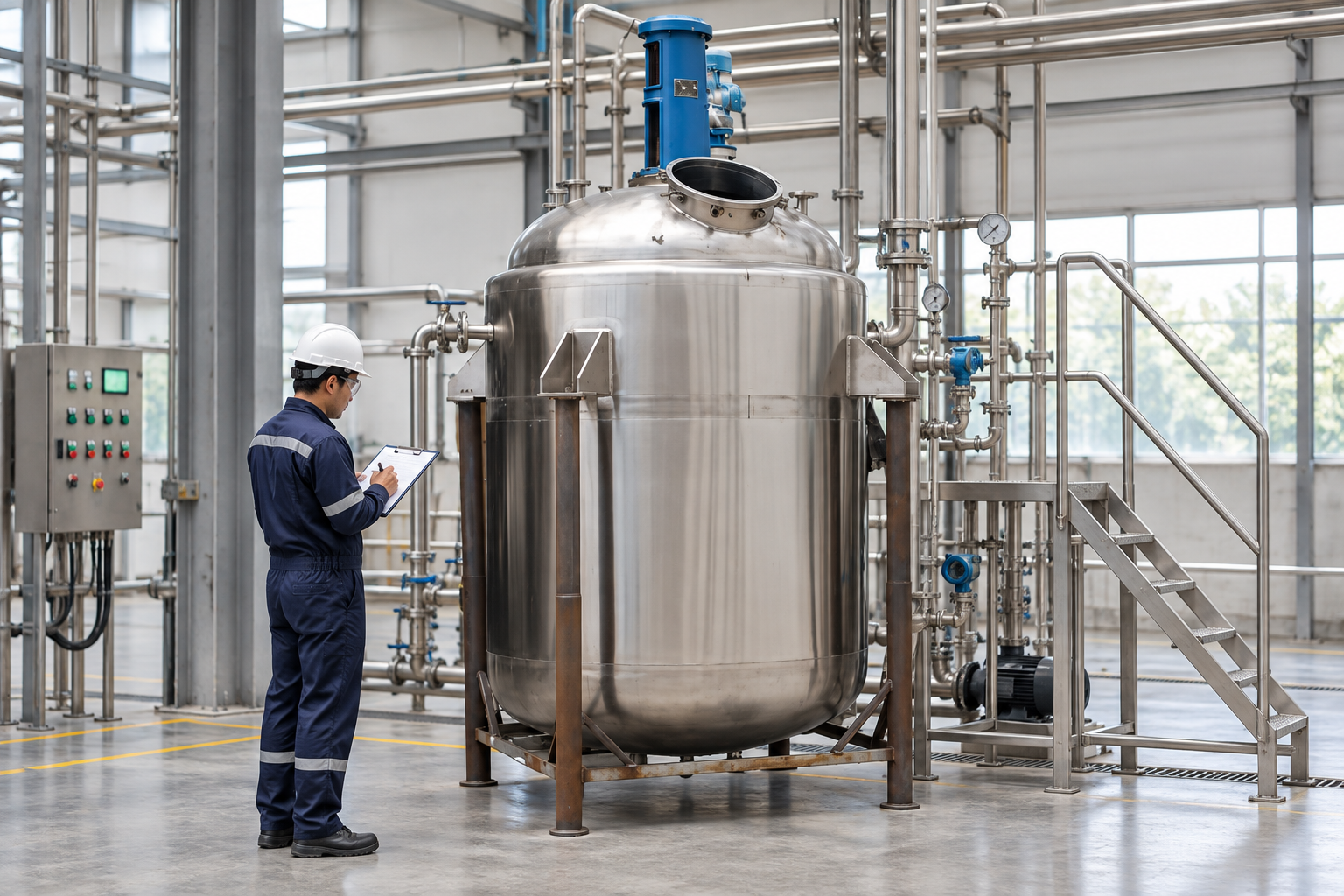
Side-by-side decision table
| Decision factor | Batch reactor | CSTR | Question for the project |
|---|---|---|---|
| Production pattern | Discrete lots and campaigns | Continuous sustained flow | Is demand stable enough for continuous operation? |
| Product flexibility | Recipe changes are comparatively direct | Changeover can create transition material | How many products and campaigns are planned? |
| Composition | Changes with batch time | Ideally uniform at steady state | Which history gives required conversion/selectivity? |
| Utilization | Includes non-reaction turnaround | Can be high between shutdowns | What uptime is realistically maintainable? |
| Quality traceability | Defined lots | Time-based segments and transition material | How will off-spec product be isolated? |
| Cleaning | Scheduled between lots/campaigns | Requires planned shutdown or validated strategy | How often must product-contact surfaces change? |
Compare reactor design equations correctly
For an isothermal constant-volume batch reaction, design relates the time required to move from initial concentration to target conversion through the rate law. For an ideal steady-state CSTR, the component balance is feed minus outlet plus generation equals zero; the reaction rate is evaluated at the reactor/outlet condition. This backmixed condition can demand more volume than plug flow for many positive-order reactions, but comparison with a batch reactor must include batch turnaround and actual production schedule.
Do not compare residence time in a CSTR with reaction hold time in a batch vessel as if they were identical. CSTR residence time is nominal vessel volume divided by inlet volumetric flow. Actual molecules have a distribution of residence times. A batch charge has a common processing history only under the ideal well-mixed model.
Kinetics and selectivity may decide the winner
The preferred concentration profile depends on the reaction network. High reactant concentration early in a batch can accelerate a desired positive-order reaction, but it may also accelerate an undesired side reaction or intensify heat release. A CSTR maintains the lower outlet concentration throughout the vessel, which may help or hurt selectivity. Semibatch addition can deliberately control concentration and heat generation.
Use validated kinetic expressions across the expected temperature and composition range. Include catalyst deactivation, inhibition, equilibrium, gas-liquid transfer, viscosity changes, and multiple reactions where relevant. Laboratory conversion at one condition is not enough to select industrial mode.
Heat removal and process safety
Batch reactors can accumulate reactants before the maximum heat-release rate occurs. A cooling failure or excessive addition may create a severe transient. CSTRs can limit inventory history through continuous flow but may exhibit multiple steady states or unstable thermal behavior for exothermic reactions. Feed shutoff, emergency cooling, quench, venting, containment, and relief design must follow a formal hazard evaluation.
LearnChemE’s stirred-tank energy balance module compares batch, semibatch, and steady-state CSTR balances. OSHA’s process safety management resources provide regulatory context for covered processes. Neither replaces reaction calorimetry, relief analysis, or project engineering.
Quality, traceability, and changeover
Batch production naturally creates identifiable lots, but within-batch uniformity and sampling still require control. A CSTR produces a time-continuous stream; disturbances travel through the residence-time distribution. The quality plan must define how to detect a deviation, divert affected product, and determine when steady state has returned.
Frequent product changes often favor batch operation because a continuous system may generate significant transition material and require line-wide cleaning. A dedicated high-volume product may favor continuous operation by reducing repeated charging and turnaround. Allergens, potent compounds, color, odor, and cross-contamination can override simple throughput economics.
Economics must use the full process
Compare installed equipment, controls, utilities, labor, raw-material losses, cleaning, analytical release, waste, downtime, maintenance, inventory, and downstream capacity. A CSTR may operate for long periods, but redundancy or planned shutdown capacity can be expensive. A batch plant may use one flexible vessel for many products, but scheduling losses and cleaning can dominate.
Model production over a representative year, including ramp-up, shutdown, campaigns, maintenance, rejects, and demand variability. Include feed preparation and product finishing. Moving the bottleneck from reactor to filtration or packaging does not increase plant output.
When batch is often the better fit
- Several products share equipment and recipes change frequently.
- Demand is intermittent or relatively low.
- Lot identity and hold-and-release are important.
- Slow or staged additions are required to control heat or selectivity.
- Feed materials vary and operator intervention is expected.
See our multi-product batch reactor guide and batch reactor sizing method.
When a CSTR may be the better fit
- One product has stable, sustained demand and consistent feed.
- A steady operating condition supports quality and automation.
- Continuous upstream and downstream equipment are available.
- Transition waste is limited and shutdown cleaning is manageable.
- Kinetics and thermal analysis support mixed-flow operation.
A cascade of CSTRs can change conversion and residence-time behavior, while semibatch operation can combine flexible lots with controlled addition. The decision is not always binary.
Equipment and RFQ implications
Both modes require verified materials, pressure and temperature design, agitation, heat-transfer surface, nozzles, instruments, access, cleaning, and relief inputs. Continuous service adds reliable feed metering, level control, outlet control, diversion, and startup/shutdown procedures. Batch service emphasizes charge accuracy, recipe control, cycle scheduling, and lot documentation.
Review YIYI’s chemical reactor vessel and the reactor category as equipment references. For exothermic resin duty, the exotherm and discharge planning guide adds application-specific questions.
Educational video
Use a staged selection study
Begin with a common process basis: required annual and peak output, feed composition, target conversion and selectivity, allowable impurities, temperature and pressure limits, physical properties, cleaning needs, and downstream capacity. Develop ideal batch and CSTR models from the same kinetics. Then add real operating losses—batch turnaround for one option and startup, transition, diversion, and shutdown losses for the other.
Next, test controllability. Identify manipulated variables, measurements, response times, sampling delay, and the action taken after a disturbance. A CSTR needs a defined startup path and proof that control can reach and hold the desired steady state. A batch process needs reproducible endpoint detection and recipe sequencing. For both, examine sensor failure, utility loss, feed error, blocked outlet, agitation loss, and cooling loss.
Pilot or demonstration data should represent the proposed regime. Batch data can support kinetic estimation, but translating it to a CSTR requires the correct mixed-flow balance and confidence that mixing and mass transfer are not limiting. Continuous pilot data should run long enough to demonstrate steady state, disturbance recovery, catalyst behavior, fouling, and product diversion. Short stable periods can overstate long-term performance.
Finally, compare alternatives with uncertainty visible. Present base, lower-throughput, and upset-recovery cases instead of one precise economic answer. Record which differences are fundamental and which could be changed by using reactors in series, a semibatch feed, a buffer tank, or campaign scheduling. The result should be an auditable design decision, not a preference for a familiar reactor type.
Include the people who will operate, maintain, clean, sample, and release the system. Their workflow often exposes assumptions that a steady-state model misses: access for inspection, instrument calibration, line clearing, waste handling, laboratory delay, shift coverage, and restart after a trip. Convert these observations into measurable requirements rather than informal preferences.
Set decision gates before detailed engineering. Kinetics and calorimetry should be adequate before final volume selection; product-quality and cleaning strategies should be credible before layout freeze; control and relief philosophies should be reviewed before purchase. If evidence remains weak, preserve flexibility through pilot capacity or modular staging instead of treating an uncertain high-volume design as proven.
LearnChemE’s university-prepared CSTR overview clearly explains the ideal continuous stirred-tank model, steady operating assumptions, and component mole balance. Use it as an educational foundation before applying project-specific kinetics and safety data.
Frequently asked questions
Is a CSTR always more productive than a batch reactor?
No. Productivity depends on kinetics, volume, uptime, transition losses, cleaning, quality release, and the capacities of the full process.
Does a CSTR produce perfectly uniform product?
Only the ideal model is perfectly mixed and steady. Real performance depends on mixing, control, residence-time distribution, and disturbances.
Can one vessel operate in batch and continuous modes?
Sometimes, but piping, controls, agitation, heat transfer, safety systems, cleaning, and validation must be designed and approved for both modes.