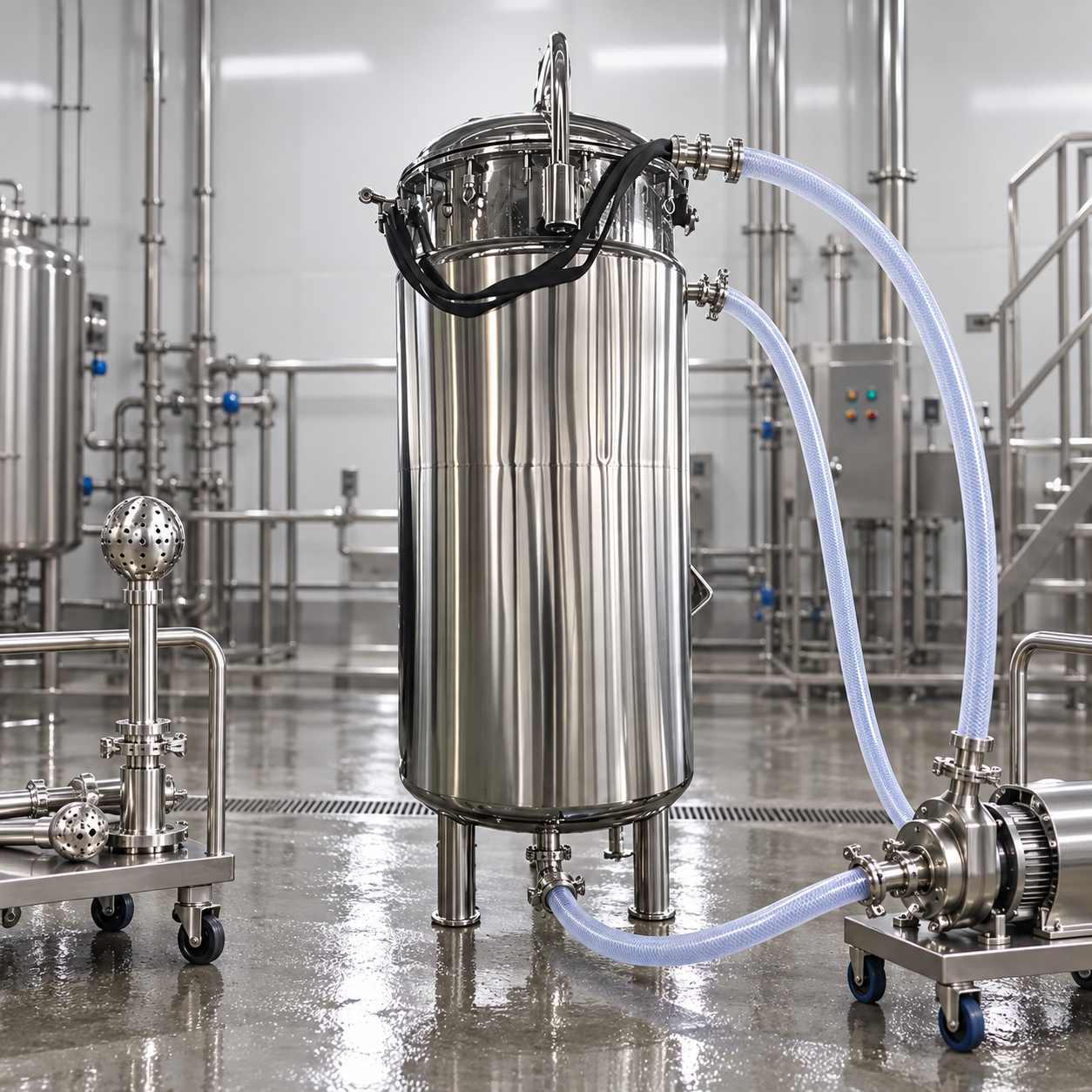
A storage tank hydrostatic test uses water to verify the completed tank boundary, settlement behavior where relevant, and visible leakage under a defined liquid head or test pressure. It is not simply “fill it and see what happens.” The correct test depends on whether the tank is atmospheric, low-pressure, or code-stamped; its design basis, supports, foundation, materials, coatings, and site conditions all matter. Buyers should require an approved procedure, calibrated instruments, safe fill and drain arrangements, inspection hold points, and a signed report tied to the tank serial number. This article is a procurement and documentation guide, not a substitute for the governing code or a project engineer’s test calculation.
Define the test boundary and governing basis
Start by identifying the tank type, design code or standard, design liquid level, specific gravity, pressure and vacuum limits, and whether the test occurs in the fabrication shop or after erection. An open atmospheric tank filled to a stated level is not tested the same way as a pressure vessel. Never apply a generic pressure multiplier to an atmospheric storage tank. List every nozzle, manway, temporary blind, gasket, instrument connection, vent, overflow, and drain included in the boundary. Mark excluded piping and devices on the drawing.
Confirm the water quality and compatibility with the tank material, lining, welds, and later service. Stainless steel projects may need chloride limits, controlled contact time, prompt drainage, and drying. Lined tanks may require coating cure confirmation before immersion. The owner must decide how test water will be sourced, contained, characterized, and discharged. A procedure that ends with “drain to grade” is incomplete where environmental rules or contamination concerns apply.
Check structure and foundation before filling
Water is heavy: approximately 1,000 kg per cubic meter near room temperature. The full test load can exceed the operating load when the stored product has lower density. Verify the foundation, slab, saddles, anchors, temporary supports, and lifting or transport condition for the intended fill level. For field-erected vertical tanks, survey points and settlement monitoring may be required by the governing standard. For a shop-tested horizontal tank, ensure the saddles and floor can carry the filled mass without unintended restraint or distortion.
Piping should not impose uncontrolled loads during the test. Temporary hoses need rated fittings, restraint, and routing that will not create trip hazards or siphon unexpectedly. Keep vents open unless the approved procedure specifically requires pressure and the vessel is designed for it. The long horizontal form shown in the 40,000 L resin tank illustrates why support and access checks must be completed before filling; the photograph alone does not define an approved test level or pressure.
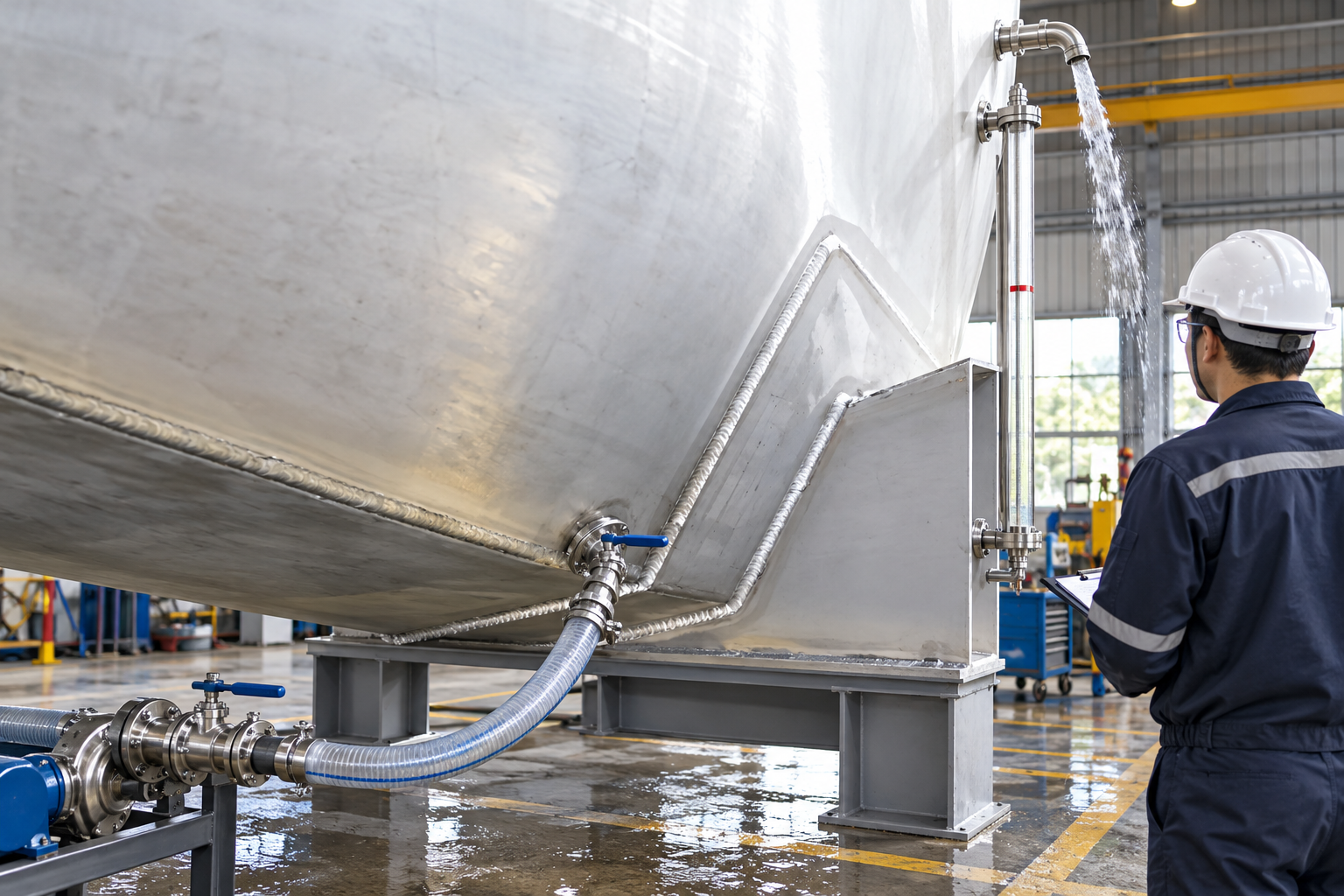
Approve a step-by-step procedure
The written procedure should state test purpose, boundary, drawing references, responsibilities, water requirements, fill rate, target level or pressure, stabilization time, hold duration, inspection sequence, permissible adjustments, acceptance criteria, drain method, drying, and restoration. It should list calibrated gauges and level instruments with ranges and certificate numbers. Where pressure is measured, use instruments whose range gives meaningful resolution at the test value; an oversized gauge may technically move but provide poor evidence.
Define weather limits for outdoor work and how temperature will be recorded. Temperature changes can affect pressure, water volume, condensation, and interpretation. For elevated tanks or large site tanks, emergency plans should address hose failure, foundation distress, rapid leakage, and controlled dewatering. Barricade the area and prevent personnel from standing in likely release paths. The U.S. Occupational Safety and Health Administration’s general control-of-hazardous-energy requirements are relevant to isolation planning in covered workplaces, but the project safety plan must address the actual equipment and jurisdiction.
Inspect before the first liter enters
Complete dimensional, weld, and visual inspections required before testing. Confirm examination reports and repair closures are accepted. Check that temporary blanks are correctly rated, gasketed, bolted, and identified; that drains are accessible; and that the top is safely vented. Remove or isolate instruments that cannot tolerate immersion or test pressure. Verify that coatings, insulation, or cladding do not hide areas that must be observed. A hydrostatic test should not be used to compensate for incomplete weld inspection.
Record baseline dimensions and survey readings where required. Photograph critical joints, supports, and the dry floor. Verify the calibration status of instruments and the identity of the tank. Hold a pre-test briefing so the operator controlling the water supply, the inspector, and the safety lead understand stop conditions. Typical stop conditions include abnormal support movement, unexpected deformation, foundation distress, uncontrolled leakage, blocked venting, or instrument behavior that prevents reliable control.
Fill slowly and observe in stages
Introduce water from a controlled point while allowing displaced air to escape. A staged fill provides opportunities to inspect low nozzles, bottom seams, supports, and settlement before the full load is reached. The approved procedure should state each hold level and what must be recorded. Avoid rapid filling that creates surge, traps air, or outruns inspection. If pumps are used, know their maximum shutoff pressure and provide appropriate control; the vessel limit, not pump capability, governs.
Leaks at temporary fittings must be distinguished from leaks in the permanent boundary, but neither should be ignored. Stop safely, lower the level if necessary, repair under an approved method, and document the event. Do not tighten a connection or weld on a loaded tank unless the approved engineering procedure explicitly allows it. Never enter a filled tank. For field tanks, review settlement readings at specified stages and pause if differential movement exceeds the project criteria.
Hold, inspect, and record actual conditions
At the target level or pressure, allow stabilization as required, then begin the formal hold. Record start and end times, water temperature, ambient conditions, liquid level or pressure, gauge identification, visible condition, and survey readings. Inspect shell seams, heads, nozzles, manways, drains, reinforcement, and accessible attachments. A dry exterior improves leak detection; condensation and previously spilled fill water can create false indications, so clean and recheck questionable areas.
Acceptance criteria must come from the governing design basis and approved project documents. “No visible leakage” may be one requirement but may not be the only one. Settlement, distortion, pressure stability, or coating condition may also matter. ASME’s published material includes a dedicated discussion of tank hydrostatic testing; buyers should obtain and apply the actual standard or code required for their tank rather than treating secondary web articles as specifications.
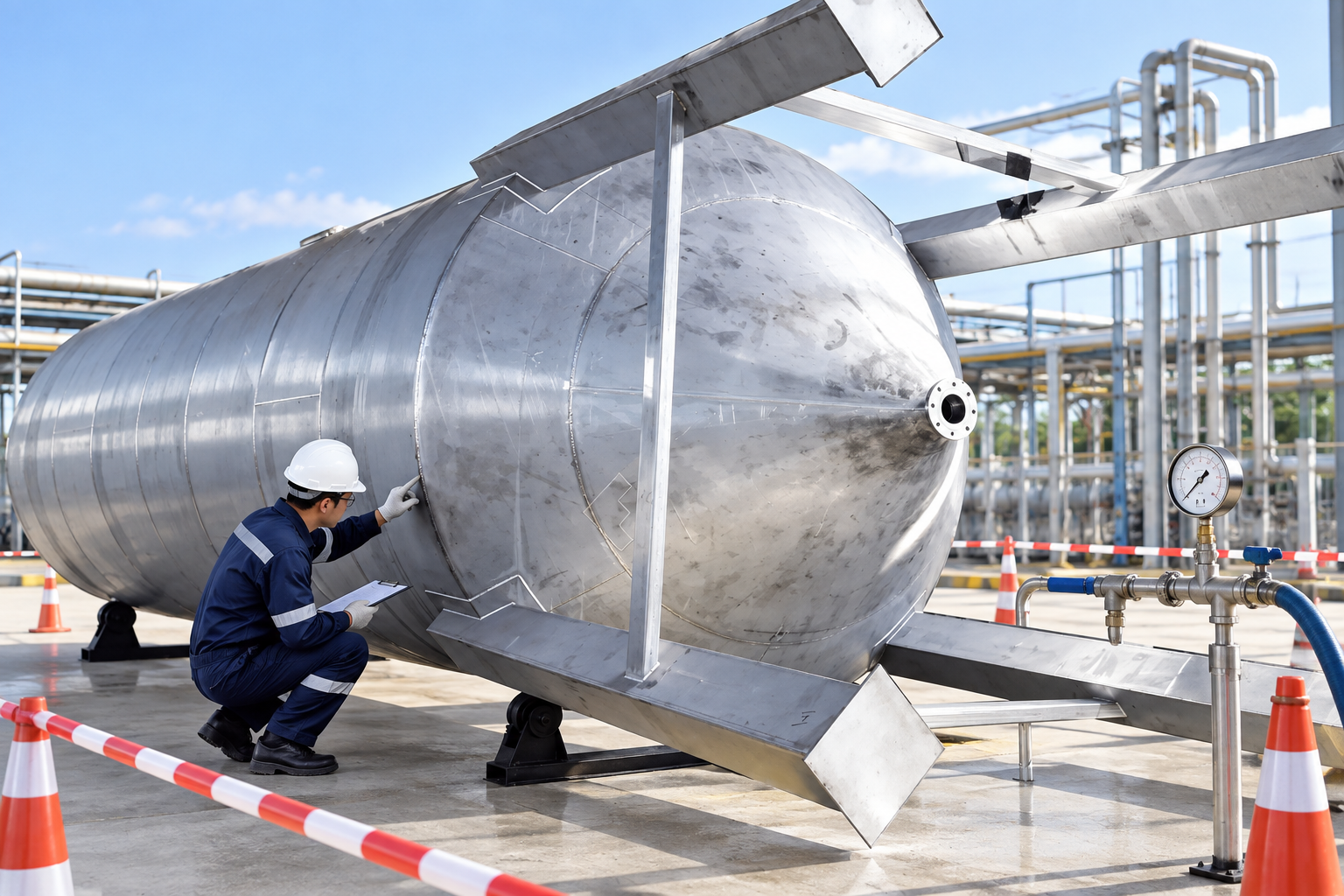
Drain without creating vacuum or instability
Controlled drainage is part of the test. Keep adequate venting open so withdrawal cannot pull a vacuum on a tank not designed for it. Route water to an approved destination, control hose movement, and prevent erosion or flooding around foundations. Large tanks may require a maximum drain rate to protect the tank, foundation, or disposal system. Observe supports and settlement as the load comes off. Confirm that temporary valves or blanks do not trap water in nozzles or jackets.
After draining, remove residual water from low points and dry the internal surface to the specified condition. Stainless tanks intended for hygienic, oxygen-sensitive, or water-reactive service may require particularly clear drying and preservation criteria. Inspect for flash rust, staining, coating damage, debris, or retained water. Restore permanent gaskets, instruments, vents, and closures under controlled records. If passivation follows, coordinate water quality and the final surface-treatment sequence with the tank passivation specification.
Buyer documentation checklist
| Record | Minimum useful content | Buyer check |
|---|---|---|
| Approved procedure | Boundary, target, stages, hold, safety, drain and acceptance | Matches tank and governing basis |
| Instrument list | ID, range, accuracy and calibration expiry | Suitable resolution and current certificates |
| Water record | Source, quality results, volume and temperature | Compatible with materials and disposal plan |
| Inspection log | Times, stages, readings, observations and signatures | All hold points completed |
| Survey report | Baseline and staged readings where applicable | Within approved criteria |
| Restoration record | Drying, temporary-item removal, permanent closure | Ready for shipment or commissioning |
What a test certificate should say
A useful certificate identifies the manufacturer, customer, project, tank tag and serial number, drawing revision, governing procedure and revision, test date and location, test medium, target and achieved level or pressure, hold duration, temperatures, gauges, witnesses, results, deviations, repairs, retest status, and final acceptance signatures. Attach calibration certificates, water analysis where specified, survey sheets, photographs, and the restoration checklist. A one-line declaration with no traceable readings should not close a contractual hold point.
Link the report to the as-built data book and open-deviation list. If a repair occurred, include the approved repair method, examination, and repeated test scope. The FAT documentation guide provides a broader framework for supplier records, while the storage tank range shows available equipment categories. Neither replaces the project-specific hydrostatic test basis.
Educational video
This educational video provides a general visual introduction to hydrostatic testing. It does not establish the allowable test pressure or procedure for a particular storage tank.
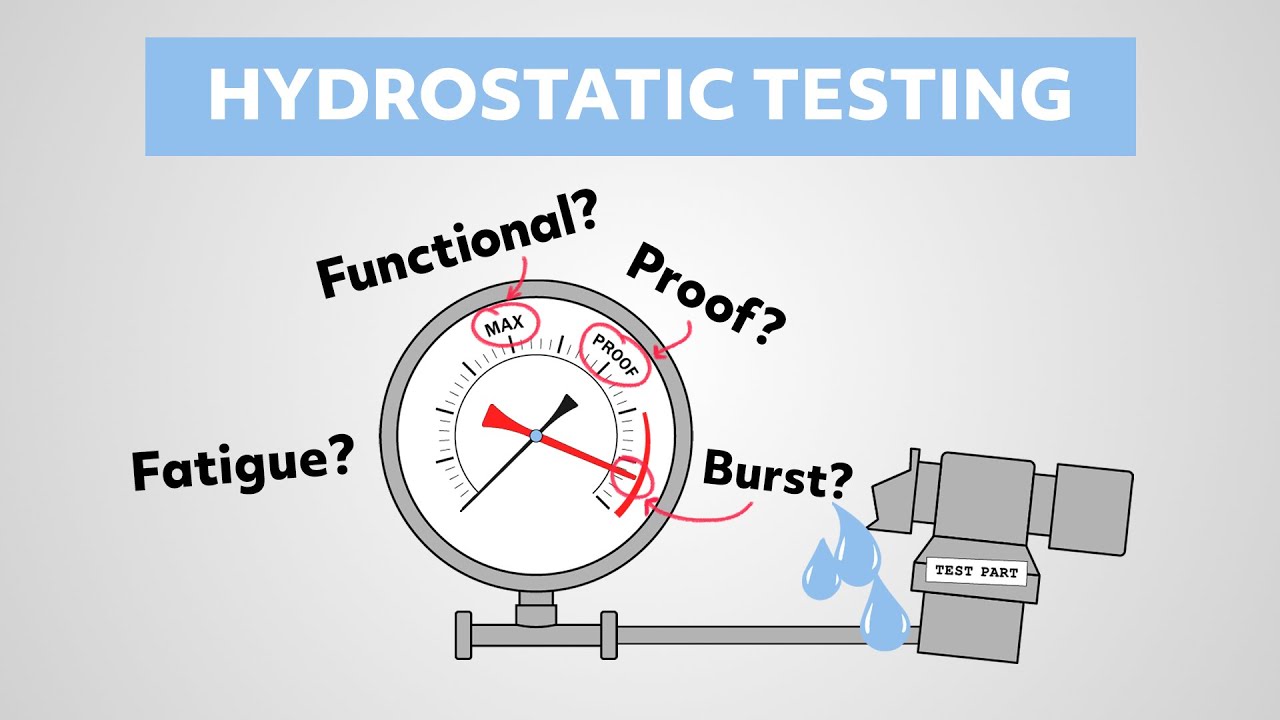
View the hydrostatic testing explainer on YouTube. Validate training media before use.
Frequently asked questions
Can an atmospheric storage tank be pressure-tested like a pressure vessel?
No. Use only the test conditions permitted by the tank’s design basis and governing standard. Applying an arbitrary pressure can damage or collapse an atmospheric tank.
Why record water quality for a stainless tank?
Water chemistry, contact time, drainage, and drying can affect staining and corrosion risk. The project materials specialist should set appropriate limits.
Does passing a factory hydrotest prove the installed system is safe?
No. Site supports, piping loads, vents, instruments, controls, and installation joints still require commissioning checks.