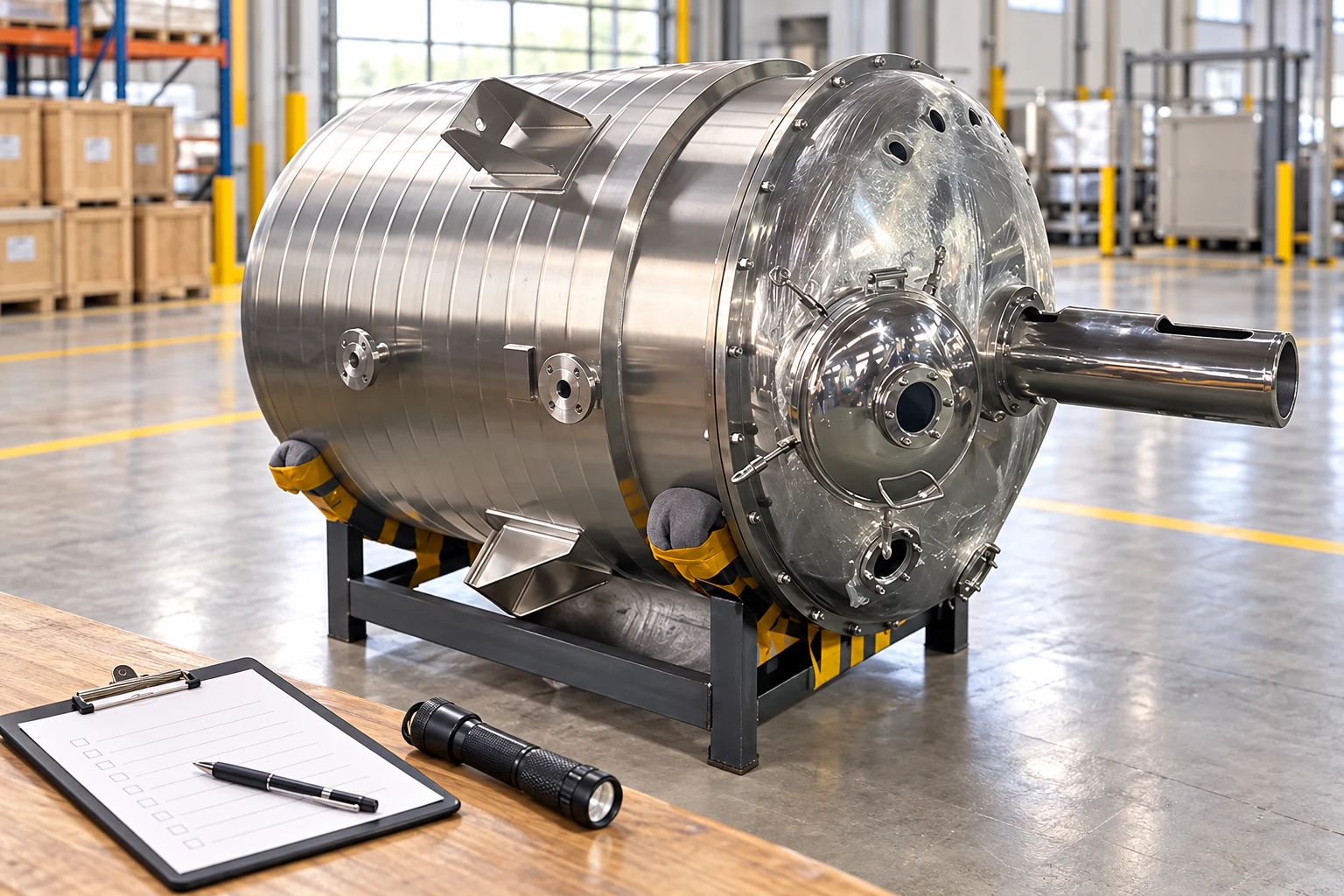
Polyester resin equipment planning becomes clearer when the batch is described as a series of transitions rather than as one viscosity and one temperature. Charging, reaction, finishing, and transfer may each impose different demands on mixing, utilities, ports, seals, and downstream readiness. A controlled data pack lets a supplier address those interfaces without claiming to validate the formulation.
Read the broader reactor range alongside the resin reaction vessel guide when preparing a project-specific inquiry.

Part 1. Start with the Batch Transition, Not a Single Viscosity
One nominal viscosity hides the moments that matter to a reactor inquiry. The batch may begin as a mobile charge, evolve through a temperature-sensitive reaction period, and finish with a transfer condition that requires different handling. Capture each transition in the same process sheet used for quotation review.
That sheet should identify who owns the formulation data and who approves operating limits. Equipment suppliers can work from stated conditions, but an image or product category cannot settle chemical compatibility or final resin performance.
Part 2. Turn Viscosity Changes into Agitation Inputs
Describe the mixing job by stage. State whether the objective is bulk circulation, incorporation, heat distribution, suspension, or another defined outcome. Then list the known viscosity range, batch level, temperature window, agitation continuity expectation, and any point where the process owner expects a change in behaviour.
| Batch phase | Buyer should provide | Procurement use |
|---|---|---|
| Initial charge | material identities, start temperature, and fill level | frames initial geometry and port assumptions |
| Reaction period | viscosity trajectory, mixing objective, and temperature profile | makes agitation assumptions reviewable |
| Finishing | allowable hold time, blend or additive steps, and quality ownership | identifies control and access questions |
| Transfer | discharge condition, route, receiving equipment, and cleanout method | connects the reactor to the next operation |
The related heavy-duty mixing tank guide can help frame questions about a documented mixing duty, but it cannot replace polyester process data.
Part 3. Define Temperature Control as a Shared Boundary
Temperature control spans more than a vessel surface. Record the utility medium, available temperature range, utility stability, flow constraints, instrument locations, control responsibility, and any known process restrictions. Keep a line between what the facility supplies, what the equipment quotation includes, and what the process owner must verify.
| Boundary item | Owner to name | Evidence to retain |
|---|---|---|
| Process profile | formulation owner | approved temperature stages and limits |
| Utility availability | facility team | supply conditions, variations, and restrictions |
| Equipment interface | supplier | proposed connections, instruments, and exclusions |
| Operating approval | responsible engineering team | reviewed procedure and safeguards |
Important: Temperature-control hardware does not prove resin quality, reaction safety, or an acceptable operating recipe. Process hazards and safeguards require project-specific review; CCPS provides public process-safety context.
Part 4. Scope Seals, Ports, and Transfer as One Interface
Shaft seals, top ports, vents, instruments, bottom outlets, and downstream piping interact during a real batch. Include the media, vapour conditions, cleaning chemicals, temperature range, pressure boundary, cycle frequency, maintenance access, and shaft-seal boundary that affect those interfaces. Never treat a resin name as a complete seal-selection specification.

Transfer deserves the same discipline. State whether the product is gravity discharged, pumped, filtered, heated, held, or sent directly to a receiver. The discharge route and cleaning method help clarify responsibilities for valves, hoses, pumps, instrumentation, and cleaning, without promising that a particular route will suit an undisclosed formulation.
Part 5. Compare Evidence Instead of Generic Capacity Claims
Capacity is useful only after the proposals share a common batch basis. Ask each bidder to state the assumptions used for working volume, mixing duty, utility interface, material selection, seal boundary, discharge condition, drawings, and documentation. Differences then become questions to resolve rather than hidden variations in scope.
| Quotation topic | Buyer should define | Supplier should state |
|---|---|---|
| Batch stages | viscosity and temperature records | configuration assumptions by stage |
| Agitation | desired mixing outcome and operating window | proposed drive and internal arrangement basis |
| Interfaces | utility, seals, ports, and transfer route | supplied items, exclusions, and access needs |
| Documentation | drawings, inspection needs, and milestones | documents included with the offer |
Part 6. Bring a Controlled Data Pack to the Supplier
A 100L reactor configuration discussion can begin once the process data is controlled and ownership is clear. If a different working range is required, use the YIYI reactor category to set the equipment context, then send the process data for review.
- List each batch stage with viscosity, temperature, level, and mixing objective.
- Describe available utilities, process restrictions, measurement points, and approval responsibility.
- Provide media and cleaning conditions relevant to seals, ports, valves, and transfer equipment.
- Include requested materials, drawings, records, site interfaces, and clearly stated exclusions.

FAQs
What is a polyester resin reactor?
It is reactor equipment considered for a polyester-resin batch process. Its final arrangement depends on the recorded chemistry, viscosity progression, temperatures, utilities, materials, connections, and project requirements.
Why does viscosity need a stage-by-stage record?
The mixing objective and transfer conditions can change across the batch. A staged record makes these changes visible instead of forcing a quotation to rely on one averaged property.
Does temperature control prove product quality?
No. Equipment controls can be part of a configuration, but product quality depends on the formulation, procedure, process data, testing, and release decisions assigned by the project.
What should be stated about mixing continuity?
State the operating stages, desired mixing outcome, known viscosity range, temperature conditions, allowable interruptions, and the team responsible for process decisions.
Is a seal chosen from resin name alone?
No. Seal review needs the actual media, vapour exposure, temperature, pressure boundary, rotation, cleaning chemicals, maintenance expectation, and project requirements.
Which information improves quotation comparison?
Use the same stage data, utility boundary, agitation objective, interface list, materials, documents, exclusions, and responsibilities for every supplier response.
References
- CCPS at AIChE — public context for project-specific process-safety review.