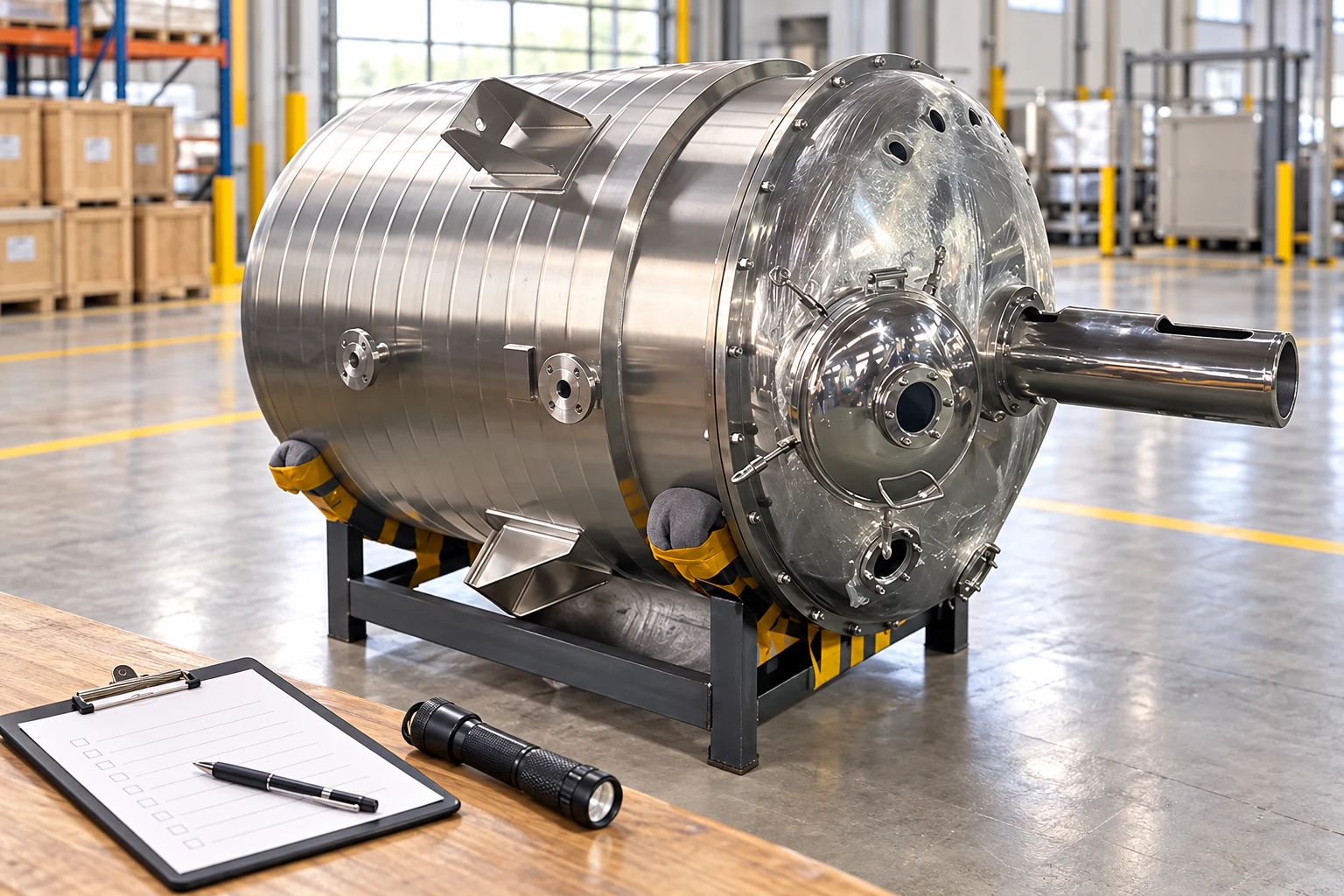
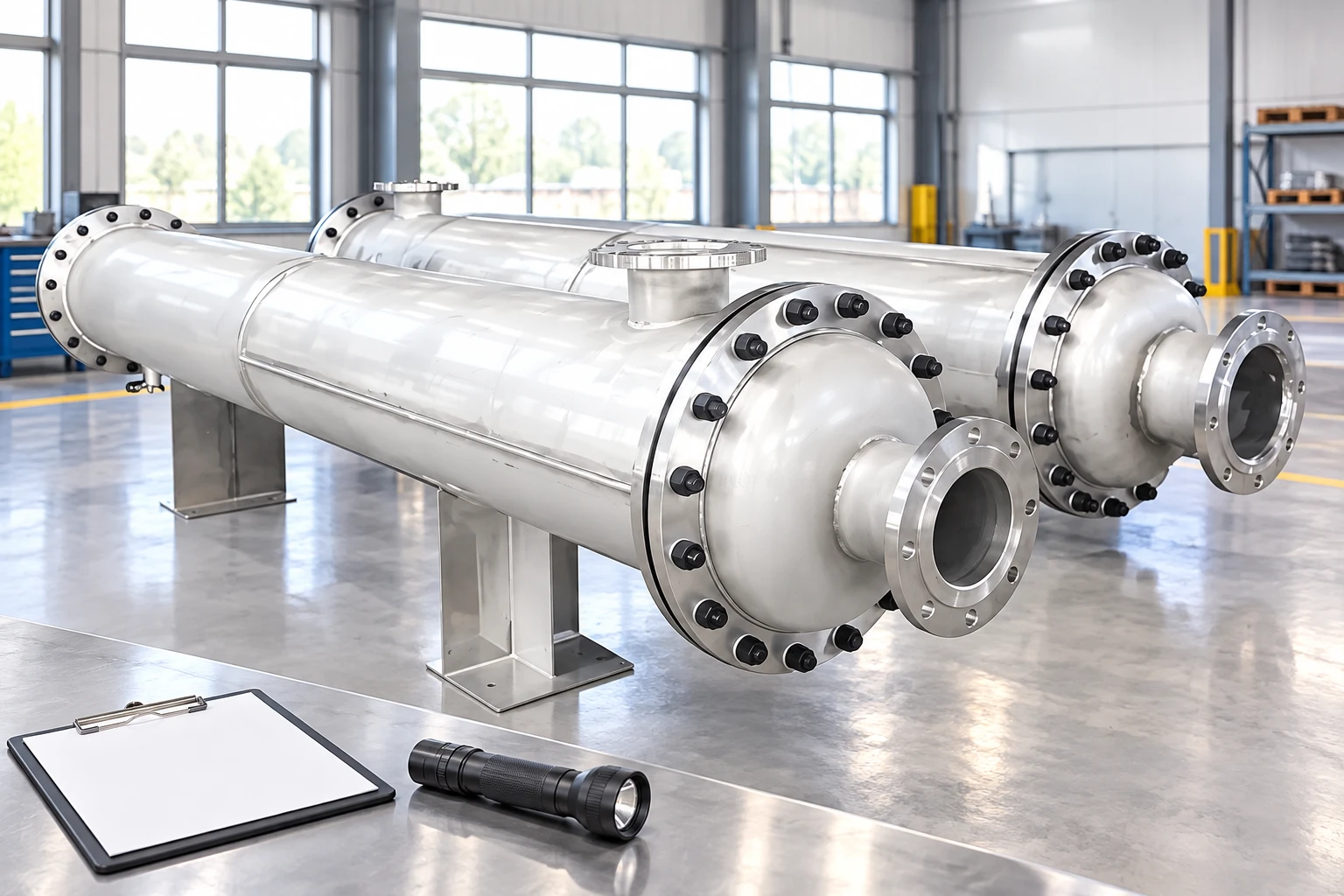
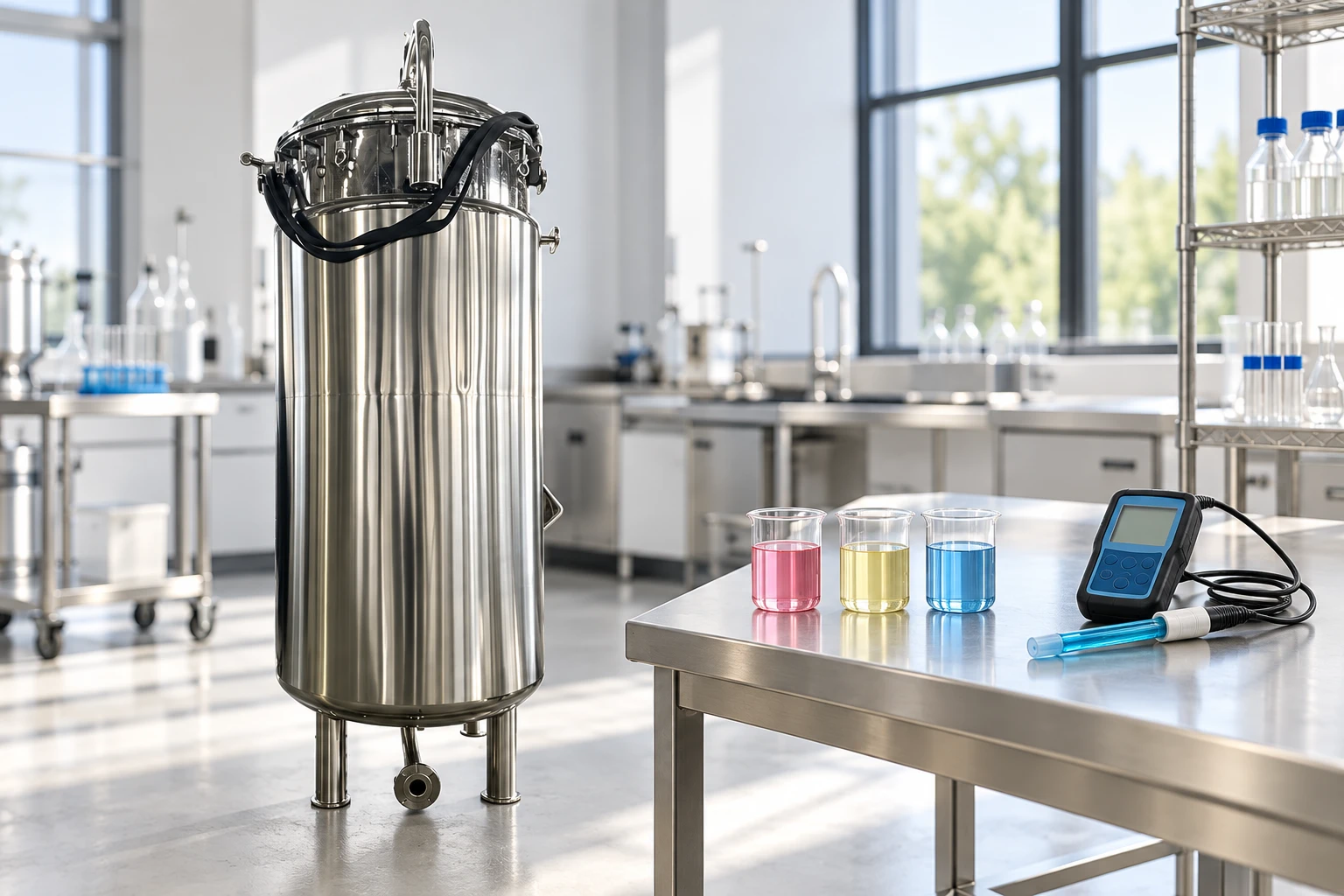
A syrup tank must be selected from the product’s viscosity and temperature behaviour, not from volume alone. Formulation, concentration, batch sequence, hold time, transfer route, heating or cooling duty, agitation, cleaning, drainability, and acceptance method all shape the equipment request. A catalog vessel cannot guarantee syrup flow, heat-up time, crystallisation control, or food-process compliance.
This guide helps buyers turn a syrup process into a usable RFQ. For general heat-loss questions, see the insulated heated storage tank guide. For a wider equipment overview, read heating tank types and uses.

Part 1. What Defines a Syrup-Tank Duty?
Start with the syrup itself. Record formulation or ingredient class, concentration, viscosity range over the operating temperature window, batch volume, starting and target temperature, time held in the vessel, and the transfer sequence. A tank that stores a thin liquid may not suit a colder or more viscous syrup without a different outlet, heating, mixing, or cleaning approach.
The required result should be observable. State whether the vessel must receive ingredients, hold a finished syrup, maintain a specified operating range, feed a downstream line, or support cleaning between batches. Then identify the plant’s acceptance method rather than turning a desired result into an unsupported equipment promise.
| Duty input | What to send | Why it changes the proposal |
|---|---|---|
| Product range | Formulation class, concentration, and temperature-viscosity range | Defines transfer and mixing questions |
| Batch sequence | Charge, heat/cool, mix, hold, and discharge steps | Links equipment to actual operation |
| Working volume | Minimum, normal, and maximum fill | Tests outlet and agitator operation |
| Transfer route | Pump, gravity, line length, and receiving point | Defines connection and drain boundary |
| Acceptance method | Temperature, flow observation, or approved plant check | Replaces generic process claims |
Part 2. How Does Viscosity Change the Tank and Agitator Discussion?
Viscosity can change as syrup temperature and composition change. That is why an RFQ should ask for the range, not a single nominal number. A supplier needs to know whether the product is charged warm, cooled during hold, contains particulates, becomes more difficult to discharge, or requires circulation before transfer.
Agitation is not an automatic requirement. Some duties need only gentle turnover, while others may need a defined mixing sequence to maintain uniform temperature or composition. The appropriate arrangement depends on product behaviour, vessel geometry, fill range, shear sensitivity, and the process test; it should not be inferred from the phrase “syrup tank.”
| Viscosity question | Buyer decision | Proposal evidence to request |
|---|---|---|
| Product at minimum temperature | Can the product still move and discharge? | Temperature-viscosity duty assumptions |
| Product during hold | Is settling, layering, or crystallisation a concern? | Proposed operating sequence and inspection boundary |
| Agitation need | Is gentle turnover, blending, or no mixing required? | Impeller concept, fill range, and limits |
| Transfer | Does the outlet and line arrangement match the product? | Connection, drain, and transfer-scope assumptions |
Part 3. When Are Heating and Insulation Inputs Needed?
Heating may be considered when the process requires a temperature range for transfer, dissolution, or hold. Insulation may be considered when the vessel and environment make temperature loss relevant. Both decisions need the actual utility, start/target temperatures, product behaviour, batch duration, mixing sequence, external piping boundary, and acceptance method.
Do not assume a jacket or heater will produce a particular heat-up time. Heat-transfer result depends on the complete duty, including available area, utility condition, product properties, agitation, losses, and controls. Request a proposal that states its operating assumptions.

| Thermal input | Question for the project | Why it matters |
|---|---|---|
| Temperature profile | What are start, target, maximum, and cleaning temperatures? | Sets material and control questions |
| Utility | Which heating or cooling medium is available? | Defines the supplier interface |
| Insulation scope | Does it include shell, connections, valves, or piping? | Prevents interface omissions |
| Acceptance | How will the plant assess the batch condition? | Avoids a cycle-time promise |
Part 4. Which Agitation and Transfer Details Should Be Stated?
Describe the route from charge to discharge. Include inlet location, ingredient-addition sequence, working volume, desired mixing action, outlet size and elevation, line route, pump boundary, and cleaning access. This lets the supplier assess whether the vessel needs an agitator, a different bottom outlet, a jacket interface, or a different operating sequence.
An agitator proposal should describe its assumptions rather than promise a uniform product. Ask for impeller position, speed range, start condition, product range, and the planned acceptance check. If the syrup is shear-sensitive or holds solids, include those facts early in the RFQ.
Important: Heated, viscous syrup duties can introduce hot-surface, cleaning, access, and transfer risks. Define the plant procedure, isolation, and acceptance method instead of assuming a vessel alone controls those risks (Codex Alimentarius).
Part 5. What Hygiene, Cleaning, and Material Boundaries Matter?
List product-contact materials, seals, drain path, access openings, cleaning chemistry, cleaning temperature, and the planned cleaning method. A suitable material or fitting for one product may not be suitable for a hotter cleaning cycle or a different syrup formulation. EHEDG provides useful language for hygienic-design and cleanability discussions, not a certificate for a specific build.
State what is in and out of the supply scope. Vessel, agitator, jacket, insulation, instruments, external pipework, controls, spray devices, and validation records can be supplied by different parties. Clear boundaries make quotations comparable and reduce the risk of a missed interface.
Part 6. What Belongs in a Syrup-Tank RFQ?
Use the heated mixing tank configuration reference and the stainless steel storage tank family as equipment context. Then send the syrup process duty sheet to YIYI with the actual process inputs.
- Product formulation class, concentration, temperature-viscosity range, solids, and cleaning chemistry.
- Working/minimum/maximum volume, batch sequence, hold time, transfer route, and acceptance method.
- Heating or cooling objective, utility, insulation boundary, and control requirement.
- Agitation objective, product sensitivity, outlet/drain needs, access, and maintenance boundary.
- Material, seals, hygiene documents, external interfaces, exclusions, and requested records.

FAQs
What is a syrup tank?
A syrup tank is a vessel used to receive, hold, mix, condition, or transfer syrup in a defined process. Its configuration depends on the product range and operating sequence.
Does every syrup tank need a heater?
No. Heating is a process decision. Specify it only when the product, temperature range, utility, hold condition, and acceptance method support the requirement.
Why does syrup viscosity matter?
Viscosity affects how syrup circulates, transfers, discharges, and responds to temperature. Give the supplier the operating range rather than a single value.
Can a tank guarantee no crystallisation?
No. Crystallisation behaviour depends on formulation, temperature history, residence time, process handling, and validation. Request a duty-specific review rather than a catalog guarantee.
What agitation is appropriate for syrup?
The answer depends on viscosity, product sensitivity, solids, fill range, vessel geometry, and the intended action. Ask for a proposal with stated assumptions and an acceptance check.
What should a supplier quote include?
Request vessel scope, product-contact assumptions, thermal and agitation interfaces, drain and cleaning details, instruments, documents, exclusions, and the duty-sheet inputs used.
References
- EHEDG — hygienic-design terminology for food-process equipment discussions.
- Codex Alimentarius — public food-hygiene context; project obligations vary by jurisdiction.
- ASME codes and standards — background source for documenting code questions around a defined syrup-processing scope.