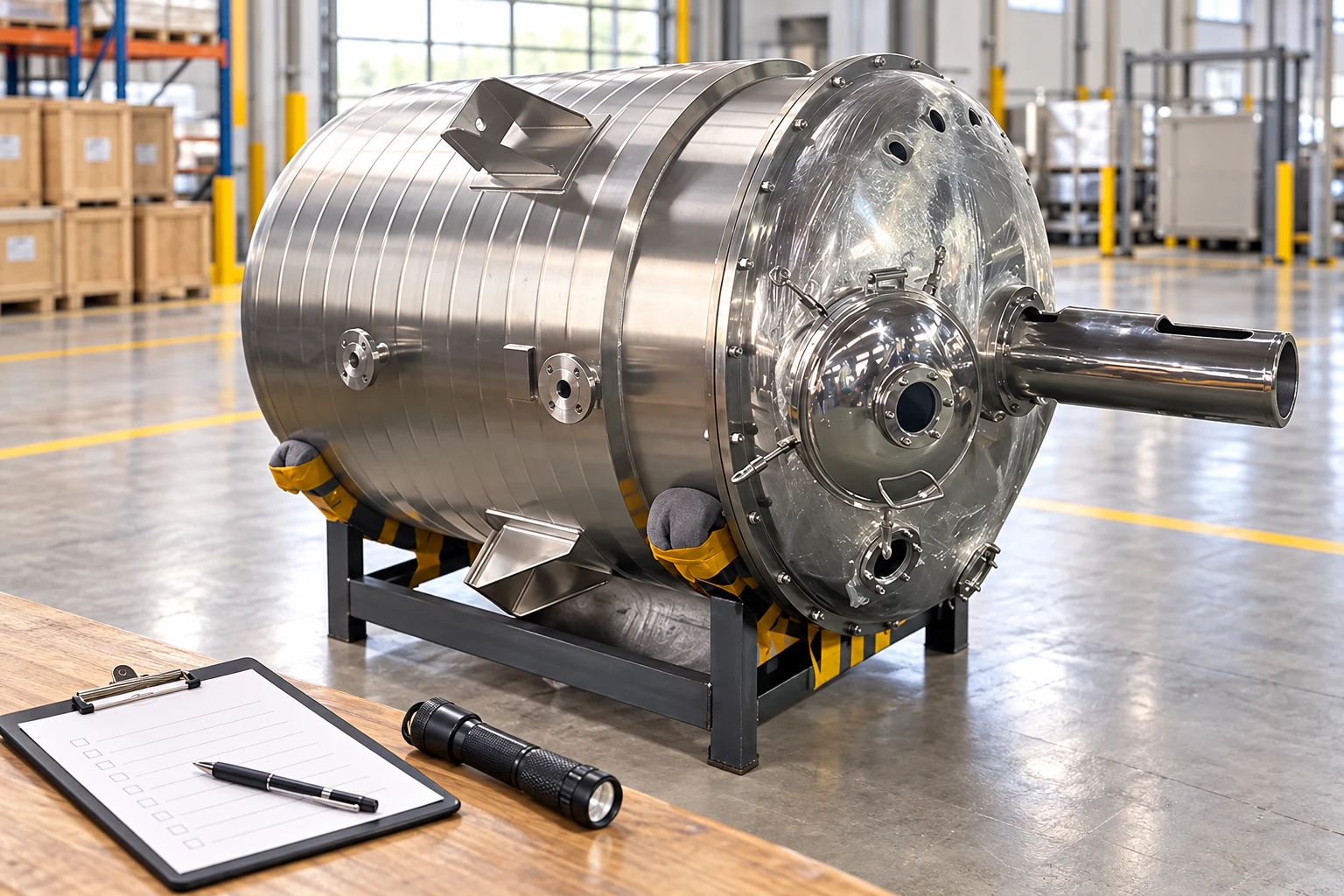
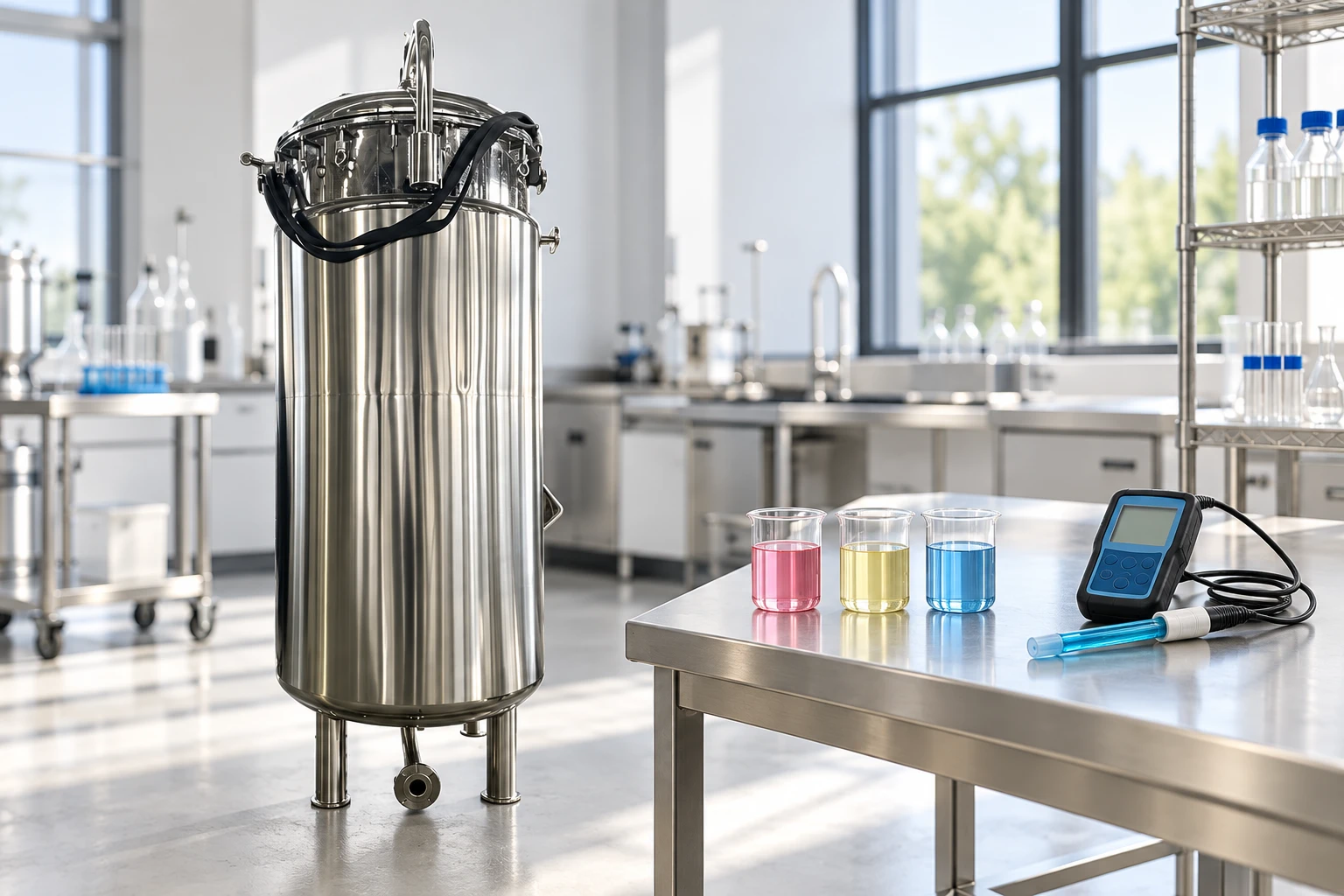
For a vacuum homogenizer mixer, “speed” is only one part of the shear story. Geometry, rotor or stator gap, viscosity, temperature, residence time, batch fill, and recirculation all change the work applied to a product. A lab result therefore needs a duty sheet and a scale-up test plan before it becomes an equipment specification.
This guide focuses on shear-rate language, batch-scale transfer, vacuum and foam control, and a practical RFQ acceptance test. The companion vacuum homogenizer selection guide covers the broader emulsion-versus-dispersion decision. The high shear mixing tank guide is useful when dispersion energy is the main question.

Part 1. Translate Lab Results into Duty Inputs
Start with the material and the result that must be repeated. Record phases, solids, viscosity at process temperature, density if relevant, batch temperature, air sensitivity, and the laboratory sequence. Note whether the lab used a rotor-stator head, a bottom homogenizer, a high-speed disperser, or a separate premix step.
Describe the result with a test method: visual dispersion, sieve residue, microscopy, droplet-size distribution, or another plant-approved method. Avoid writing “same RPM” as the scale-up requirement. The production machine may use different geometry and therefore a different shear field.
| Lab input | Record this | Scale-up risk if missing |
|---|---|---|
| Product state | phases, solids and temperature | Supplier cannot reproduce starting conditions |
| Shear device | head type, gap and sequence | RPM comparison becomes misleading |
| Batch size | working and minimum volume | Small-batch circulation may fail |
| Acceptance test | method, sample point and timing | “Looks uniform” is not repeatable evidence |
Part 2. Explain Shear-Rate Variables
Local shear depends on velocity gradients created by geometry and speed. In practical procurement terms, ask for rotor or stator diameter, gap, tip-speed basis, operating speed range, viscosity assumption, and residence or recirculation time. These fields let an engineer compare two proposals without treating a motor nameplate RPM as a universal shear-rate number.

| Variable | Why it matters | RFQ question |
|---|---|---|
| Rotor/stator geometry | Sets the local flow path and gap | What dimensions and clearances apply? |
| Speed range | Changes velocity and power demand | What speed is used at each recipe stage? |
| Viscosity | Changes load and circulation | Which temperature and viscosity are assumed? |
| Residence time | Determines exposure to high shear | Is the stage batch, recirculating, or pass-through? |
| Temperature | Affects viscosity and product stability | What heat removal is available during shear? |
Part 3. Plan Batch-Scale Transfer
Production scale changes more than vessel diameter. Fill height, impeller coverage, bottom clearance, baffles, inlet location, and discharge geometry can change circulation. Compare minimum, nominal, and maximum working volumes and define where samples are taken.
If the product is charged in phases, specify the addition order and the point at which vacuum begins. Powder wetting may need a controlled induction step; adding it too quickly can overload the mixer or create a floating layer. Keep the plan descriptive unless the supplier has validated numbers for the actual formulation.
| Scale-up checkpoint | What to compare |
|---|---|
| Working volume | Minimum, target and maximum fill |
| Geometry | vessel diameter, height, baffles, head position |
| Addition sequence | liquid phase, powder, premix and vacuum timing |
| Sampling | location, time and test method |
| Heat removal | jacket or coil duty during high-shear stage |
Part 4. Control Vacuum, Temperature and Foam
Vacuum can help remove entrained air, but it can also change boiling, foaming, evaporation and temperature behavior. State the desired pressure envelope, ramp and hold sequence, condenser or vapor-handling boundary, and the response to a vacuum loss. Do not convert a general vacuum label into a guaranteed deaeration result.
Important: A vacuum setting is not a substitute for recipe validation, pressure-equipment documentation, or hygienic-process approval. Keep the facility’s acceptance criteria aligned with applicable local hygiene guidance — source note: EHEDG cleanability vocabulary.
Temperature should be tracked through charging, homogenizing, vacuum hold and cooling. A shear stage can add heat, while evaporation under vacuum can change concentration. Ask for alarm and interlock behavior and identify who owns recipe limits.
Part 5. Build an RFQ Acceptance Test
An acceptance test should describe the material, starting state, batch size, sequence, operating conditions, sample points, and pass/fail method. If particle size or droplet size matters, define the instrument, sampling practice and reporting basis. If the project only needs a visual dispersion check, say so rather than implying a tighter result.
| Acceptance field | Example question |
|---|---|
| Material | Is the supplier test material representative and approved? |
| Sequence | Which stage runs first, and when is vacuum applied? |
| Conditions | What speed, temperature and pressure are recorded? |
| Samples | Where and when are samples taken? |
| Result | Which test method and tolerance define pass? |
Part 6. Connect the Duty to YIYI Equipment
Use the vacuum emulsification homogenizer configuration reference as a starting point, then provide YIYI with the full batch-scale duty through contact YIYI. The mixing tank product family provides broader equipment context. Published pages do not replace duty-specific engineering, testing, or certification evidence.

FAQs
Is RPM the same as shear rate?
No. RPM is a speed input. Shear exposure also depends on geometry, gap, viscosity, temperature, flow path and residence time.
What should a lab report include for scale-up?
Include the material state, batch size, temperature, head geometry, speed and sequence, vacuum timing, sample method and acceptance result.
Does vacuum always improve homogenizing?
No. Vacuum may help with air control but can introduce foaming, boiling or evaporation issues. Define the pressure and temperature envelope for the actual formulation.
How should a buyer compare two homogenizer heads?
Compare geometry, gap, speed range, power or torque basis, residence time, cleanability, wear materials and the test evidence offered for your duty.
What is the most important batch-scale check?
Verify performance at minimum and target working volume, not only at nominal capacity. Record sampling location and the same acceptance method at both scales.
Can YIYI guarantee a particle-size result from a product page?
No. Particle size and emulsion results require formulation-specific testing and agreed acceptance criteria. Send the duty sheet for a configuration discussion.
References
- EHEDG — cleanability and drainability terminology
- ASME codes and standards — pressure-vessel code context when applicable