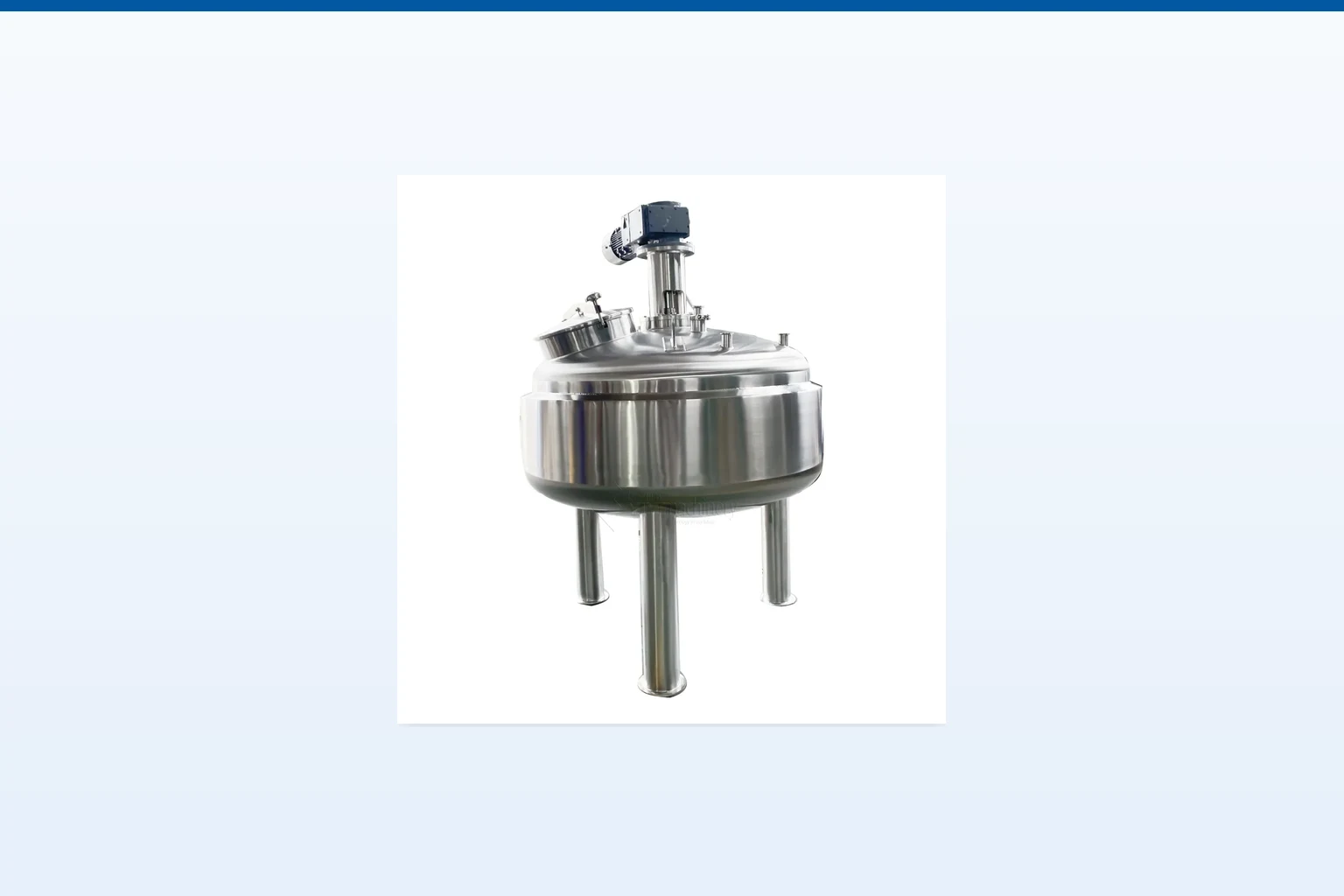
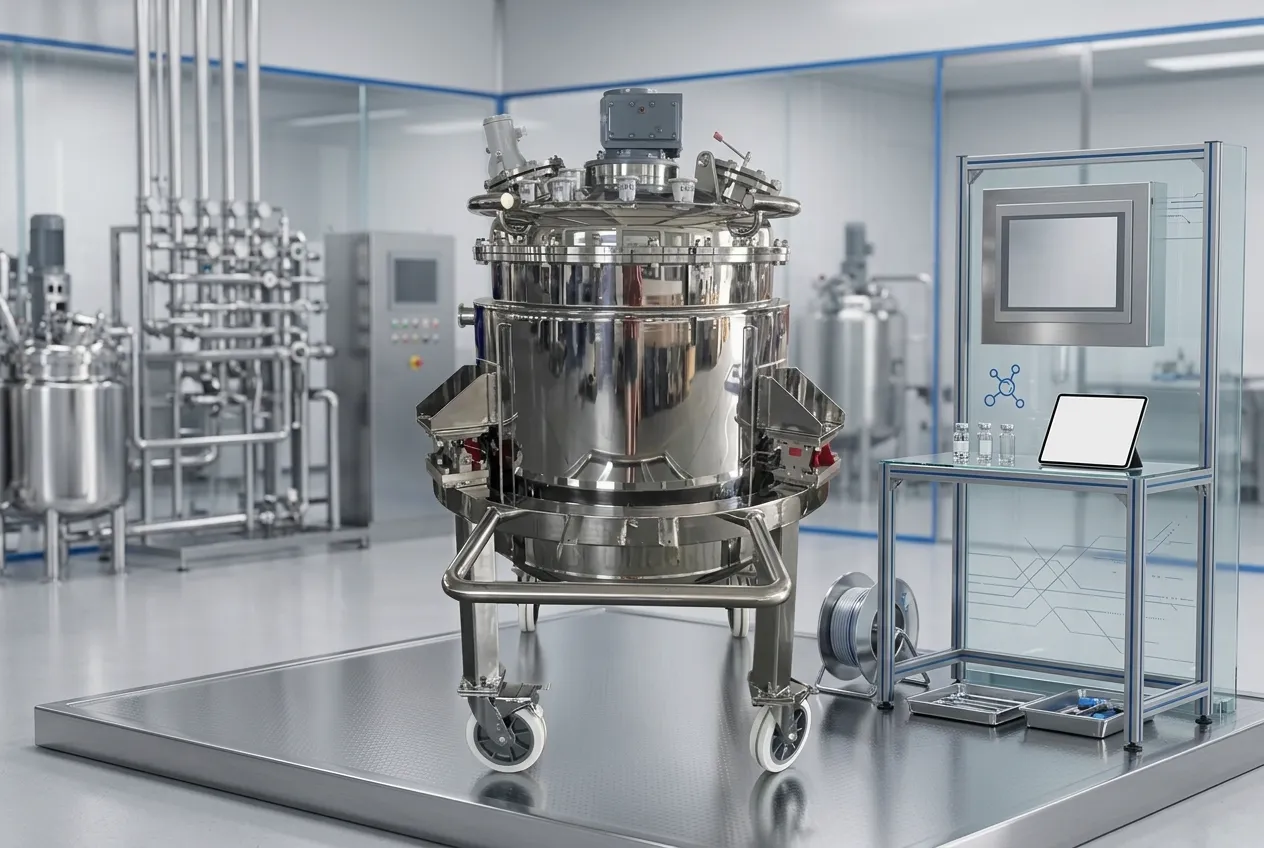
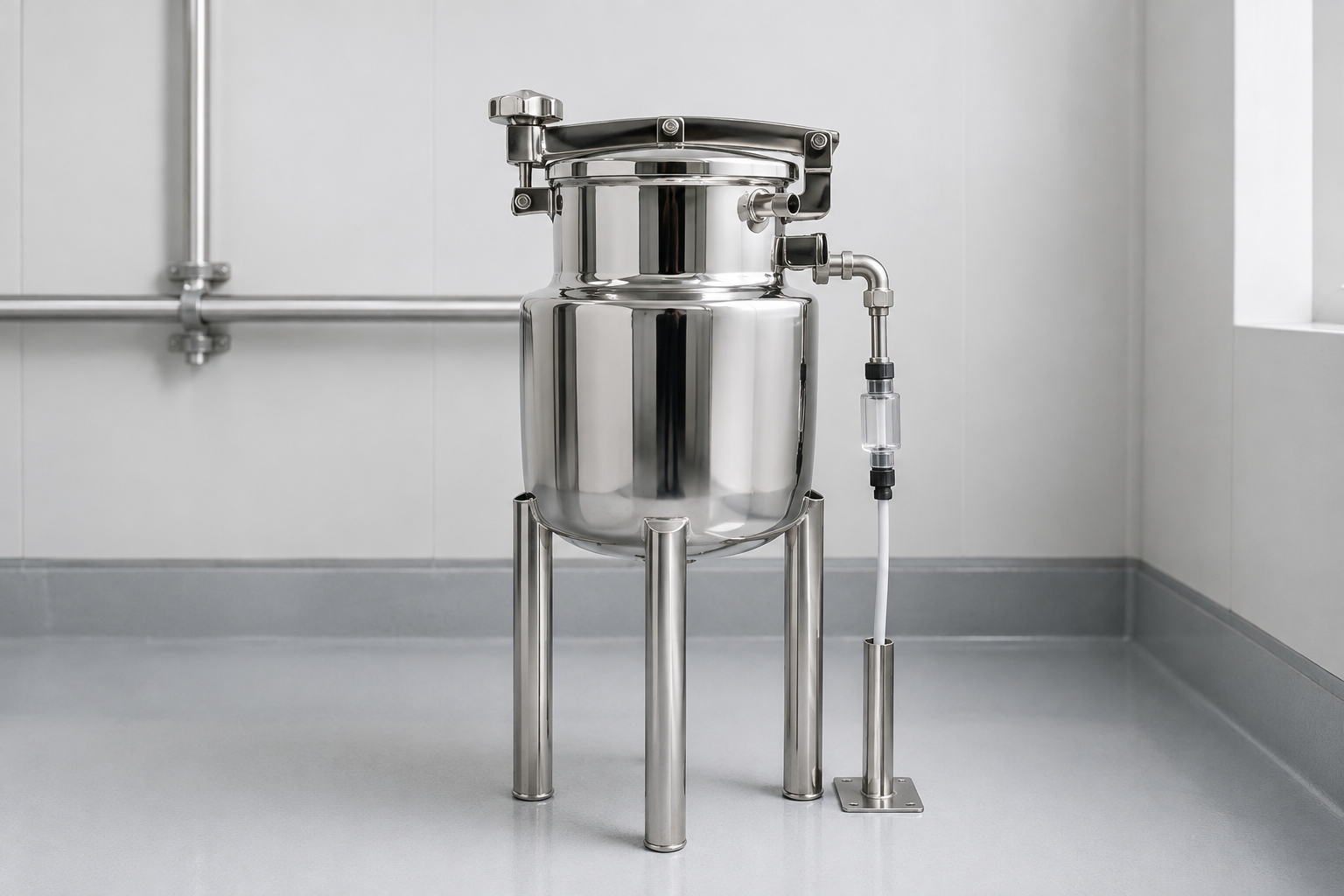
A steam heating stirrer tank heats batch product with plant steam in a jacket while an agitator blends in the same vessel. A jacketed mixing tank is the wider category: any mixed vessel with an outer jacket that may use steam, thermal oil, or electric heat, sometimes quoted without a full agitation package. Buyers compare them when a heated blending line must be scoped for RFQ—and when catalog language mixes “steam stirrer tank” with “jacketed mixer.”
This guide separates definitions, heat-transfer paths, utility dependencies, and RFQ lines. Product examples reference published YIYI INTELLIGENT mixing tank lines; project-specific steam pressure, trap sizing, and certification must be confirmed on the quotation.
Part 1. What is a steam heating stirrer tank—and what is a jacketed mixing tank?
A steam heating stirrer tank integrates three scopes in one line item: vessel, steam jacket heat source, and agitator for heated blending. Steam condenses in the jacket (or coil) and releases latent heat across the wall into product.
A jacketed mixing tank describes the vessel with a jacket channel first. The quote may include only the tank shell and jacket, with agitation sold separately, or the jacket may be designed for cooling as well as heating. The heat transfer fluid in the jacket is not always steam—it may be thermal oil or electric-heated glycol in other configurations.
| Term | What the buyer usually receives | Typical buyer intent |
|---|---|---|
| Steam heating stirrer tank | Heated stirred batch vessel with steam utility interface | Cook, melt, or hold temperature while mixing |
| Jacketed mixing tank | Vessel with jacket; agitation may be optional | Flexible platform for heat or cool duties |
| Steam jacketed mixing tank (narrow) | Jacketed tank with steam as the jacket fluid | Same utility as steam stirrer tank; see dedicated guide |
Start with the stainless steel mixing tanks category, then decide whether the RFQ is tank-only, tank plus agitator, or a fully integrated steam heated stirred package.
Part 2. How does heat reach product in each configuration?
In a steam-heated arrangement, saturated steam enters the jacket, condenses on the cold wall, and transfers latent heat inward. Agitation moves product away from the wall, which matters for viscous sauces, gels, and suspensions that would otherwise form hot films.
| Heat path | Steam heating stirrer tank | Jacketed mixing tank (general) |
|---|---|---|
| Energy source | Plant steam | Steam, oil, or electric per design |
| Heat entry | Jacket or coil condensing steam | Jacket fluid chosen per utility |
| Agitation role | Required for uniform temperature | May be light mixing or full shear duty |
| Response | Fast when steam pressure is stable | Depends on jacket fluid and heater |
| Off-batch state | Steam traps and condensate paths stay in scope | Oil or electric loops may idle differently |
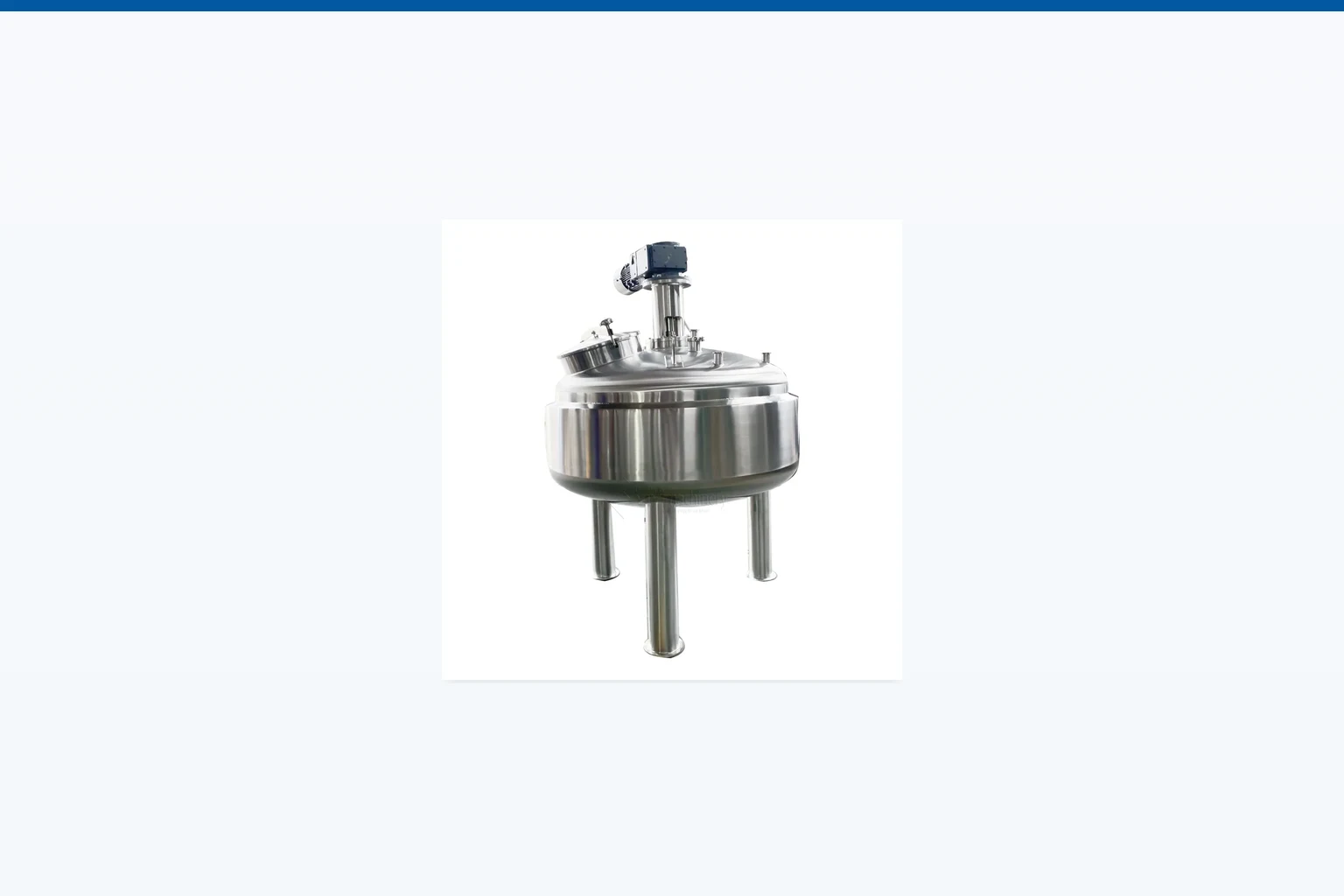
Jacket geometry—dimple, half-pipe, or full jacket—affects pressure rating and fabrication cost. When the vessel falls under pressure equipment rules, state whether the jacket is pressurized and request design scope references such as ASME BPVC Section VIII where applicable to the project.
Part 3. When should buyers choose steam heating over oil or electric jackets?
Steam heating stirrer tanks win when steam is already on site at stable pressure, when fast heat-up on moderate-to-large batches is valued, and when operations already maintain condensate recovery. They are weaker defaults when no boiler exists, when the line is a remote pilot skid with only electrical service, or when buyers want closed-loop oil without condensate—compare the thermal oil heating stirrer tank guide and electric heating stirrer tank buyer’s guide.
| Criterion | Steam heating stirrer tank | Oil jacketed mixing tank | Electric jacket |
|---|---|---|---|
| Site utility | Steam header and condensate | Circulation loop and heater skid | Electrical supply |
| Condensate | Traps, legs, recovery policy | None from jacket fluid | None |
| Temperature hold | Good with stable steam pressure | Strong on viscous long holds | Good with control; cycling on elements |
| Packaging on skids | Needs steam tie-in | Closed loop easier to package | Simplest for small pilots |
| Operating cost driver | Steam generation efficiency | Heater fuel or electricity to oil unit | Tariff and kW |
General background on combined heating and agitation appears in heating and stirring tanks. For steam jacket procurement detail without the stirrer comparison frame, see the steam jacketed mixing tank guide for industrial buyers.
Part 4. What steam, condensate, and trap details affect quotes?
Quotes fail in commissioning when steam pressure at the nozzle is assumed higher than the plant delivers, when condensate return is undefined, or when trap type is missing from the P&ID boundary.
| RFQ topic | Minimum detail | Why suppliers need it |
|---|---|---|
| Steam supply pressure | Available gauge pressure at tie-in | Sizes jacket and coil |
| Steam quality | Saturated vs superheated (if any) | Condensation rate |
| Condensate return | Gravity vs pumped return; backpressure | Trap and leg design |
| Trap responsibility | Supplier vs owner furnished | Interface clarity |
| Jacket MAWP | Maximum allowable jacket pressure | Fabrication and safety devices |
| Insulation | Required thickness and cladding | Heat-up time and personnel protection |
Tip: Ask whether the supplier includes steam control valve, strainer, and trap station or expects owner-furnished items at the nozzle. Document the split on the line list to avoid duplicate or missing components (steam learning resources for condensate concepts).
Part 5. Which materials and services fit food vs chemical heated blending?
Stainless steel 304 and 316L remain the common shell materials for heated stirred tanks. 316L is often selected for chlorides, certain acids, or aggressive CIP chemistry; 304 may suffice for many food duties when the supplier confirms compatibility.
| Service | Material starting point | Design notes |
|---|---|---|
| Food, dairy, sauce | 304 or 316L sanitary welds | Sloped bottom, CIP spray balls, 3-A sanitary expectations where required |
| Cosmetic emulsions | 316L common | Seal elastomers vs fragrances and solvents |
| Chemical blending | 316L or higher alloy per chart | Venting and grounding per MSDS |
| High-viscosity melt | 316L + anchor or ribbon agitator | Wall scrape reduces steam hot spots |
Internal polish and drainability affect cleaning time and heating uniformity. A stagnant heel below the agitator can overheat near the jacket if drainage is poor—state minimum working volume in the RFQ.
Part 6. What belongs in a steam heated stirred vessel RFQ?
A usable RFQ turns comparison tables into testable quotations. Include process data, steam interface data, and mechanical interfaces together.
| RFQ section | Example inputs |
|---|---|
| Process | Product, viscosity range, batch volume, fill level |
| Thermal | Target temperature, heat-up time, hold time |
| Steam utility | Pressure, condensate return, hours of operation |
| Agitation | Impeller type, speed range, shear sensitivity |
| Mechanical | Nozzle schedule, sight glass, manway |
| Materials | 304 vs 316L, gasket elastomer, internal finish |
| Standards | Sanitary, pressure, electrical area (if any) |
| Documentation | P&ID support, FAT checklist, spare seal list |
Attach a single-line diagram showing steam inlet, condensate outlet, product charge, and discharge. Suppliers can then confirm whether a heated mixing tank with sight glass jacket class unit fits or whether a larger 1000L mixing tank platform is closer to duty.
Part 7. What sizing mistakes appear, and which YIYI lines illustrate each type?
Field problems often trace to undersized jacket area for viscous product, agitator torque quoted for water-like viscosity, or steam pressure listed as boiler capacity rather than nozzle pressure.
| Mistake | Field symptom | Prevention |
|---|---|---|
| Jacket sized for water only | Slow heat-up on viscous batch | State viscosity and minimum working volume |
| Trap omitted from scope | Water hammer or cold jacket | Define trap station responsibility |
| Agitator undersized | Poor blending; hot wall film | Provide torque or power band |
| Tank-only quote without agitator | Installation mismatch | State integrated stirrer tank scope explicitly |
Fit boundary: Steam heating stirrer tanks fit plants with managed steam and condensate. They are a weak default without steam infrastructure or for very small electric-only pilot lines.
YIYI publishes examples such as the 1000L stainless steel mixing tank for jacketed batch platforms and heated mixing tank with sight glass jacket for heated jacket visibility. Confirm capacity, jacket type, and agitator scope on the exact SKU page before purchase. For project layouts, request a quote with the RFQ sections in Part 6.
FAQ
Is a steam heating stirrer tank always jacketed?
Yes in typical process designs: steam delivers heat through a jacket or coil around the vessel while the agitator runs inside. The integration of heat and agitation defines the steam heating stirrer tank scope.
Can a jacketed mixing tank use oil instead of steam?
Yes. Jacketed mixing tanks may use thermal oil, water-glycol, or electric heat. Compare oil jacket procurement in the dedicated oil jacketed mixing tank guide and viscous stirrer duty in the thermal oil heating stirrer tank article.
Do I need plant steam for a steam heating stirrer tank?
You need a reliable steam supply at the vessel nozzle with condensate removal. Remote skids without steam should compare electric or oil jackets instead.
How fast does steam heat compared with electric jackets?
Steam often gives fast heat-up when pressure is stable and the jacket is well sized. Electric jackets can be simpler to install but may cycle on elements; state heat-up minutes in the RFQ for either utility.
What condensate details belong in an RFQ?
List return pressure, whether return is gravity or pumped, and who furnishes traps and control valves at the interface.
Which agitator types suit viscous heated batches?
Anchor, helical ribbon, or scrape-wall designs are common for viscous heated products. Low-viscosity blends may use turbine or propeller impellers with lower torque.
When is a jacketed tank enough without a dedicated stirrer package?
When duty is storage with light mixing or cooling, a jacketed tank without heavy agitation may suffice. Heated blending with viscosity usually needs the integrated steam heating stirrer tank scope.
How does this relate to the steam jacketed mixing tank guide?
The steam jacketed guide focuses on steam jacket procurement. This article compares that heated stirred duty with the broader jacketed mixing tank category and other utilities.
References
- ASME BPVC Section VIII — Pressure Vessels — jacket and vessel pressure scope when applicable
- 3-A Sanitary Standards — sanitary equipment expectations for food and dairy owners
- Spirax Sarco — Learn about steam — condensate and steam system concepts