A rotary lobe pump for shear-sensitive products should be accepted on the condition of the transferred product, not on a general claim that positive-displacement pumping is gentle. A pump can deliver the required flow while changing texture, breaking suspended inclusions, entraining air or exposing material to an unacceptable handling history. Start with a measurable definition of product damage, establish an unpumped reference and compare samples under representative conditions. This guide explains how to prepare that acceptance trial. It does not assign a universal safe speed, guarantee particle survival or replace the pump manufacturer’s operating limits.
Define what must survive the transfer
Shear sensitivity is a description of a product response, not a complete pump specification. For a structured food, the concern may be an irreversible texture change. For an emulsion, it may be a change in droplet distribution or subsequent separation. For a suspension containing soft pieces, it may be a changed particle-size distribution. A product may also be sensitive to temperature, air exposure or residence time, which can resemble a pumping problem without having the same cause.
List the critical attributes and how they will be assessed. Specify whether changes are temporary, recover after a defined rest, or remain unacceptable. Agree who owns the analytical method and product-release decision. A photograph of two samples can support an observation, but it should not be the only acceptance test when the commercial decision depends on a less visible property. Include the downstream process: a texture that survives transfer but fails during filling still requires investigation.
Avoid using viscosity as the only description
Two products with the same reported viscosity can respond differently to pumping. Their measurements may have been taken at different temperatures, instrument settings or sample histories. Some materials change apparent viscosity with the imposed shear conditions. Others recover structure over time. Consequently, an isolated viscosity value does not establish what happens in a particular pump or pipeline.
Эт NIST discussion of rheology distinguishes Newtonian behavior from viscosity that depends on shear rate at a given temperature. Apply that distinction as a reason to describe the test conditions, not as a way to calculate a complete pump result from a catalogue number. Provide the pump supplier with the available flow behavior, solids information and temperature range. Where the material is poorly characterized, an appropriately controlled product trial is more informative than an unsupported extrapolation.
Build a baseline that separates pumping from storage
Retain an upstream sample before the transfer, using an agreed collection and handling method. Also consider an unpumped control held for the same time and under comparable temperature conditions. Without that control, natural settling, ageing or thermal drift can be mistaken for pump damage. Use representative material from the same batch where practical, rather than comparing unrelated batches with different processing histories.
Document the time between collection and measurement. A thixotropic material assessed immediately after transfer may give a different result after rest. A product that separates slowly may appear acceptable at the pump outlet and fail later. Decide in advance whether both immediate and delayed observations are required. Do not select the most favorable observation time after looking at the results. Retain the baseline and trial records together so the comparison can be reconstructed.
Specify the actual transfer path
The pump is only one part of the handling system. Record the vessel outlet, suction line, fittings, restrictions, delivery line, control devices and receiving arrangement. A small valve opening or an unnecessarily restrictive line can introduce conditions that a pump-only bench test does not reproduce. Repeated recirculation can expose the product to a different history from a single pass.
Use the intended line arrangement for an acceptance trial, or clearly identify deviations. If a temporary rig has a shorter line or a different receiving method, explain why its result is relevant and which questions remain unresolved. Confirm the safe startup, shutdown and pressure-protection arrangements with the supplier before running. This article does not authorize reducing safeguards to make the trial appear gentle. Inspect and operate the equipment only through approved procedures with guards and containment in place.
Agree a trial matrix before changing settings
Choose a small, justified set of operating cases that represents the expected duty. These may include the lowest and highest expected product temperatures, a difficult formulation and the intended transfer rate. The specific cases depend on the process. Do not vary every parameter at once: a failed result becomes difficult to interpret if speed, temperature, valve position and batch condition all changed together.
For each case, record the actual operating state rather than only the requested setpoint. Include flow, relevant pressure measurements, temperature and time, using suitable instruments and units. When measurements are unavailable, record that limitation. A trial described only as slow, normal or fast cannot reliably support a future purchase or investigation. Stay inside the approved equipment envelope; the supplier must review any proposed operating case that could exceed it.
| Вопрос | Документы для сбора | What it can help distinguish |
|---|---|---|
| Did the product change during the transfer? | Upstream, downstream and unpumped-control samples | Pumping effects versus natural time-dependent change |
| Does repeated handling matter? | A defined single-pass case and an approved recirculation case | Immediate transfer effects versus cumulative handling |
| Are inclusions being damaged? | A consistent count, size or retained-fraction method | Particle breakage versus a subjective visual impression |
| Is air affecting appearance? | Agreed air-content or density observations and line-condition records | Entrained gas versus an actual composition or structure change |
| Does the product recover? | Measurements at preselected rest times | Temporary response versus persistent change |
| Is the result transferable to production? | Actual piping, temperature and operating records | A representative acceptance case versus an easier demonstration |
The table is a qualitative planning aid. It does not supply acceptance limits or prove the suitability of a specific pump model.
Evaluate samples consistently
Use the same containers, preparation, measurement temperature and test method for baseline and transferred samples. Where a method requires redistribution, define it. Avoid shaking one sample aggressively while treating another gently, or comparing warm outlet material with a cooled retained sample. Those differences can overwhelm the effect under investigation.
If particle integrity matters, define which particles are included and how the sample is subdivided. If texture matters, choose a method suited to the product and intended use. If emulsion stability matters, evaluate the property and hold condition that actually predicts downstream performance. A generic photograph or viscosity reading is not a universal substitute. The laboratory or qualified product specialist should confirm the method’s suitability, including how repeatability and measurement variation will be handled in the decision.
Treat a failed trial as a diagnosis
When a result is unacceptable, preserve the operating record before changing equipment. Ask whether the baseline was stable, the sample was representative and the method could resolve a meaningful difference. Then examine the transfer path, operating case, recirculation history and potential air entry. Increasing or decreasing pump speed without that review can exchange one problem for another.
Do not assume every change is caused by rotor contact or an internal defect. Suction difficulties, temperature changes, a restrictive downstream component or a different formulation may contribute. Equally, do not dismiss a consistent product change merely because the pump achieved the specified flow. The acceptance criterion concerns the delivered material. Changes to the configuration or operating envelope should be reviewed by the supplier and then tested against the same agreed product requirements.
Make the commercial acceptance conditions explicit
A useful purchase specification states the product, temperature range, transfer arrangement, required output and the evidence needed to accept the result. Describe who supplies trial material, how much is required, who performs analysis and how retained samples will be managed. Include the handling of a failed or inconclusive result, rather than leaving those issues until after the equipment has been delivered.
A trial can establish evidence for the tested conditions; it does not guarantee every future formulation or operating case. Identify the changes that require review, such as a different inclusion size, a new thickener, a lower transfer temperature or a longer recirculation period. This prevents a successful initial test from being treated as an unlimited low-shear guarantee. Maintain the approved configuration and test records as part of the equipment handover.
Use validation principles without claiming certification
Эт FDA guidance on process validation describes a documented, lifecycle approach in its pharmaceutical manufacturing context. Its regulatory scope does not automatically apply to every industrial or food transfer. Nevertheless, the practical discipline of predefined requirements, collected evidence and continued monitoring is useful when designing an equipment acceptance plan.
For a nonpharmaceutical application, define the applicable legal and quality requirements independently. Do not describe a pump as FDA approved, validated for all products or certified gentle because a supplier ran one demonstration. The relevant claim is narrower: the recorded configuration met the agreed product criteria under the documented trial conditions. Anything beyond that requires its own evidence.
Connect the trial to the YIYI equipment discussion
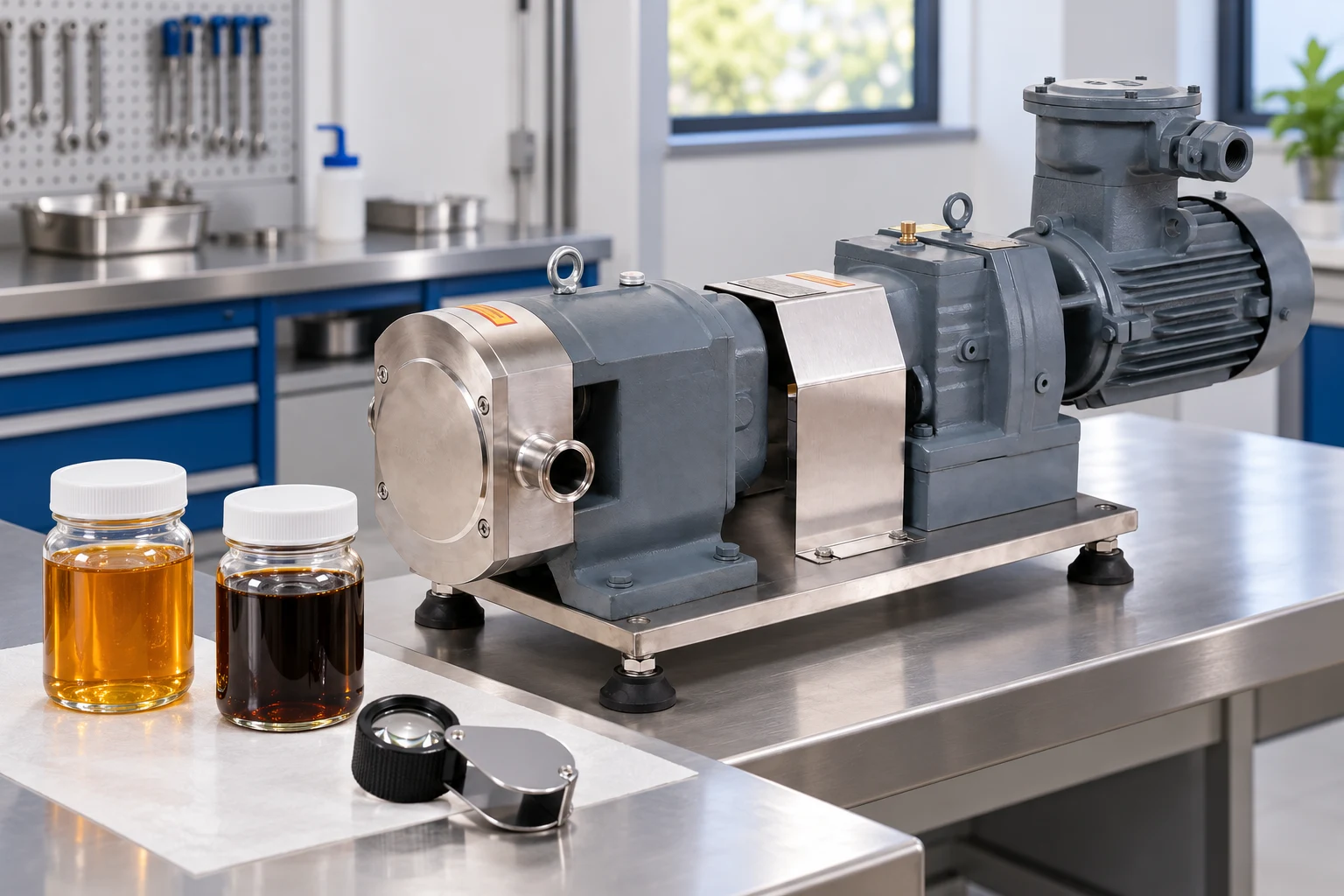
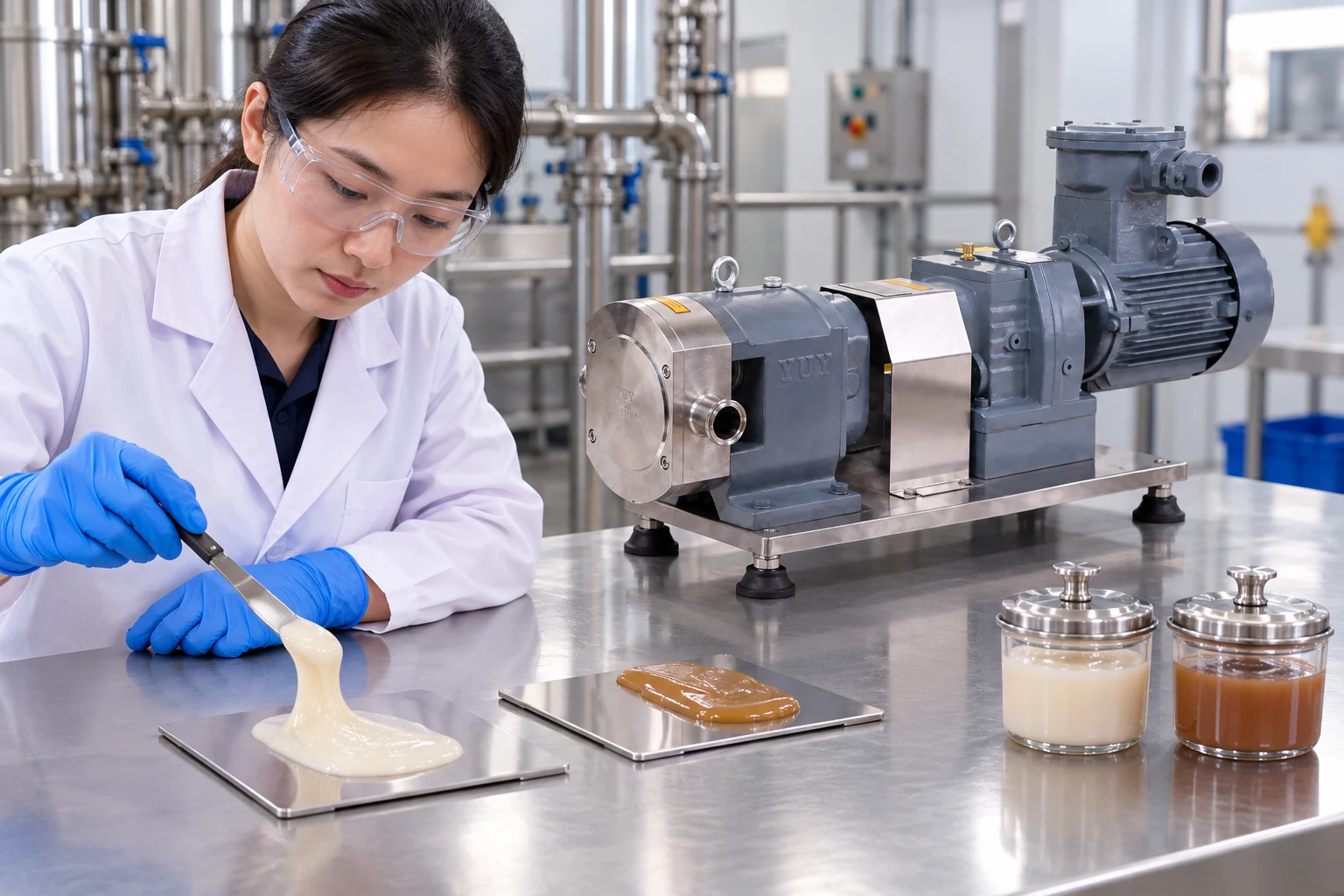
When discussing the YIYI rotary lobe transfer pump, provide a representative material description and the product-damage acceptance plan. Ask for confirmation of the proposed pump configuration, materials, approved operating range, cleaning arrangements and available test support. The website photograph identifies a product family; it does not verify internal clearances, inclusion limits or a guaranteed texture outcome for your formulation.
Прочитайте high-viscosity pump-speed guide for the separate hydraulic operating discussion, the Руководство по кавитации for suction-side diagnosis and the rotary-lobe versus progressive-cavity comparison when the pump family itself remains undecided. Use those pages alongside, rather than instead of, a product-specific acceptance trial.
Educational reference: shear and fluid behavior
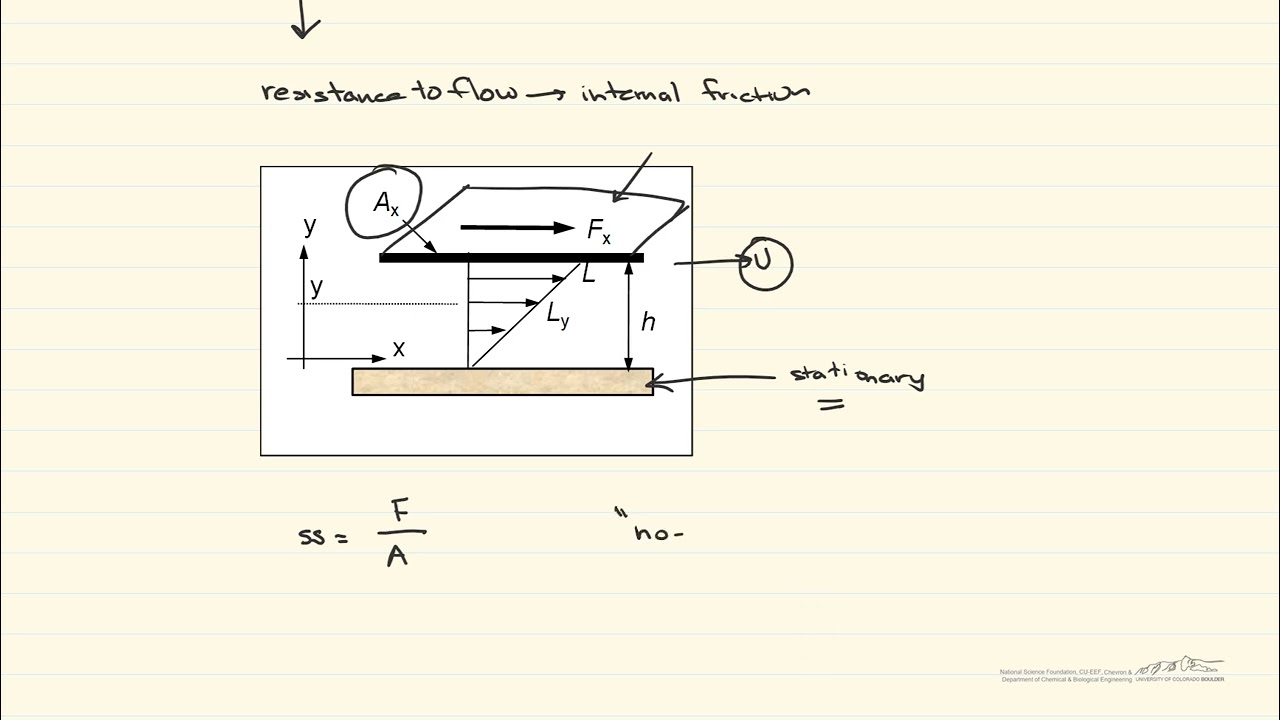
Watch Viscosity and Shear Stress by LearnChemE
This educational explanation supports the fluid-behavior discussion. It is not a product demonstration or evidence that a particular YIYI pump preserves every sensitive formulation.
Часто задаваемые вопросы
Is a rotary lobe pump always a low-shear solution?
No universal outcome follows from the pump family alone. Product behavior, the actual configuration, operating conditions, piping and repeated handling all matter. Define and test the delivered-product requirement.
Can a water trial prove that my viscous product will remain intact?
A water trial can help check some equipment and measurement functions. It cannot reproduce every structural, inclusion or rheological response of the actual product, so its acceptance scope must remain limited.
What should I send before requesting a product trial?
Provide the formulation’s relevant handling properties, temperature range, inclusions, intended transfer path, flow requirement and measurable acceptance criteria. Identify confidentiality or sample-handling requirements before shipping material.