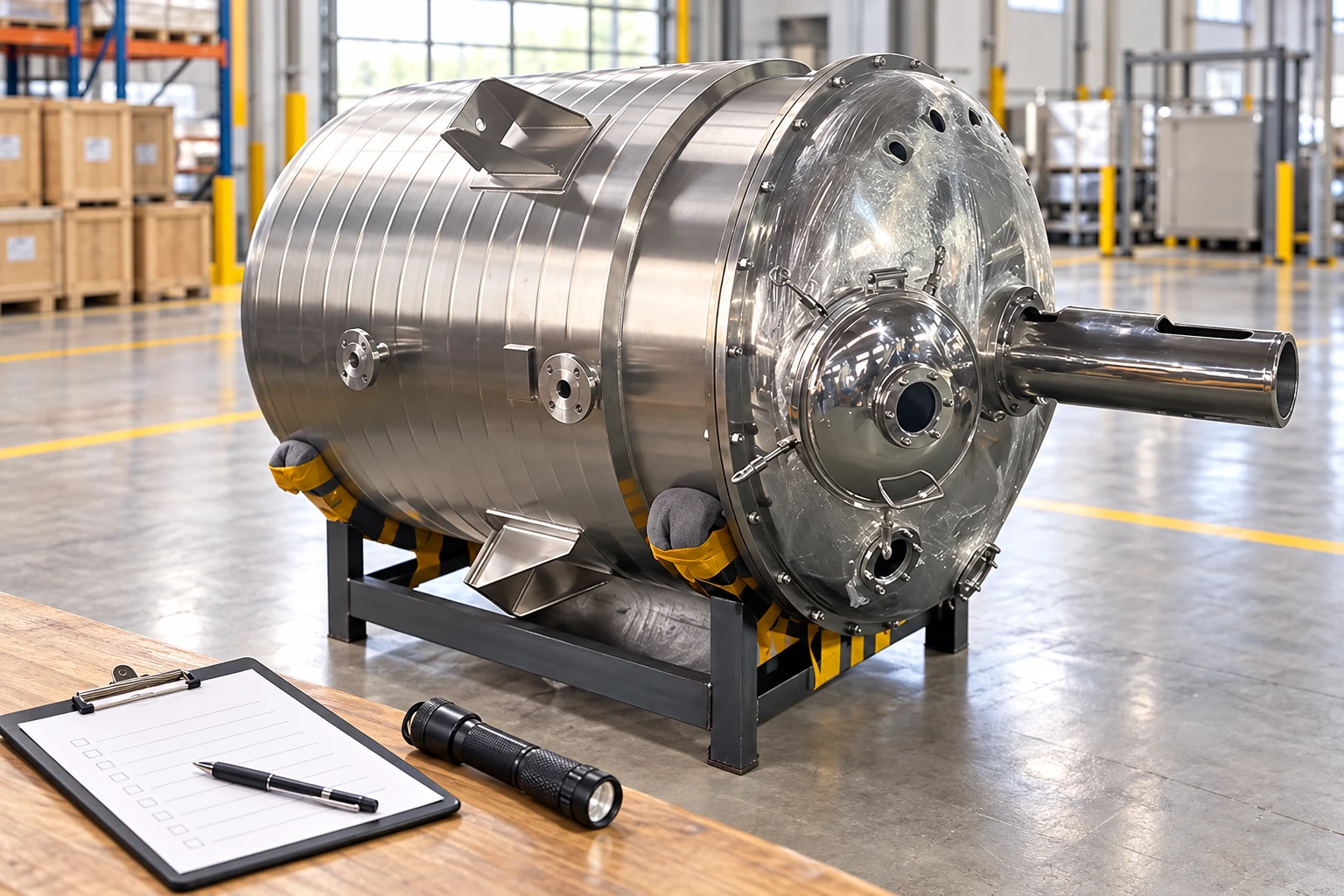
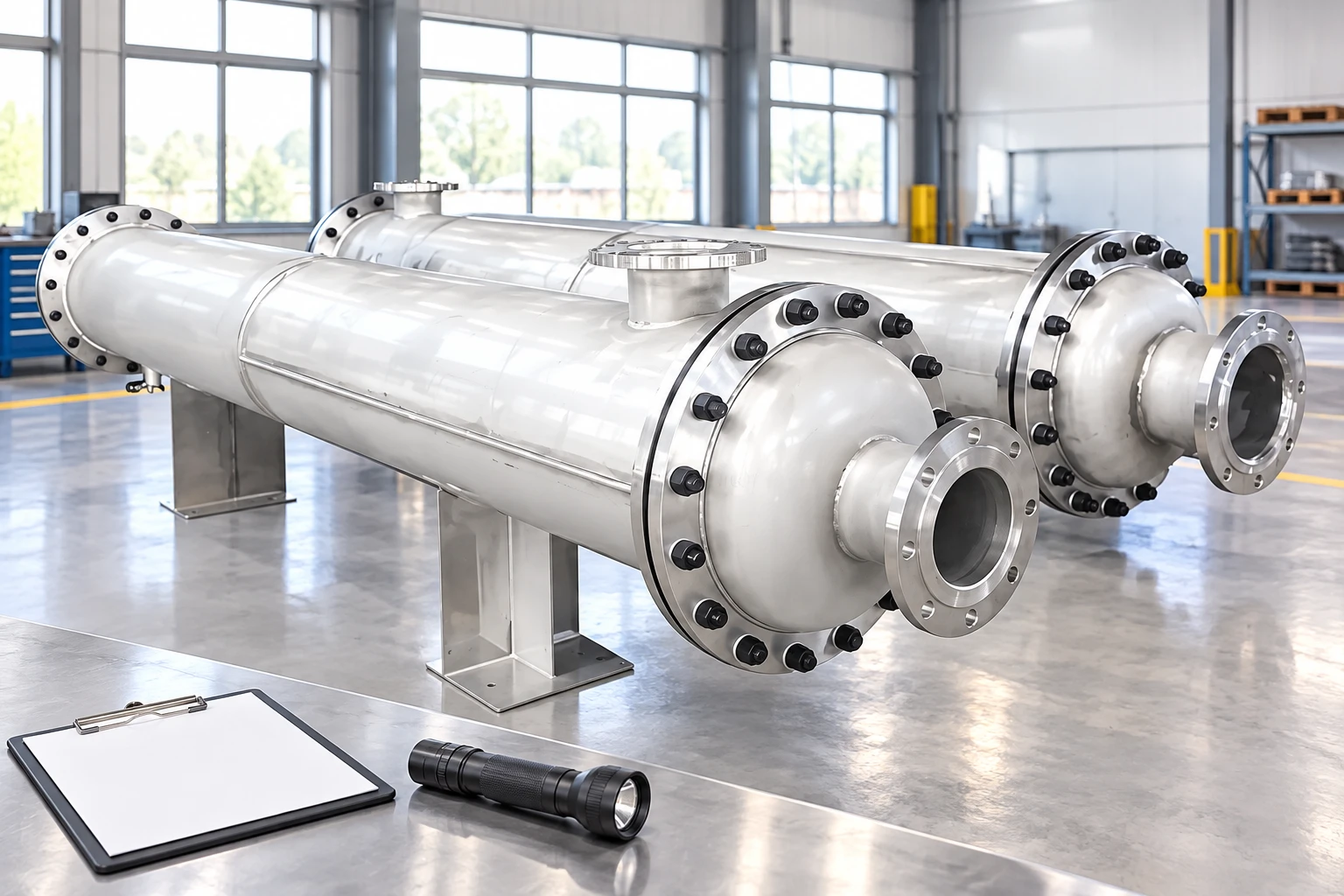
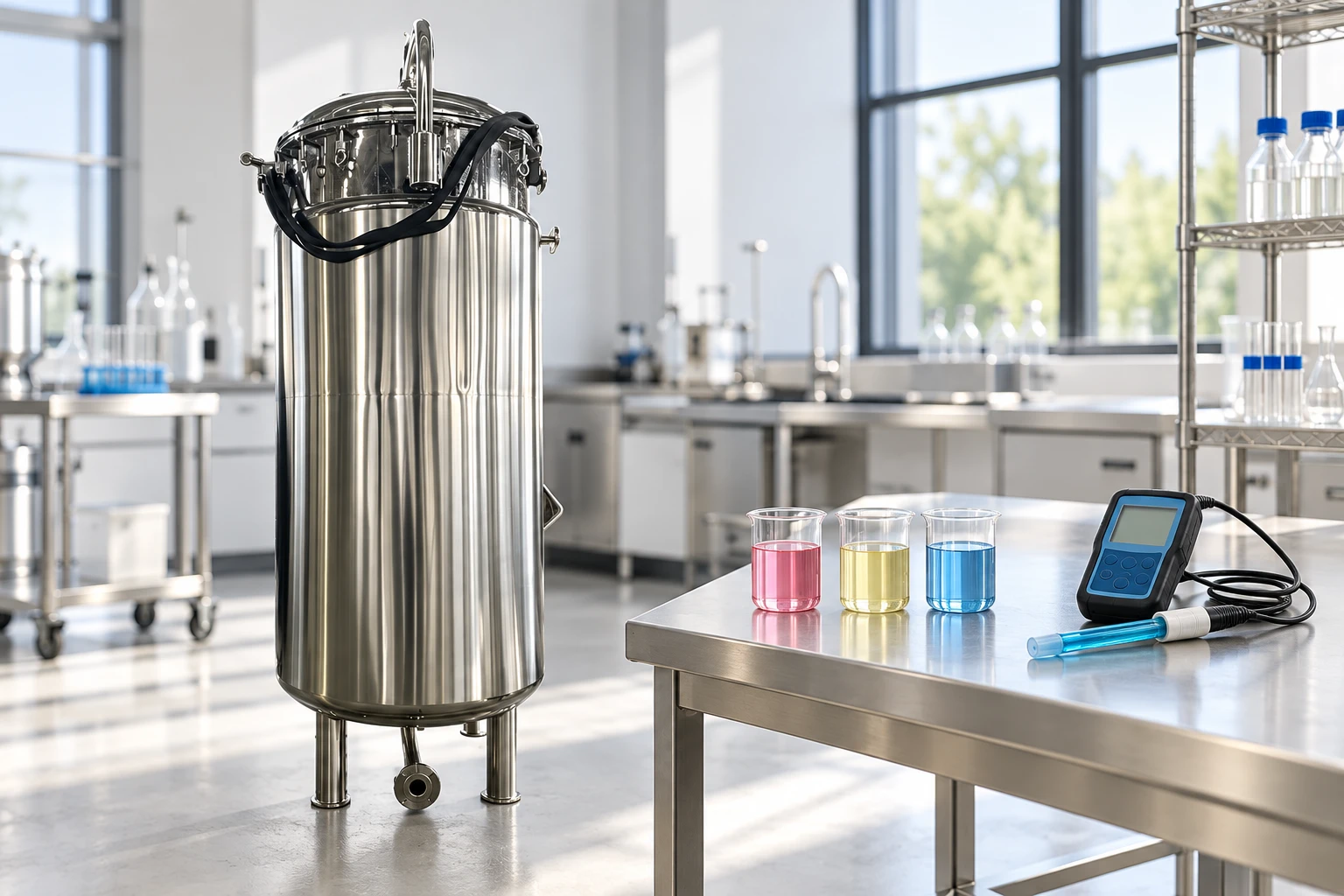
Slurry mixing tank sampling should establish whether the collected material represents the solids and liquid that matter to the production decision. A clear sample from an easy-to-reach outlet can give a precise laboratory result for the wrong material. Before selecting bottles or calculating a concentration, define the batch condition, collection location, sampling time and handling method. Then check whether settling, segregation, sample-line hold-up or preparation changes the result. This guide concerns representative solids sampling from an industrial slurry vessel. It does not provide a procedure for opening a pressurized, hazardous or biologically active system.
Begin with the decision, not the sampling valve
A production-release sample, a troubleshooting sample and a sample used to compare tank locations do not necessarily require the same collection plan. For release, the question may be whether material delivered to the next process meets an agreed solids range. For troubleshooting, the question may be whether large particles are accumulating near the bottom while finer material remains suspended. For equipment acceptance, the question may be whether repeatable samples can distinguish satisfactory suspension from an unacceptable operating condition.
Write that question before the trial. Record the material, solids distribution, approximate rheological behavior, expected batch stages and the analytical method. Specify what population the result represents: the entire batch, the material leaving a particular outlet, or a local region inside the vessel. A single local grab should not silently become a certificate for an entire tank. The sampling plan and the laboratory method need to address the same decision.
Keep sampling error separate from laboratory error
A laboratory can weigh and analyze a small portion carefully while the original bottle remains unrepresentative. Sources of variation occur at several stages: selecting a tank location, drawing material through a connection, filling a container, transporting it, redistributing its contents and removing the test portion. Repeating only the final laboratory measurement describes only part of that chain.
Use field duplicates to investigate collection variability and laboratory replicates to investigate preparation or analysis variability. These are complementary checks. Two portions from one bottle cannot establish that the bottle represents a settling tank. Conversely, different results from independent field samples do not automatically mean the analytical instrument is defective. Preserve the origin of each replicate in the record so that troubleshooting can identify which stage introduced disagreement.
Эт NIST guidance on evaluating measurement uncertainty provides a useful framework for identifying contributions rather than reporting an unexplained final number. Its framework does not prescribe a slurry sampling location or an acceptable production tolerance; those remain process-specific decisions.
Describe the batch state when each sample is taken
Record whether the agitator is running, its approved operating condition, liquid level, recent ingredient additions and the time since the last operating change. Also record whether the sample was taken during filling, normal mixing, holding, discharge or restart. Results collected under different conditions may answer different questions even when the bottles carry the same batch number.
Do not stop an agitator simply to make sampling convenient unless the approved procedure calls for it. Stopping may change the solids distribution that the test was intended to measure. Likewise, a sample collected immediately after an addition should not be compared with a late-batch sample without noting that distinction. Safe access and containment take priority: use an engineered sampling arrangement and the site’s approved isolation or operating procedure, rather than improvised access through a hatch.
Choose locations that can reveal segregation
The most accessible location is not necessarily representative. A bottom connection can preferentially collect settled solids or retained material. A high connection can miss coarse particles. A sample close to an addition point may reflect an incompletely distributed charge. An outlet sample may be entirely appropriate when the real question is the composition supplied downstream, but that does not establish uniformity throughout the vessel.
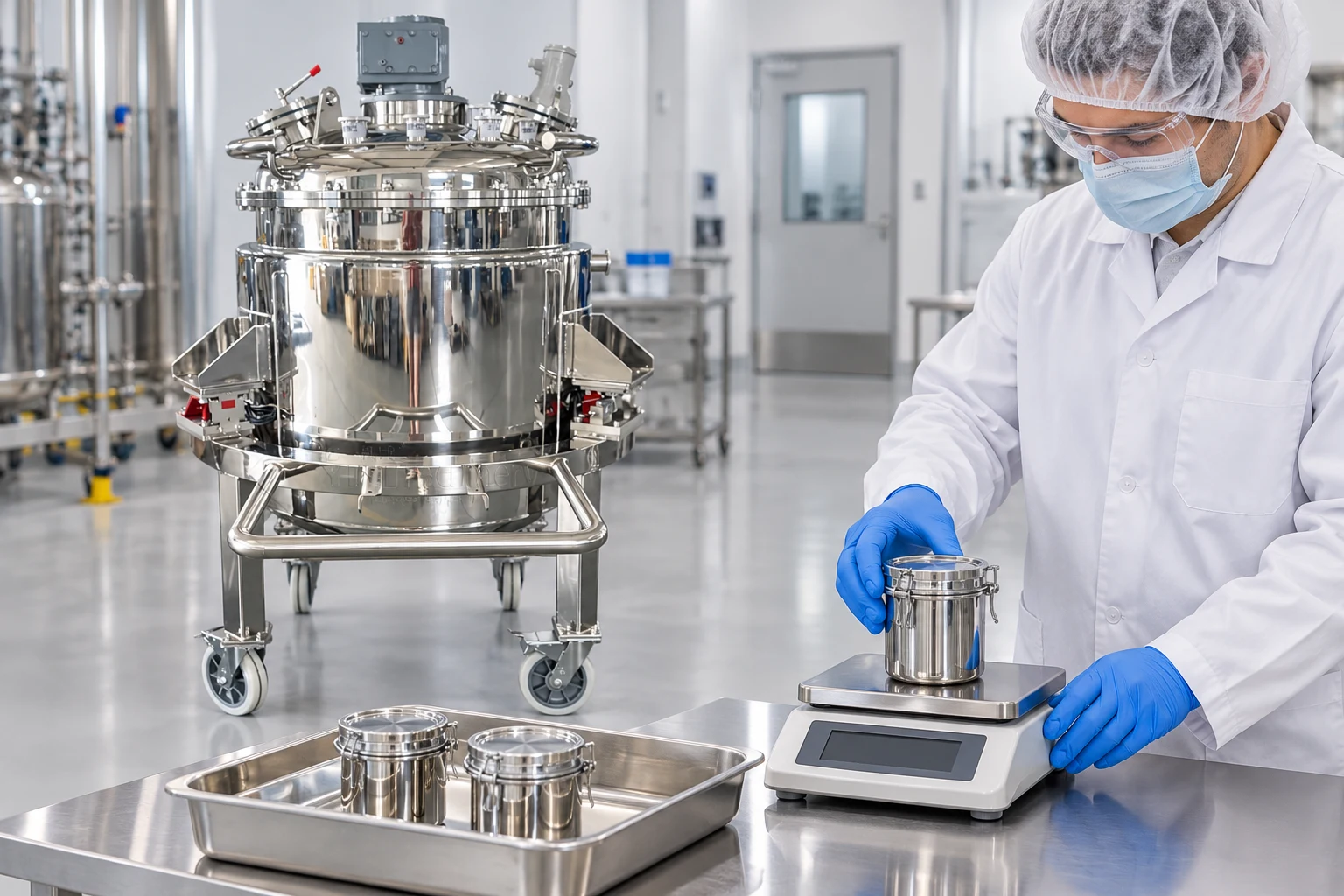
For a commissioning investigation, compare locations selected from the actual geometry and flow pattern. Define how each location can be sampled safely before approving the test. If the installed equipment cannot provide access to a relevant region, record that limitation rather than inventing a result for it. Do not infer an internal sampling path from an exterior product photograph. Tank drawings, the agreed sampling arrangement and the material’s behavior are the appropriate design inputs.
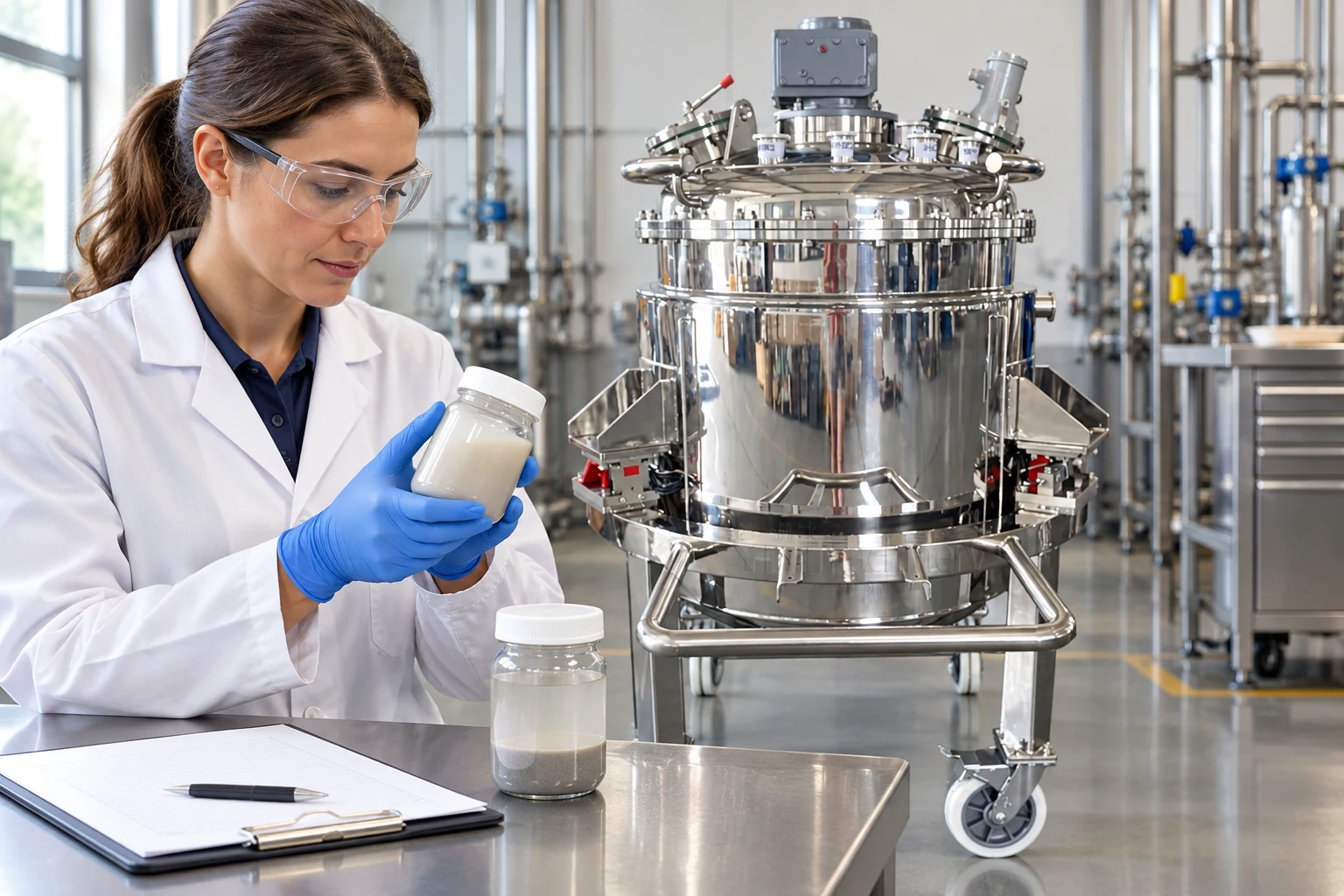
Review the sample path before deciding on a purge
A valve pocket, small-bore tube or flexible hose can retain material from an earlier state. Large particles may be excluded by a restriction, while solids can accumulate in a horizontal section. A sample may therefore represent the path rather than the vessel. Document the connection dimensions, direction, retained volume and any conditioning step that can change concentration or particle distribution.
A purge may be appropriate, but there is no universal purge volume for every slurry. Excessive purging can waste hazardous material or disturb a small batch; insufficient purging can leave an old sample in the line. Establish the method through a safe, material-appropriate investigation, with controlled collection or return arrangements. Never return a laboratory sample to production unless an approved process explicitly permits it. Do not substitute a water-only flow observation for evidence that the path transports the actual solids.
Use a decision table to plan the investigation
The following table is a qualitative investigation aid. It supplies no universal sampling frequency, particle-size limit or release specification.
| Observation | Possible sampling contribution | Useful controlled check |
|---|---|---|
| First bottle differs from later bottles | Retained material or a changing batch | Record collection sequence and compare the approved conditioning step |
| Bottom sample is consistently richer in solids | Settling or a location-specific flow region | Compare safely accessible locations under the same batch condition |
| Laboratory portions from one bottle disagree | Settling inside the container or inconsistent preparation | Define redistribution and test-portion withdrawal before repeating analysis |
| Coarse particles appear only in some samples | Restriction, intermittent segregation or insufficient sample mass | Review the sample path and the particle distribution with the laboratory |
| Results drift with transport time | Settling, evaporation or material change | Compare controlled hold times and storage conditions |
| Outlet samples change during discharge | The downstream product may vary over the batch | Assess a time-resolved discharge plan rather than assuming a single grab is sufficient |
Select containers and sample quantities with the laboratory
Ask the laboratory what quantity and container are required for the actual analysis. The answer depends on particle distribution, expected heterogeneity, concentration and the preparation method. A small container that works for dissolved chemistry may be unsuitable for a coarse suspension. A sample quantity should allow the required tests and retained material without encouraging uncontrolled subdivision.
Confirm closure compatibility, cleanliness, labeling and any restrictions on headspace, temperature or preservation. Avoid transferring the sample through several unnecessary containers, which can leave solids on walls or introduce contamination. Where mass balance matters, record relevant container masses and transfers. Do not specify a generic preservative for every slurry: treatment that stabilizes one analyte may invalidate another measurement or change the physical structure being investigated.
Prevent transport and preparation from changing the answer
A bottle that looks separated on arrival does not prove that the original vessel was poorly mixed. Settling may occur after collection. Conversely, vigorous laboratory redispersion may conceal agglomerates or structures that were part of the production problem. Define what should remain unchanged and what preparation the analytical method requires.
Document collection time, analysis time, storage temperature and any visible changes. Specify a reproducible redistribution method before removing a test portion, with the laboratory confirming that it does not invalidate the intended measurement. If a settled layer cannot be redistributed by the approved method, retain the observation and investigate it. Do not quietly discard the difficult fraction and test only the convenient liquid above it. Such a result describes a different material from the original sample.
Calculate solids concentration only on a defined basis
A solids concentration must state its basis. Mass fraction, mass per liquid volume and a volume-based estimate are different quantities. A drying method also measures material according to its operational definition; volatile material, dissolved residues and sample preparation can affect interpretation. Ask whether the chosen method measures suspended solids, total residue or another property that is relevant to the purchase specification.
For an illustrative mass-fraction calculation, dividing the dry residue mass assigned by the approved method by the original sample mass gives a fraction on that method’s basis. Multiplying by one hundred expresses a percentage. This arithmetic does not validate the drying conditions, separation method or sample representativeness. Record units, the treatment of tare mass and the applicable laboratory procedure. Do not convert the result into a volume concentration using an assumed slurry density.
Prove that the plan can detect a meaningful difference
A useful trial should distinguish a change that matters to production from normal sampling and analytical variation. Agree the acceptance question before comparing results. Review independent samples, the batch conditions and the preparation records together. A visually uniform tank surface is not evidence that the solids distribution meets the agreed criterion.
Эт USGS guidelines for automatic water-quality and sediment samplers provide primary agency material on collecting and handling suspended-sediment samples. Their environmental-water setting is different from an industrial mixing vessel, so their equipment and field procedures should not be copied as an industrial sampling method. The relevant lesson is to examine what a collection arrangement represents and preserve the evidence behind that interpretation. If the investigation cannot resolve an important production difference, improve the sampling or measurement plan before tightening the release limit.
Turn the findings into equipment requirements
For a new бак для приготовления суспензии, include the sampling question in the equipment discussion. Supply the material description, particle behavior, operating envelope, cleaning constraints, required containment and intended analytical tests. Ask the supplier to show the proposed collection path on the actual arrangement and identify access, retained-volume and maintenance limitations. A product picture alone cannot confirm those details.
Используйте slurry restart guide for the separate problem of recovering settled material, the mixing-time guide for a defined blending endpoint, and the tracer-data quality guide for instrument and timing errors in a tracer investigation. A dissolved tracer and a settling solids population need not follow the same distribution.
Further learning: representative sample collection

Watch Monitoring Suspended Sediment and Flow along the Mississippi River: Episode 3B by USGS
The educational reference illustrates a sampling principle. It is not an operating instruction for a hazardous slurry or a substitute for the site’s approved equipment-specific method.
Часто задаваемые вопросы
Is a bottom-outlet sample representative of the entire tank?
Not automatically. It can represent the material delivered from that outlet, but settled solids, retained material and the sampling path may bias it. Establish what the result must represent and verify the location against that objective.
Can I combine several samples into one bottle?
A composite may suit an average-composition question when the combination method is defined. It can conceal location or discharge-time differences, so retain separate samples when those differences are the reason for testing.
Does a precise laboratory result prove that the sample was good?
No. Analytical repeatability addresses only part of the measurement chain. Collection, transport, container redistribution and test-portion withdrawal must also be controlled and documented.