Mixing tank replacement motor storage records should show which motor was stored, what preservation instructions applied, what conditions it experienced, and which checks remain necessary before installation. A clean crate and matching power rating cannot establish that a spare motor is ready for service. Ask the responsible electrical and mechanical specialists to review the actual motor manufacturer’s instructions, storage history and condition evidence before releasing it. This guide helps maintenance planners and purchasing teams assemble that evidence; it does not provide an electrical test procedure or authorize energizing, shaft rotation or lubrication.
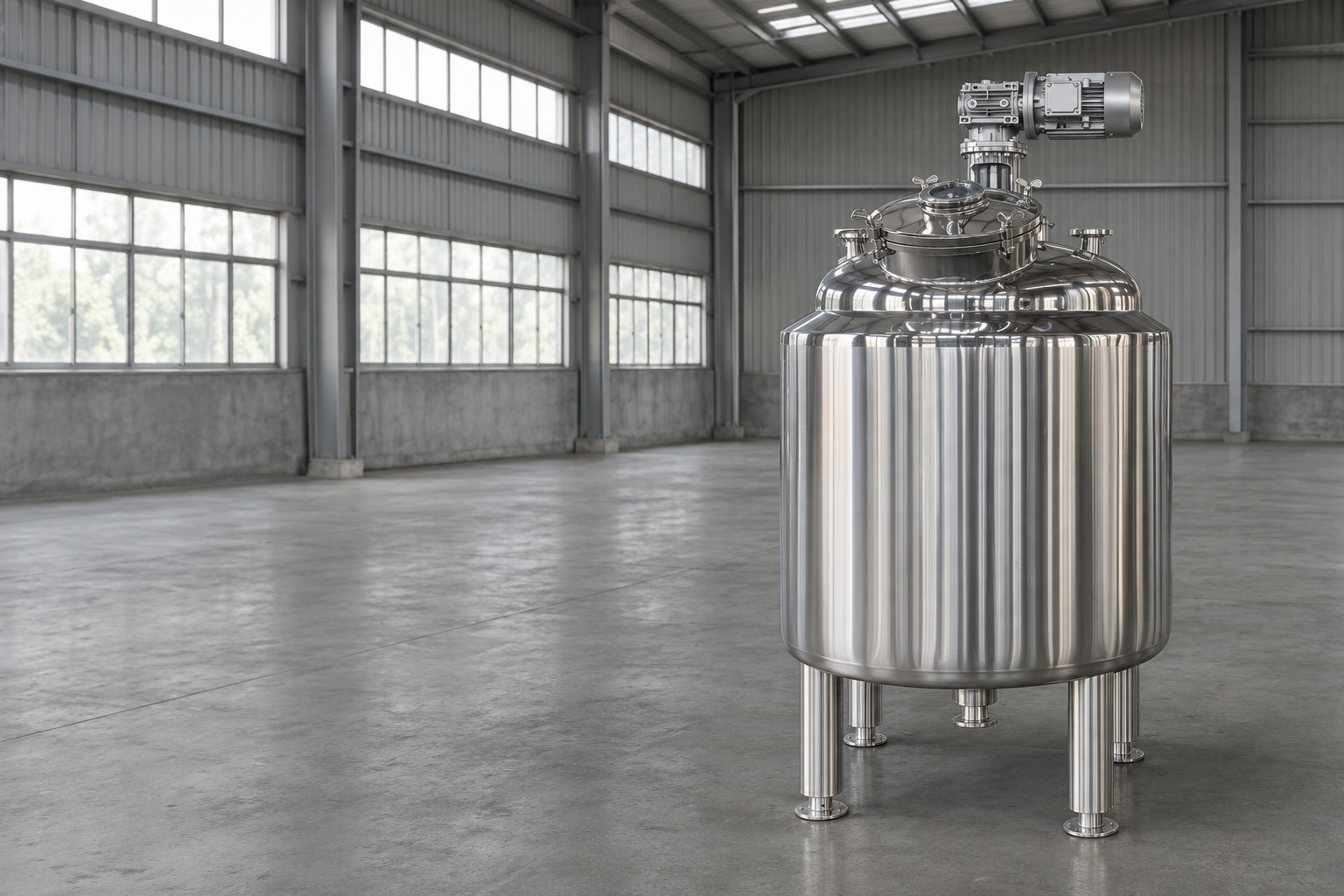
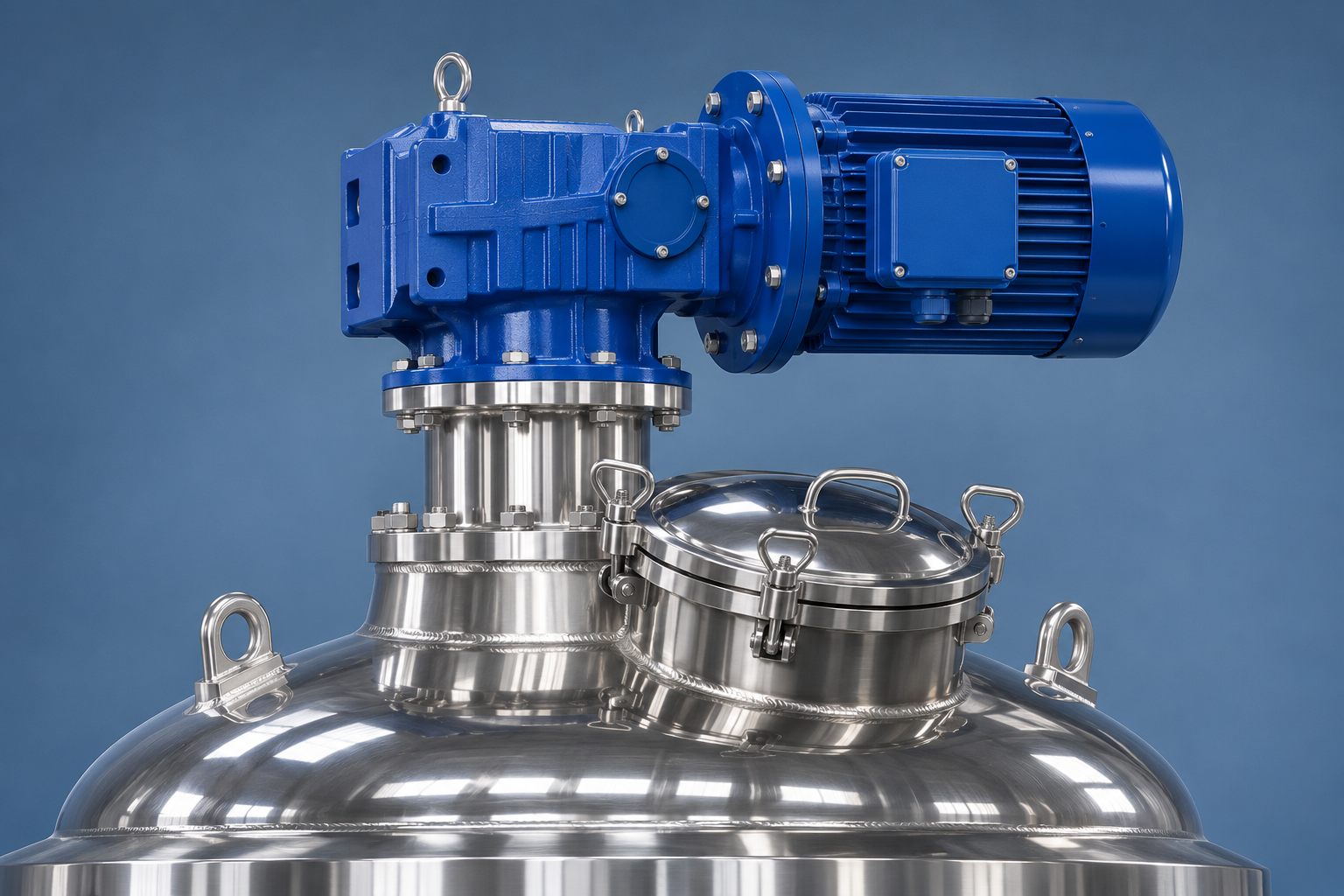
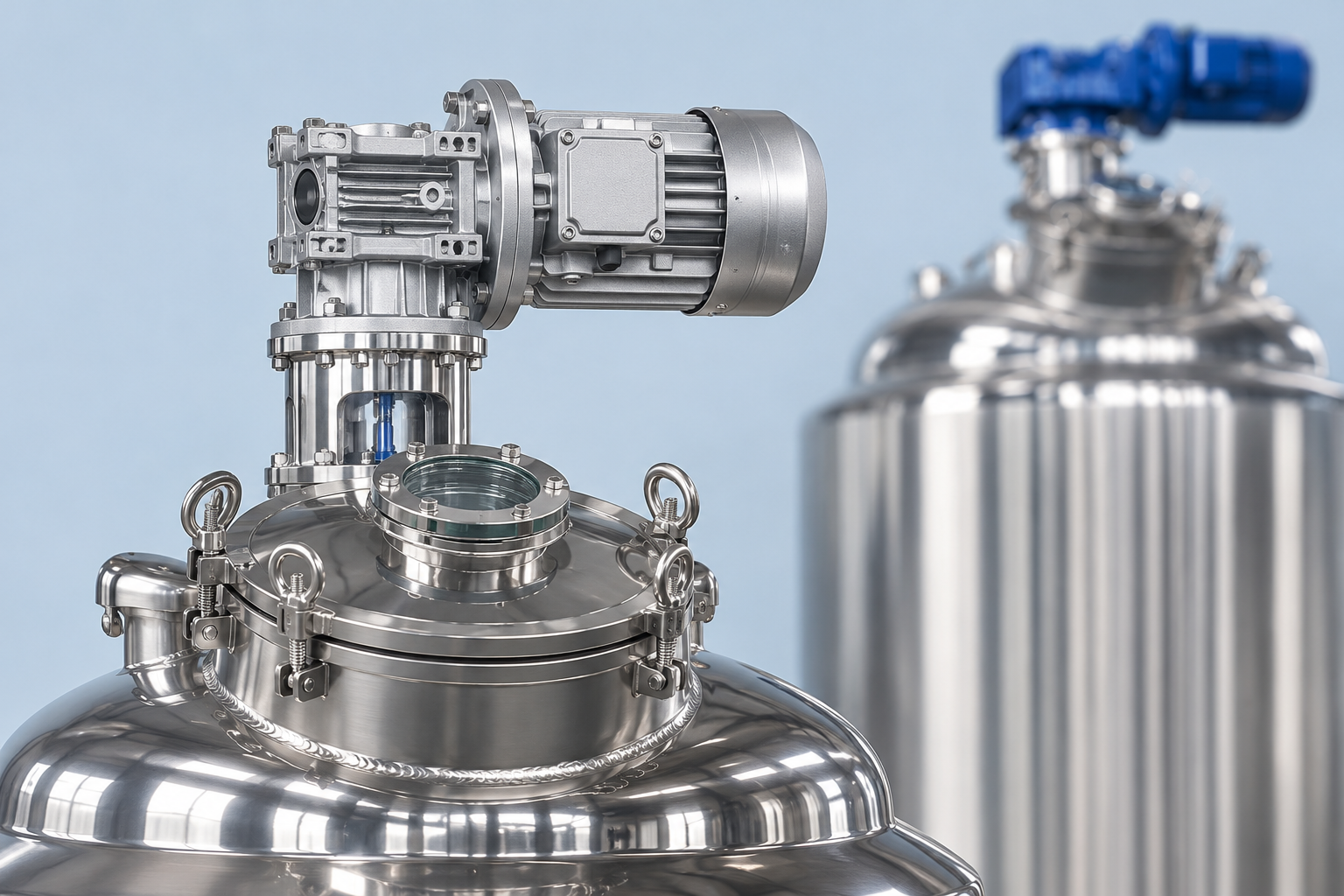
The visible drive on a YIYI mixing tank establishes equipment context. It does not identify the specifications of your installed motor, the bearing arrangement of a replacement, or a universal preservation schedule. Those details belong to the equipment file and the supplied motor documentation.
Separate suitability from storage condition
Two questions need separate answers: is the spare the approved replacement, and has it remained suitable during storage? A motor can match the order but have an incomplete preservation history. Another can have excellent storage records and still have the wrong mounting arrangement or electrical characteristics. Keep the configuration approval and condition review together without allowing either to substitute for the other.
The existing replacement motor nameplate comparison addresses the first question. This article starts after an intended replacement has been identified and examines the evidence accumulated between receipt and release. A purchase order date is not necessarily the beginning of storage: obtain the supplier’s dispatch date, earlier warehouse history where available, arrival date and any moves between stores.
Classify unknown periods explicitly. A blank month does not prove neglect, but it cannot be recorded as a completed inspection. Ask the supplier or storage owner for the missing record and explain why the information affects the next decision. Avoid turning uncertainty into an invented statement of compliance.
Find the instructions for this exact motor
Preservation requirements depend on construction, orientation, bearing type, packaging and storage duration. Obtain the applicable manual revision and any order-specific instructions. A general instruction sheet may be useful for identifying questions, but its intervals and acceptance criteria should not be transferred automatically to another motor.
For example, Nidec’s motor storage service bulletin discusses storage controls and preparations before startup. Use it as an example of why preservation needs a defined owner and documented follow-through. It is not confirmation that a particular YIYI mixing tank uses a Nidec motor or that its instructions apply to a different drive.
Create a short instruction register containing document title, revision, motor model or serial scope, date received and the person who confirmed applicability. Where the packing instructions and motor manual appear inconsistent, request a written clarification. Do not let a warehouse team decide between conflicting technical requirements from memory.
Reconstruct exposure rather than describing a warehouse
An entry saying ‘stored indoors’ is too broad to explain the conditions around a motor. Record whether the location was dry, exposed to condensation, near washdown, subject to roof leaks, or adjacent to equipment that could transmit vibration. Include changes in location and unusual events such as flooding, building work or damaged packaging.
A photograph can show an open package, corrosion or damage on a specific date. It cannot establish the moisture history inside an unopened terminal enclosure. Likewise, a warehouse environmental record may describe the room but not conditions inside a sealed package. Explain the limits of each piece of evidence instead of treating a photograph as a complete inspection.
If the motor was returned after being issued to a maintenance job, record what happened while it was away. It may have been unpacked, transported, partially assembled or exposed to a different environment. Re-entering it into stock under the original arrival date alone can conceal an important break in preservation control.
Build a review table with decisions attached
The table below is an original planning checklist. It contains no universal storage intervals or acceptance limits. The responsible specialists should attach the actual motor instructions and site requirements to each relevant line.
| Evidence item | What to reconcile | Action when evidence is incomplete |
|---|---|---|
| Motor identity | Serial or other unique identifier against the approved spare record | Keep the unit separate until its identity is resolved |
| Storage period | Dispatch, receipt, transfers and return-to-stock dates | Identify unknown periods and request supplier disposition |
| Packaging condition | Arrival photographs, openings, resealing and damage records | Assess exposure instead of simply replacing the packaging |
| Preservation actions | Required tasks against dated completion records | Obtain an equipment-specific recovery plan |
| Condition measurements | Instrument identity, method, conditions and acceptance basis | Have qualified personnel decide whether evidence is usable |
| Release authorization | Named technical reviewer and remaining restrictions | Prevent warehouse issue from becoming installation approval |
A useful table points to evidence rather than repeating ‘OK’ in every row. Include a record reference and an unresolved-action owner so another reviewer can reproduce the decision without searching several email accounts.
Keep measurements interpretable
Where the applicable instructions require electrical condition measurements, preserve the actual report. It should identify the motor, who performed the work, the method, instrument and relevant measurement conditions. A single number copied into a stock spreadsheet can lose the context needed for a meaningful comparison.
NIST’s explanation of metrological traceability supports a useful distinction: traceability concerns measurement results and their documented relationship to references. An instrument label alone does not settle whether a particular measurement is adequate for the intended decision. Ask the electrical specialist which evidence and uncertainty considerations matter for the release assessment.
This guide deliberately gives no test voltage, resistance threshold or drying instruction. Incorrect testing can damage connected equipment or expose people to hazards. Arrange testing through competent personnel using the motor manufacturer’s instructions and site controls. Do not infer that a spare is safe to energize because an old test report carries a recognizable calibration logo.
Treat bearings, transport restraints and lubrication separately
A preservation record should identify any bearing-related requirements without assuming that all motors need the same actions. Construction and shipping arrangements matter. Record whether the supplied instructions specify particular storage orientation, restraints, preservation tasks or removal-from-storage checks, and who completed those requirements.
A missing task does not automatically justify adding lubricant or rotating a shaft. Request a written disposition for the actual motor and its history. Overwriting an incomplete record with a new generic checklist can hide the issue rather than resolve it. Keep the original gap visible and attach the approved corrective action and its completion evidence.
The coupling alignment maintenance record guide covers a later installation concern. Correct alignment after assembly cannot prove that storage-related bearing or insulation issues were addressed. Conversely, a storage release does not confirm that installation alignment has been completed.
Define a release that survives another move
Agree what release means. It may authorize transfer to the installation team with conditions, further inspection at the point of use, or installation after specified actions. State the scope clearly so ‘released from stores’ cannot be mistaken for ‘approved to run’. A date and signature without a defined decision leave too much room for interpretation.
If a motor is transported after condition checks, protect the reviewed condition and preserve the new transfer record. Identify who is responsible for packaging, handling and receipt checks. Damage or unexpected exposure during the move should trigger review rather than being ignored because the motor already has a release label.
Also define what happens if installation is delayed. A release should refer back to applicable preservation requirements, not erase them. The storage owner needs a clear handover: the unit’s current status, next required action, location and responsible person. This reduces the chance that a motor waits beside a tank for weeks outside the original storage controls.
Ask for a decision, not a replacement certificate
When the history is incomplete, send a focused package to the motor supplier or responsible specialist. Include exact identity, applicable instructions, known storage dates, photographs, recorded conditions, completed preservation tasks and missing information. Ask what additional inspection or work is necessary before the proposed use.
Avoid asking simply for a certificate stating the motor is good. A useful response explains the evidence reviewed, assumptions, required actions, acceptance basis and any restrictions. If the supplier cannot assess a critical unknown remotely, record the need for a physical examination instead of translating an informal email into unconditional approval.
For a YIYI inquiry, provide the mixing tank order or equipment reference, the installed drive identification, proposed replacement identity and the storage concern. Request confirmation of equipment compatibility separately from the motor supplier’s preservation disposition. This helps both parties answer within their actual knowledge and avoids implying that a tank photograph proves the replacement motor configuration.
The mixing tank maintenance handover checklist provides an upper-level framework for transferring the motor release decision into the complete equipment work package. Keep storage condition, installation completion and operational release as explicit separate entries.
Further learning: maintenance isolation
The neutral educational video below explains hazardous-energy control as background for planning maintenance. It is not a motor storage test method. Any physical inspection, electrical testing or installation still requires the applicable site controls and qualified personnel.
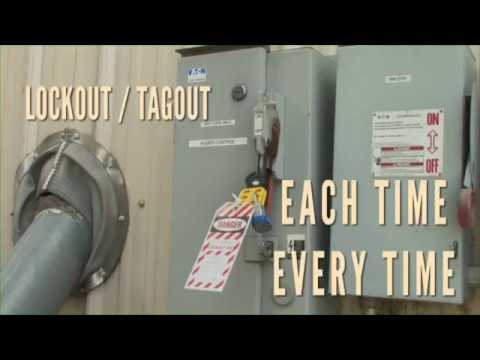
U.S. Agricultural Safety and Health Centers: Control of Hazardous Energy for lockout/tag out.
FAQ
Does unopened original packaging prove a stored motor is ready to install?
No. Original packaging is one item of evidence. Review storage duration, environmental exposure, applicable preservation instructions and required release checks. Keep unknown periods visible and obtain an equipment-specific decision before installation.
Can I use the preservation schedule from another motor manual?
Use it to identify questions, not as automatic authority. Confirm the instructions for the actual motor model, bearing construction, orientation and supplied arrangement. Ask the manufacturer to resolve missing or conflicting requirements in writing.
What if the motor has no complete storage history?
Separate it from unconditionally available stock and assemble the history that can be established. Ask the responsible electrical and mechanical specialists or motor manufacturer what assessment and corrective actions are necessary. Do not invent completed checks or assume a new inspection reconstructs every past condition.