

Heat exchanger thermal shock is the stress associated with a rapid, uneven temperature change through connected metal components. A hot stream contacting a relatively cold exchanger, an abrupt cooling event or a sudden utility change can create local temperature gradients even when the final bulk temperature is within the stated operating range. Prevention depends on the approved startup, shutdown and upset procedures for the actual exchanger. A single universal temperature difference or warm-up rate cannot safely replace that review.
For buyers and maintenance teams, the practical task is to define credible transients, obtain the manufacturer’s operating limits and preserve evidence when an abnormal event occurs. This guide explains the information needed for that discussion. It does not calculate allowable stress or authorize restarting an exchanger after a suspected damaging event.
Distinguish thermal shock from ordinary expansion
All temperature changes can produce dimensional changes. Thermal shock focuses on the severity of nonuniform, rapid changes and the stresses they can generate. The shell, tubes, tubesheets, closures and connected piping do not necessarily warm or cool at the same rate. Geometry, wall thickness, material properties and constraints all matter.
The DOE materials science handbook on thermal shock distinguishes restraint, different materials and uneven temperature change as related stress situations. Use this principle to frame the engineering question, rather than treating a bulk temperature measurement as a direct metal-stress reading.
The existing heat exchanger thermal expansion guide covers accommodation of movement and design interfaces. This article concentrates on operating transients and the evidence needed after an abrupt event. The two subjects are connected but support different decisions.
Identify the events that can create an abrupt change
Start with the real operating sequence. List initial metal and fluid conditions, the order in which each side is brought into service, the source of utilities and what happens if flow is lost. Include planned cleaning and shutdown conditions, not just the normal production duty point.
Ask what happens after a utility interruption. Does control demand remain high while flow is unavailable? Can a standby source enter at a very different temperature? Is there an automatic restart that assumes the exchanger is still at its previous condition? These are review questions for the responsible process and controls team, not instructions to change valve sequences without authorization.
Also examine manual interventions. A hurried attempt to cool hot equipment can introduce a transient outside its intended procedure. Conversely, delaying an approved protective action can create a different hazard. The operating response must balance the complete process risk; “always cool slowly” is too general to serve as an emergency instruction.
Obtain limits for the actual exchanger configuration
Request the equipment data sheet, drawing revision, materials, mechanical design information and the manufacturer’s operating instructions. Confirm whether the unit is fixed tubesheet, floating head or another arrangement. External appearance alone may not resolve internal details or allowable transient conditions.
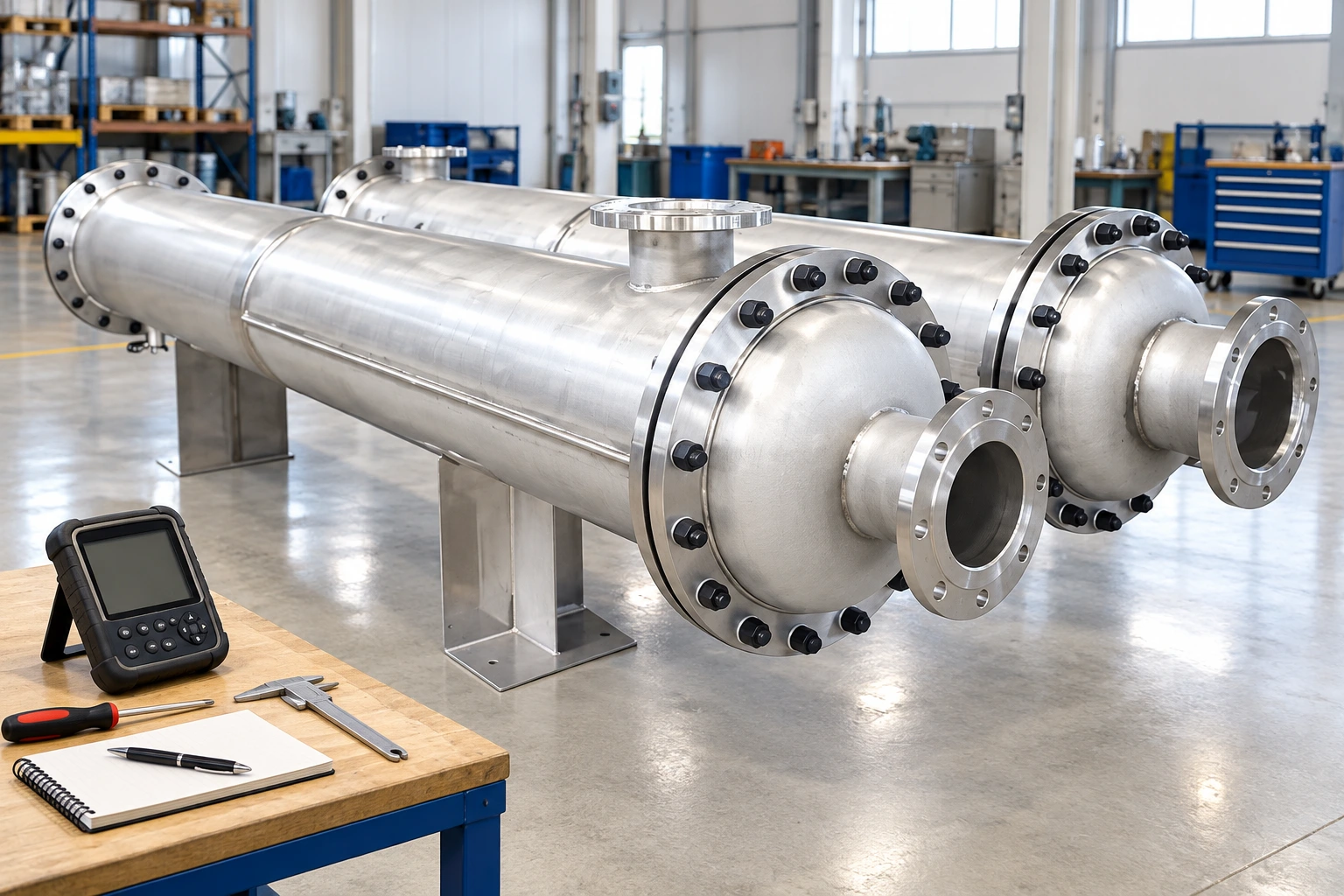
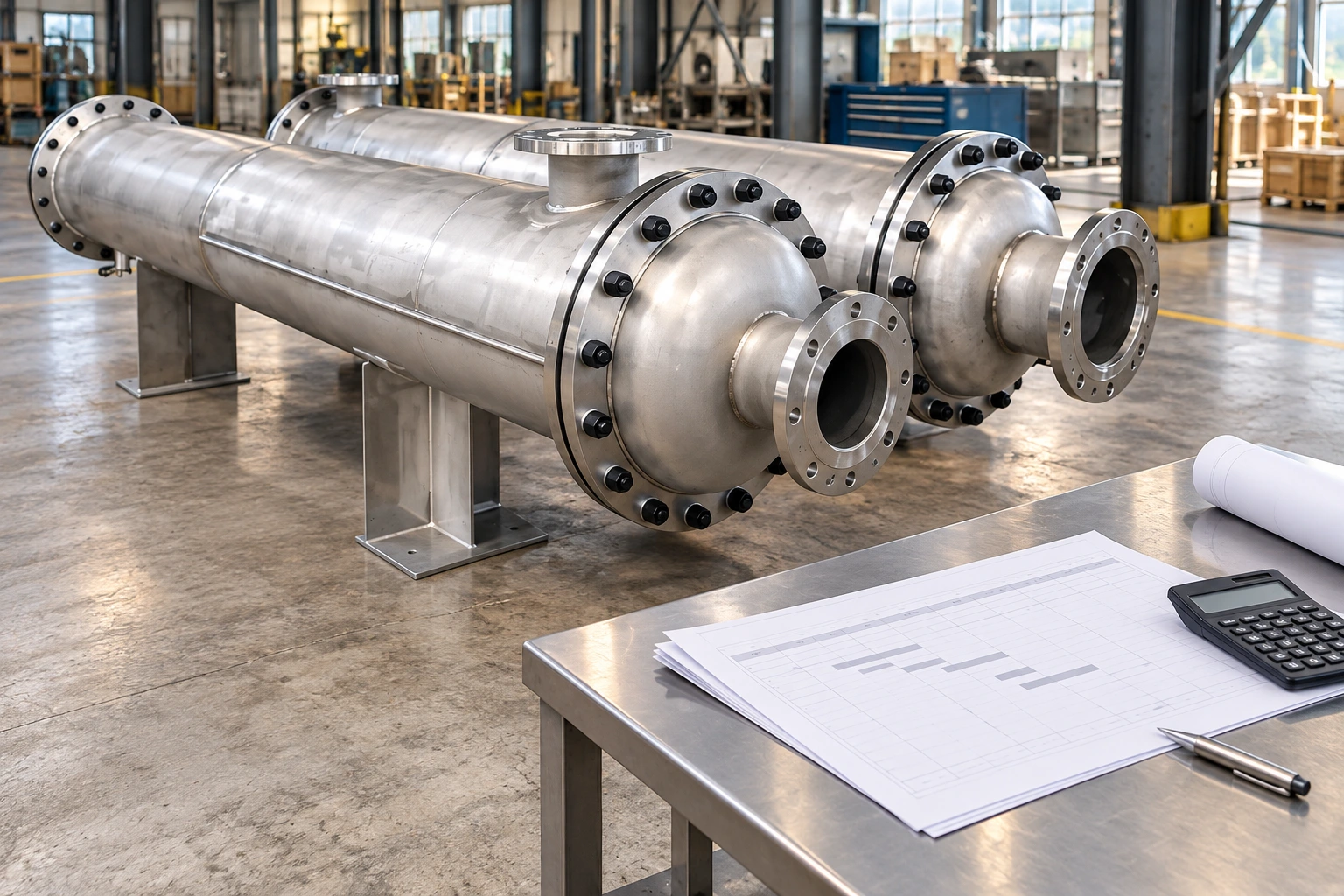
For the pictured fixed tubesheet shell-and-tube exchanger, confirm the delivered configuration and approved duty before specifying startup requirements. The product photograph establishes the exterior reference used in the illustrations. It does not prove a particular expansion allowance, transient rating or inspection outcome.
Ask the supplier how proposed startup and shutdown histories should be assessed. Provide time-dependent conditions on both sides where available. A statement containing only maximum temperature and pressure may omit the rate and sequence that drive a transient review. Include anticipated cycle frequency and credible upset cases as separate inputs.
Build a startup review around measured conditions
Write the startup review as a sequence of verifiable conditions tied to the approved instruction. Identify the required instrument indications, utility availability, flow confirmation and operator hold points. Assign responsibility for confirming readiness rather than leaving it to assumptions between departments.
The appropriate sequence depends on the service and exchanger design. Do not copy a steam-service sequence into a liquid-to-liquid duty or infer that one side must always start first. The supplier and responsible engineer should establish the permitted sequence, ramping approach and response to abnormal conditions for that equipment.
Record actual conditions during commissioning. A procedure can look reasonable on paper yet be difficult to execute because a valve responds abruptly, a flow indication is absent or the control system restores a previous demand unexpectedly. Capture those discrepancies for review before they become routine operating practice.
Preserve an event timeline after an abnormal transient
If an upset occurs, first follow the site’s approved protective response. Once the situation is controlled, preserve control-system trends and operator observations before the information is overwritten. Keep the original time stamps and identify whether different devices use synchronized clocks.
Collect both inlet and outlet temperatures, available flow and pressure signals, valve commands and feedback, pump states, alarms and operator actions. Label gaps honestly. A historian that records infrequently may miss the fastest part of an event, and a smoothed display can hide a short excursion. Do not fill missing points with an assumed straight line and present it as measured history.
A useful event report separates observed facts from interpretation. “Temperature indication changed after the pump restarted” is an observation. “The tubes cracked because of thermal shock” requires supporting examination and engineering analysis. Keeping those statements separate helps avoid an expensive repair based on an unverified cause.
| Review area | Evidence to collect | Question for the responsible reviewer |
|---|---|---|
| Initial condition | Previous duty, shutdown duration and available temperatures | What was the likely starting condition of each side? |
| Utility admission | Valve position history, supply condition and flow evidence | Was the approved transition achieved? |
| Control response | Demand, feedback, alarms and interlock sequence | Did the system act as intended during the disturbance? |
| Mechanical observation | Leakage, movement, noise and inspection findings | What examination is needed before further service? |
| Event frequency | Earlier alarms and similar operating histories | Was this an isolated event or repeated loading? |
| Restart authorization | Engineering review and completed corrective actions | Is the proposed operating envelope adequately supported? |
This table organizes evidence. It does not classify equipment as safe or unsafe from a single symptom.
Treat symptoms as reasons for investigation
Leakage, unusual noise or a performance change after an upset deserves assessment, but none uniquely identifies thermal shock. Hydraulic effects, gasket problems, fouling, corrosion or an unrelated control fault may also be relevant. Review the sequence and examination results together.
The EPRI heat exchanger maintenance guide provides broader maintenance and failure-investigation context. Its nuclear maintenance background and equipment examples require appropriate interpretation; it is not a source of universal acceptance limits for an unrelated industrial exchanger.
If a joint has leaked, preserve the removed-part evidence and assembly history where safe and appropriate. The separate gasket failure analysis checklist helps organize that work. Avoid declaring every gasket leak a transient-induced failure or assuming a new gasket resolves any underlying mechanical concern.
Use temperature trends without overestimating their meaning
A temperature sensor measures its local condition with its own response characteristics. It may not represent the fastest temperature change at a nearby metal surface. Sensor location, installation and logging interval therefore belong in the review. Comparing two displayed temperatures is useful, but it is not a complete thermal-stress analysis.
Consider a fictional commissioning record that samples a utility inlet every minute. A brief change between samples might be absent from that record. The correct conclusion is that the trace cannot resolve that short event, not that the event did not occur. Improving future measurement may be necessary, but missing historical data should remain marked as missing.
Similarly, staying below the nameplate maximum temperature does not automatically demonstrate acceptable transient behavior. The nameplate and operating documentation have distinct purposes. Ask the manufacturer what additional information is required to evaluate gradients, restraints and cyclic loading for the specific case.
Learn the stress principle from a neutral demonstration
Khan Academy’s lesson below explains how restricted expansion creates thermal stress and why abrupt heating or cooling can damage materials. The simplified educational example helps explain the mechanism. It does not provide an allowable warm-up rate or a stress calculation for a shell-and-tube exchanger.
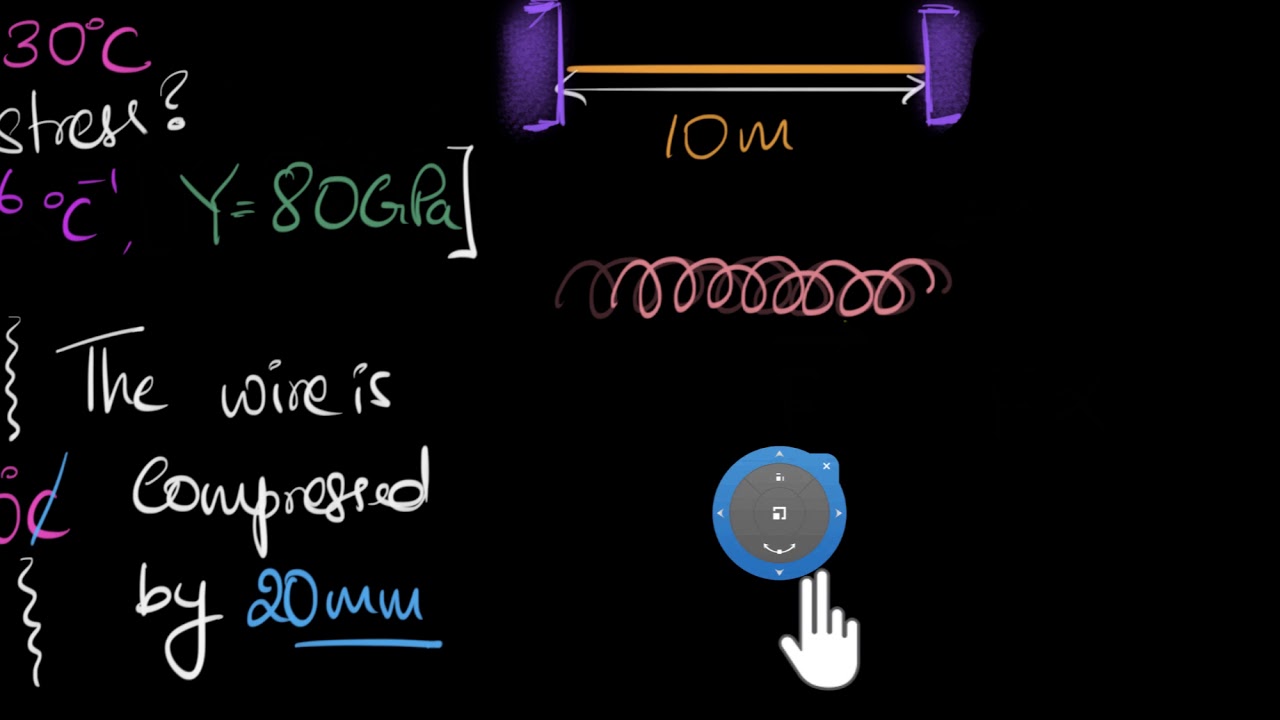
Watch Thermal stress | Class 11 (India) | Physics | Khan Academy by Khan Academy India – English
Keep restart review separate from routine performance monitoring
After a suspected significant event, obtain the examination and engineering review appropriate to the equipment and service. The absence of an obvious exterior leak cannot establish that every pressure boundary and joint remains acceptable. Conversely, the occurrence of a temperature change alone does not establish damage.
Define the evidence needed to close the event: verified operating history where available, examination findings, identified corrective actions and the authorized restart conditions. If a conclusion depends on an assumption, record it. Assign a named owner for unresolved items and avoid converting “inspection requested” into “inspection passed.”
Once the approved restart is complete, compare subsequent operation with the established heat exchanger performance monitoring record. Performance tracking can detect changes in duty or pressure drop, while the mechanical acceptance decision remains supported by its own review. A return to normal outlet temperature is useful evidence, but it does not replace required examination.
Improve the inquiry before the equipment is purchased
Give the supplier the normal duty, startup and shutdown histories, cleaning conditions, utility variability and expected cycling. Include credible interruptions and restart cases. Ask which conditions are covered by the proposed design and what operational restrictions must appear in the handover documentation.
Request practical operating guidance that matches the installed control system. If a permitted ramp depends on measurements unavailable at the plant, resolve that mismatch during design. Clarify whether site piping restraint and support arrangements require further review, since the exchanger does not operate in isolation from its connections.
The next step is a joint review of the proposed duty histories and control sequence, supported by current drawings and equipment documentation. That discussion can define measurable commissioning checks, operator hold points and escalation conditions. It gives a stronger purchase basis than a generic promise of resistance to temperature changes.
Frequently asked questions
Is there one safe temperature difference for all exchangers?
No. Materials, geometry, constraints, starting condition, temperature history and design details influence the assessment. Use the limits and procedures approved for the particular exchanger and service.
Does a normal outlet temperature prove that an upset caused no damage?
No. Normal thermal performance is one observation. The need for mechanical examination and restart authorization depends on the event and equipment assessment, not solely on outlet temperature.
Should a startup procedure be copied from a similar installation?
Use another installation only as a review input. Confirm the actual duty, exchanger configuration, utilities, controls and manufacturer’s instructions before approving a procedure for the new equipment.


