Liquid filter micron rating selection should begin with the particles that must be removed and the efficiency required at that size. A micron is one millionth of a metre, but a number printed on a filter does not by itself define retention performance. Ask whether the rating is nominal or absolute, how it was tested, which challenge material was used, and under what operating conditions. Then check pressure drop, capacity, material compatibility, sealing, and downstream quality. This guide helps industrial buyers specify a defensible retention requirement without assuming that the finest available filter is the best choice or that every filter marked with the same micron number performs identically.
Translate the process problem into a measurable target
Describe the reason for filtration before choosing a number. Protection of a small passage, removal of visible particles, recovery of suspended product, and a validated microbial barrier represent different tasks. Collect a representative feed sample and define an outlet acceptance method. The required result should be measurable by the process team rather than inferred from how clean a liquid looks.
Record the particle-size distribution, concentration, and expected variation. A feed containing occasional large fragments behaves differently from one containing many fine particles, even if total suspended solids are similar. Soft particles can deform, fibres can behave according to orientation, and aggregates can break during pumping. Ask whether the supplier’s test material represents these properties sufficiently for the intended decision.
Mechanical particulate filtration is also different from removing dissolved substances. The EPA water-purification guidance distinguishes microporous filtration from treatment of dissolved solids. Its treatment examples help explain the mechanism, but they do not establish performance for an industrial solvent, syrup, or pharmaceutical process.
Understand what nominal and absolute actually tell you
Nominal ratings generally describe a stated degree of retention under defined conditions rather than a universal sharp cutoff. Absolute ratings are intended to describe a more stringent retention boundary, but the label still needs a test method and performance definition. Suppliers may use different conventions, so comparing only the number can hide substantial differences.
The EPA filtration factsheet explains the importance of distinguishing nominal and absolute ratings in drinking-water filtration. Do not transfer its health recommendations to industrial liquids as an automatic specification. For procurement, request the actual retention curve or challenge-test evidence, together with the rating definition used for the proposed element.
Ask how efficiency changes with particle size, flow, loading, and pressure difference. An element may retain some particles smaller than its stated rating while allowing some larger particles through under its nominal convention. Deformable contaminants and seal bypass further complicate interpretation. A well-defined performance statement is more useful than an unexplained “high precision” claim.
Compare retention evidence rather than identical labels
If a supplier expresses efficiency as captured particles divided by upstream particles at a given size, the arithmetic is straightforward: efficiency = 1 − downstream count / upstream count. The sampling method, particle sizing, concentration, operating condition, and counting uncertainty determine whether that number is useful. Agree those details instead of treating a percentage as independent proof.
For a hypothetical example, 1,000 upstream particles and 10 downstream particles in an equivalent sampled volume would correspond to 99% removal at the measured size. This is an arithmetic illustration, not a test of any YIYI element. Different sample volumes, agglomeration, or changes between samples can invalidate a direct comparison. Request a documented method and suitable interpretation from the responsible testing specialist.
For critical service, define whether the acceptance applies to a fresh element, a loaded element, or the entire operating cycle. A result taken immediately after installation may not describe startup flushing, a pressure surge, or the end of a service run. Document the operating stages that matter and ask the supplier how they are represented in performance evidence.
Choose a practical rating and staging arrangement
Start from the downstream quality requirement and compare candidate elements that can meet it. A coarser upstream stage may protect a finer final stage from large debris, but staging must be justified by feed data, pressure allowance, and service cost. Two arbitrary numbers in series do not guarantee an efficient or reliable system.
Avoid selecting an unnecessarily fine final element to compensate for missing process information. Finer filtration can increase resistance, shorten useful cycles, or create cleaning difficulties. These effects depend on the actual media, construction, fluid, and solids. Evaluate them through relevant curves and trials rather than a universal rule that a particular micron rating always causes a particular pressure drop.
The industrial filter tank sizing guide addresses area, loading, and cycle requirements. Keep the retention decision connected to that hydraulic assessment. A filter can satisfy a laboratory particle-removal criterion while being impractical at production flow, and a hydraulically generous housing can still contain the wrong retention media.
Use a rating comparison checklist
This table supports supplier evaluation. It contains questions rather than invented universal retention or pressure limits. The rating distinction is grounded in the EPA material above and the Irish EPA filtration manual, with industrial acceptance conditions established separately.
| Comparison point | Useful supplier evidence | Warning sign |
|---|---|---|
| Rating definition | Nominal or absolute convention and stated efficiency | Micron number without a definition |
| Challenge method | Particle material, sizing method and test conditions | Unidentified laboratory result |
| Operating range | Validated flow, temperature and pressure conditions | Clean-water result presented as every-liquid capacity |
| Loaded performance | Cycle data and breakthrough criterion | Fresh-element test used as lifetime guarantee |
| Sealing arrangement | Element seat, seals and bypass control | Housing polish offered as retention evidence |
| Compatibility | Media and seal compatibility with fluid and cleaning | Material name with no service review |
| Verification | Representative sample or agreed pilot trial | No practical method to confirm outlet quality |
Remember that the housing and seals are part of performance
The element rating describes only part of the assembled filtration system. Incorrect element length, unsuitable seals, damaged seating surfaces, or an unintended bypass can allow unfiltered liquid to reach the outlet. Confirm that the element and housing are designed to work together and that installation instructions specify the required sealing arrangement.
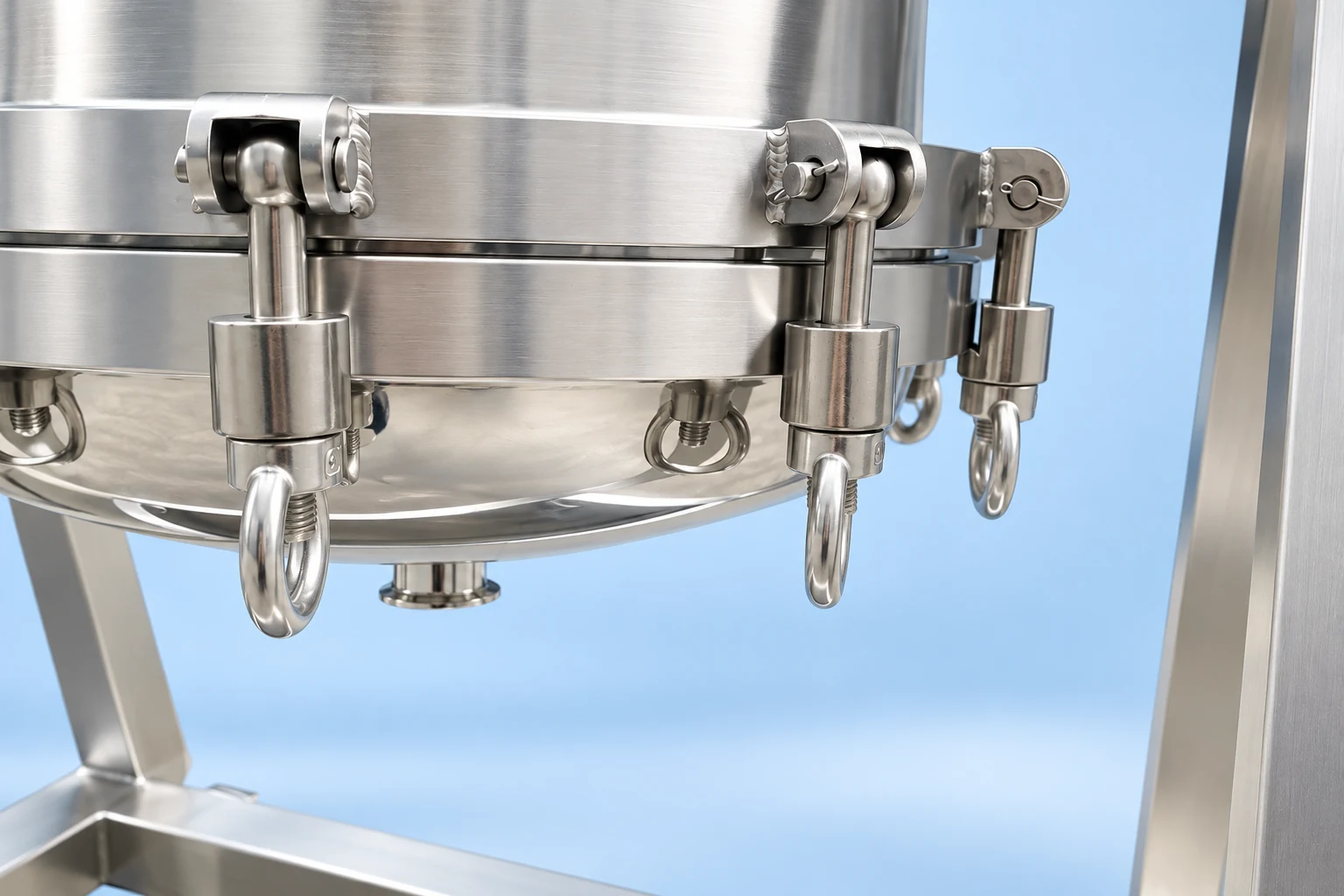
YIYI’s titanium-rod filter housing is relevant to discussions of reusable-element filtration. The product image does not reveal a verified pore distribution or efficiency curve. Request the proposed element specification and assembly drawing before assigning a rating to a supplied configuration. The filter-tank overview provides broader vessel context.
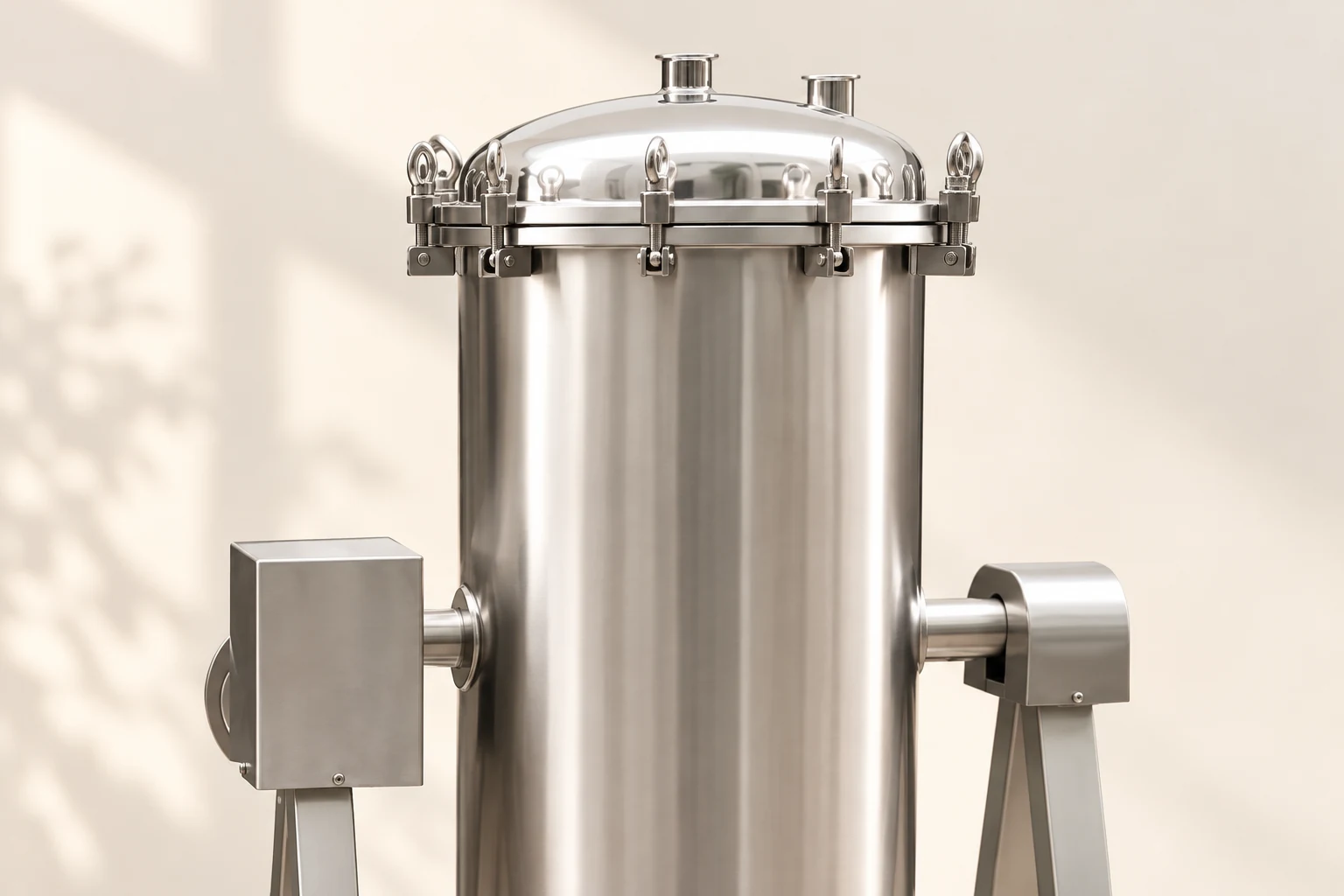
The visible openings in mounting plates are not the microscopic pores that establish a porous element’s filtration rating. Keep that distinction explicit when reviewing photographs or drawings. Neither counting visible openings nor measuring an exterior shell can determine a micron rating. This prevents visually persuasive but technically unsupported product comparisons.
Monitor pressure and outlet quality together
Record differential pressure at defined flow and fluid conditions after commissioning. Use that clean baseline to interpret later changes. Rising resistance may indicate loading, but a change in temperature or production flow can also change the reading. The exchanger pressure-drop guide offers related measurement-boundary principles; filter-media resistance needs its own model.
Low differential pressure is not proof of good retention. It can occur with bypass, a damaged element, or an incorrect installation. Conversely, a high reading does not identify the contaminant or prove that filtration is ineffective. Pair hydraulic monitoring with the outlet-quality check required by the process and act according to the approved operating limits.
Establish the sampling location so that downstream contamination does not distort evaluation of the filter. Take representative samples using a defined method, and record the operating condition at the same time. If results drift, investigate the element, seals, operating history, and feed together. Replacing the element with a finer rating without diagnosing the cause can increase cost without correcting the problem.
Treat microbial and critical product claims separately
A particulate micron label does not automatically establish sterilizing performance or regulatory acceptance. Biological retention depends on the organism, challenge conditions, element integrity, and validated system. For pharmaceutical, food-safety, or drinking-water requirements, involve the responsible quality and process specialists and use the applicable validation framework.
Do not claim that a metal housing, a reusable element, or a fine printed rating eliminates all microorganisms. Cleaning and sanitation also require their own evidence. The food-grade cleaning-validation guide provides related process-quality planning. Its tank scope does not validate a filter as a sterile barrier.
Further learning: what filtration separates
NPTEL’s IIT Madras filtration lecture explains the physical process and its water-treatment context. It helps purchasers understand why media, particle behavior, and loading matter. Apply the principles to a documented industrial duty rather than using the video as a certificate or a numerical rating for the illustrated product.
Watch Lecture 13 Filtration by nptelhrd
Prepare a retention-focused enquiry
Send the supplier the feed sample description, particle-size data, required outlet quality, analytical method, production flow, fluid properties, temperature range, available pressure, material constraints, and cleaning plan. Ask for the rating definition, performance evidence, expected hydraulic behavior, assembly sealing arrangement, and proposed acceptance trial. Identify any critical quality requirement that needs independent validation.
Compare lifecycle consequences as well as purchase price. Useful questions include how often the element must be cleaned or replaced, what confirms recovery after cleaning, and how a failed quality test is investigated. A documented rating with clear operating boundaries is easier to maintain than a finer-looking label with no supporting evidence.
Frequently asked questions
Are two filters marked five microns equivalent?
Not necessarily. They may use different rating conventions, media, challenge tests, and operating conditions. Compare the definition and performance evidence before treating them as substitutes.
Can visible holes in a filter housing establish its micron rating?
No. Mounting and flow-distribution openings are different from the pores or media structure responsible for retention. Obtain the actual element specification and test evidence.
Should I always choose the smallest micron number?
Choose the rating that meets the measured downstream requirement at workable flow and cycle conditions. Unnecessary fine filtration can add resistance and maintenance without useful process benefit.