Nitrogen purging removes air, oxygen, moisture, or process vapor from a reactor before charging, startup, maintenance, or shutdown. The principle is simple, but a safe and repeatable purge is not just “open nitrogen and wait.” The required oxygen target, purge method, pressure limit, vent route, analyzer location, and end point must be defined for the actual vessel and process.
This guide explains how engineers and buyers can specify a reactor nitrogen purging system without assuming one universal oxygen value or purge time. It is written for jacketed batch reactors handling flammable, oxidation-sensitive, moisture-sensitive, or quality-critical products. For vessel construction options, see YIYI’s chemical reactor and broader reactor range.
Why purge a reactor?
A purge changes the composition of the gas space. It may be used to move the atmosphere outside the flammable range, reduce oxidation, limit moisture pickup, clear residual vapor before opening, or establish an inert condition before a sensitive charge. These are different objectives. A system designed only to protect product quality may not satisfy the safety basis for flammable service.
Before selecting hardware, document the purge objective and the controlling hazard. A formal process-hazard review should address normal operation, loss of nitrogen, blocked venting, analyzer failure, reverse flow, human entry, and the effect of agitation or heating. OSHA’s Process Safety Management information is a useful framework for covered processes, while the U.S. Chemical Safety Board’s nitrogen asphyxiation safety bulletin explains why inert gas must be treated as a serious personnel hazard.
Set an oxygen target from the process hazard
There is no defensible universal oxygen target for every reactor. For flammable service, the target should be derived from reliable test data for the actual fuel, temperature, pressure, diluent, and composition, with an engineering margin below the limiting oxygen concentration. For product protection, the target may instead come from oxidation testing, moisture limits, shelf-life studies, or a validated manufacturing procedure.
| Purge objective | Basis for the end point | Important confirmation |
|---|---|---|
| Flammability control | Documented limiting oxygen concentration and approved safety margin | Worst-case fuel, temperature, pressure, and sampling location |
| Oxidation control | Product or reaction study | Oxygen rebound after charging or agitation |
| Moisture control | Allowable water content or dew point | Dryness of nitrogen and vessel surfaces |
| Vapor removal before opening | Approved gas-test criteria | Both oxygen and toxic/flammable vapor measurements |
An oxygen analyzer measures only where its sample reaches. Stratification, dead legs, dip pipes, condensers, and internal coils can trap a different atmosphere. Locate the verification point where it represents the last volume to clear, or use more than one point when the geometry warrants it. Do not infer safe entry from an oxygen result alone; confined-space and toxic-gas procedures still apply.
Choose a purge method
Displacement purging
Displacement introduces nitrogen so it pushes the existing gas toward the vent with limited mixing. It can use less nitrogen in favorable tall, simple vessels, but actual performance depends on density, inlet velocity, temperature, internal obstructions, and inlet/vent positions. It should not be assumed to create an ideal piston front. Trials or concentration measurements are needed when low consumption is important.
Dilution purging
Dilution intentionally mixes nitrogen with the vessel atmosphere and vents the mixture. It is generally easier to predict for complex reactor geometry. The concentration falls exponentially rather than reaching zero after one “vessel volume.” A theoretical estimate is a starting point; real systems need allowance for imperfect mixing, connected equipment, leakage, and analyzer response.
Pressure-cycle purging
Pressure-cycle purging alternately pressurizes the closed vessel with nitrogen and depressurizes it to an approved recovery or vent system. Each cycle reduces the unwanted gas fraction. It can be effective where the reactor is rated for the cycling pressure, but it must remain within the vessel’s allowable pressure and vacuum limits. Never use a convenient plant nitrogen pressure as the vessel set point.
Vacuum-cycle purging
A vacuum-capable reactor can be evacuated and backfilled with nitrogen. This can reduce nitrogen use, but it adds requirements for vacuum rating, condensate handling, vacuum-pump compatibility, emission control, and prevention of air ingress. A vessel designed only for positive pressure must not be evacuated without confirmation.
Specify pressure and flow safely
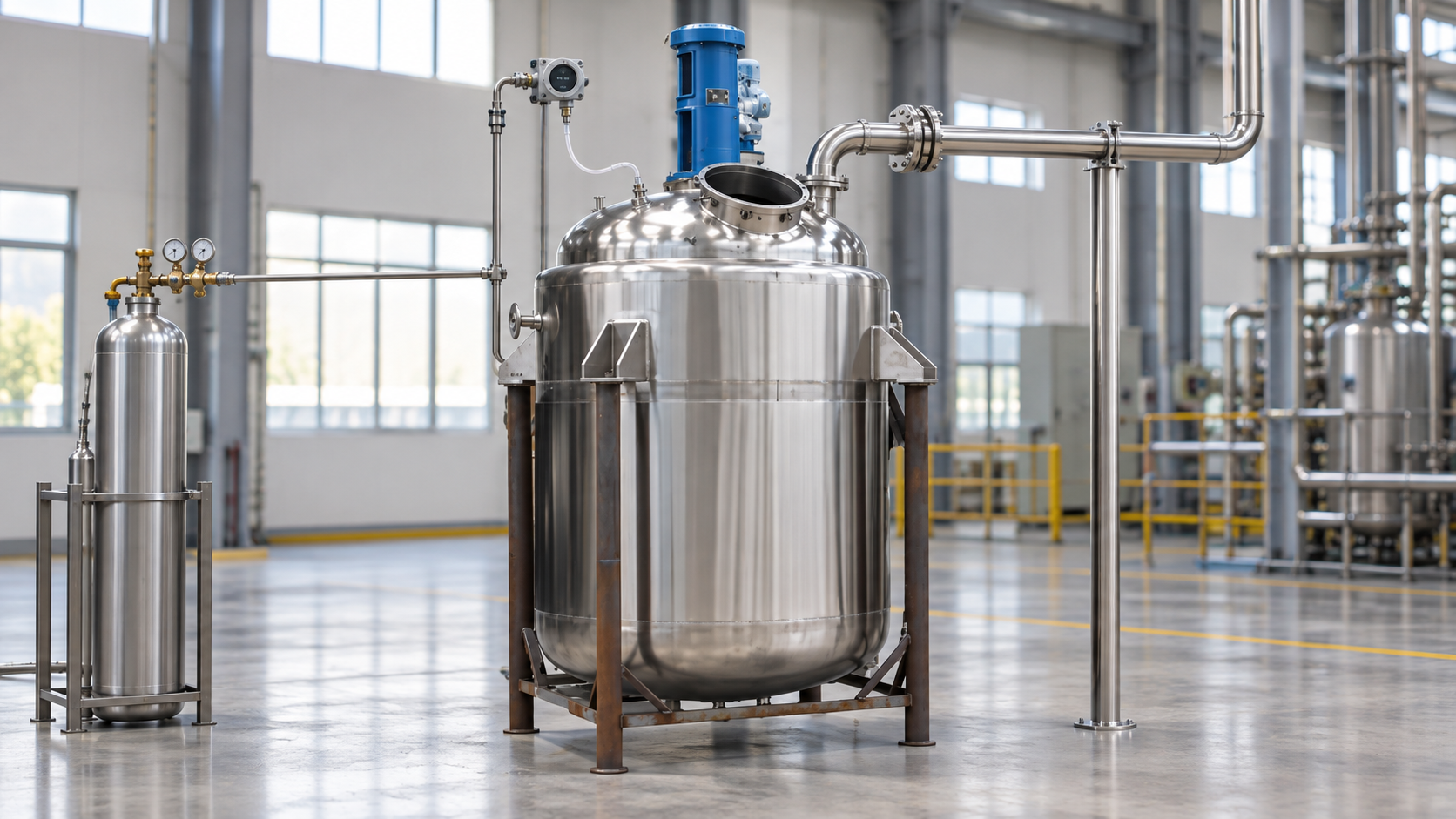
The nitrogen supply commonly has much more pressure capacity than the reactor. Use a dedicated regulator or controlled valve, a pressure indicator, positive isolation, and protection against regulator failure. The vent path must pass the maximum credible inflow without exceeding the allowable working pressure. Where vacuum can occur during cooling or draining, provide appropriate vacuum protection as well.
A rotameter or mass-flow device can make purge delivery repeatable, but a flow reading is not proof of the final oxygen concentration. A check valve or other engineered safeguard may be required to prevent process liquid or vapor from migrating into the nitrogen header. The relief system remains independent protection; see the guide to reactor rupture discs and safety valves.
A practical purge sequence
- Confirm the approved procedure. Identify the objective, oxygen or moisture target, maximum and minimum pressure, nitrogen source, vent destination, and required permits.
- Line up the equipment. Verify valves, blinds, connected condenser, receiver, sample lines, relief devices, and instruments against the piping diagram.
- Remove liquid and isolate hazards. Drain or recover material as the procedure requires. Prevent incompatible material from entering during the purge.
- Establish the vent path first. A blocked or undersized vent can overpressure the reactor as soon as nitrogen enters.
- Start nitrogen at the validated rate. Keep the reactor within its design envelope and avoid static, foaming, or entrainment problems.
- Sample after stabilization. Allow sample tubing and the analyzer to clear. Record location, time, pressure, flow, and result.
- Confirm the end point. Require the specified reading and any hold time or repeated measurement stated in the procedure.
- Move to blanketing or isolation. Purging is a transition operation; ongoing nitrogen blanketing needs its own pressure-control design.
Estimate consumption without treating the estimate as proof
For an ideal well-mixed dilution purge at constant volume, the remaining fraction is often approximated by C/C₀ = e−N, where N is the number of ideal volume changes. Real reactors deviate because internals, nozzles, connected lines, temperature change, and imperfect mixing create hold-up. Pressure-cycle estimates similarly depend on the ratio of absolute pressures, not gauge pressures.
Use calculations to size the supply and set an initial cycle count, then validate the sequence with measurement. Include headspace, vapor piping, condensers, receivers, and any part of the system that must reach the target. If agitation is allowed during purging, define speed and seal conditions; review reactor agitator selection when mixing affects gas dispersion or seal loading.
Instrumentation and interlocks
A robust system may include pressure and vacuum transmitters, nitrogen low-pressure alarm, oxygen analyzer, flow indication, valve-position feedback, and permissives that prevent charging or heating until the purge is complete. The analyzer technology must suit the gas, pressure, temperature, humidity, and contaminants. Specify calibration gas, proof-test interval, sample conditioning, response time, and the safe state on loss of power or signal.
Do not let an automatic sequence hide the physical risk. Operators need a clear display of reactor pressure, purge step, analyzer status, and vent condition. Manual bypasses should be controlled and logged. Alarm limits, relief set points, and operating targets must have enough separation to avoid routine approach to the protection layer.
Ventilation and personnel protection
Nitrogen has no warning odor and can displace oxygen rapidly. Route vents outdoors or to a designed treatment system; do not discharge into an occupied room simply because the gas is nonflammable. Fixed or portable area oxygen monitors, ventilation, access control, training, and rescue planning may be needed. OSHA’s confined-spaces guidance applies whenever entry conditions meet the regulatory definition.
Information to give a reactor supplier
- Process materials, flammability and toxicity data, temperature and pressure range.
- Required purge objective, target, method, cycle time, and verification method.
- Available nitrogen pressure, purity, dew point, and peak flow.
- Reactor volume, working volume, headspace, internals, and connected vapor equipment.
- Required nozzle sizes, sample location, analyzer interface, vent destination, and emission controls.
- Hazardous-area classification, control philosophy, alarms, interlocks, relief and vacuum protection.
YIYI can configure nozzle orientation, controls, jackets, agitation, seals, and instrument connections around a documented process requirement. A purge concept must still be reviewed and approved by the owner’s process-safety team for the installed system.
Frequently asked questions
What oxygen level should a reactor reach after nitrogen purging?
Use the approved process basis, not a generic percentage. Flammable service requires data for the actual mixture and operating conditions plus an engineering margin; quality-driven purging requires a validated product limit.
How many nitrogen volume changes are needed?
The number depends on the purge method, starting and target concentrations, pressure ratio, mixing, connected volume, and leakage. Calculate an initial requirement, then verify the end point with a suitable analyzer.
Can the reactor vent nitrogen into the production room?
That is generally unsafe without a specific ventilation and exposure assessment. Nitrogen can create an oxygen-deficient atmosphere, so vents are normally routed to a designed outdoor or treatment location.