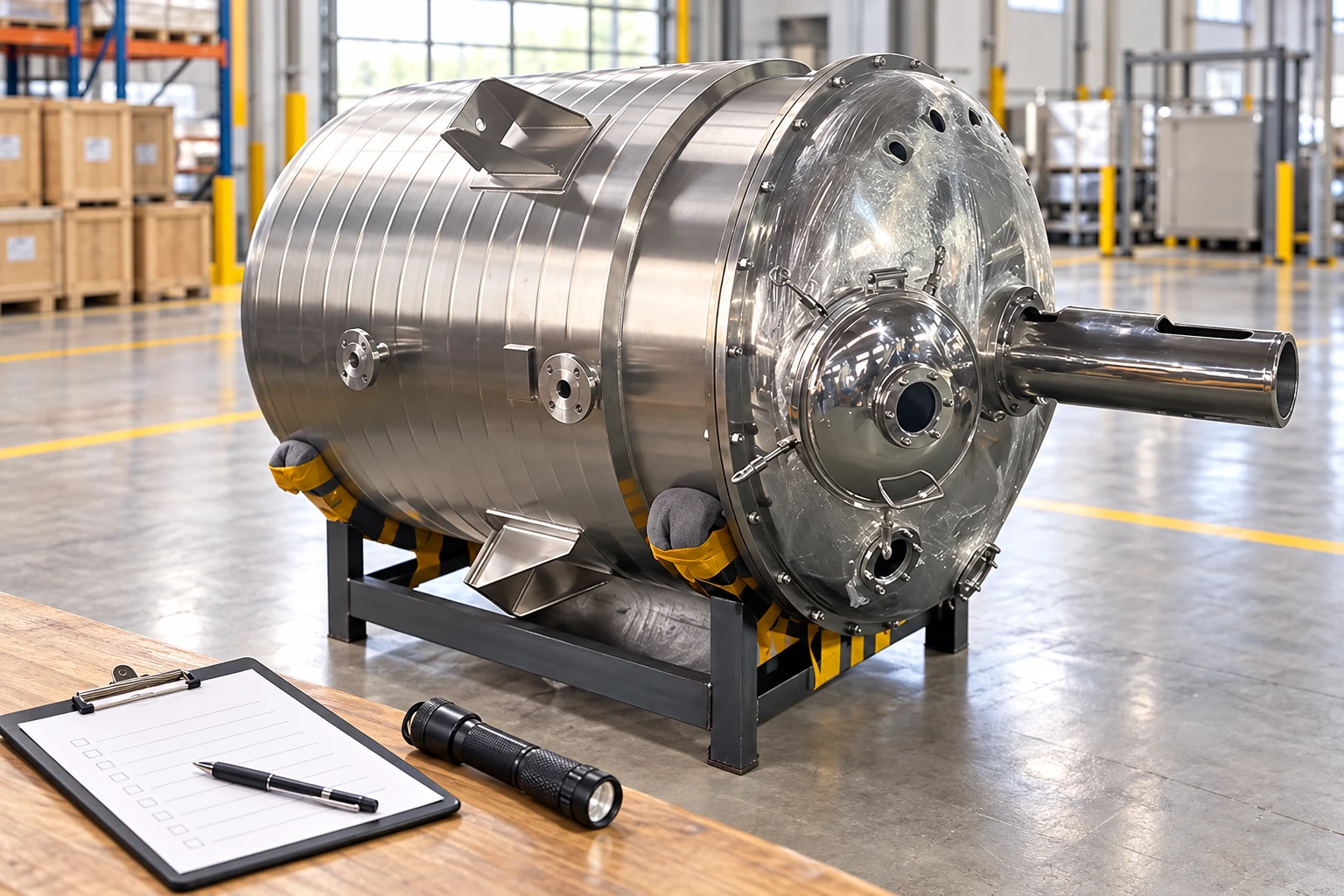
An equipment receiving inspection checklist for a mixing tank should establish what arrived, whether it matches the purchase agreement and whether transport or storage has introduced a condition requiring investigation. It should not quietly become permission to lift, energize, pressurize or operate an unfamiliar vessel. Begin with a documented receipt, identify the equipment and accessories, preserve packaging and damage evidence, and reconcile the supplied documents before accepting the installation handover. This guide focuses on the buyer’s delivery inspection. Factory acceptance testing, weld qualification and process commissioning remain separate activities with their own evidence and responsible personnel.
Define the receipt boundary before the truck arrives
Identify who coordinates delivery, who can record a discrepancy and who has authority to release equipment for installation. Arrange a suitable receiving area and agree how the consignment will be identified. Unloading and lifting require an approved plan for the actual load; a delivery checklist does not replace competent handling arrangements or establish the capacity of an attachment point.
Have the purchase order, agreed specification, packing list and applicable drawings available in their approved versions. Decide how the team will record findings and communicate them to the supplier and carrier. This preparation reduces the chance that a missing accessory is discovered only after packaging is discarded or that a visible transport concern becomes difficult to distinguish from later site damage.
Identify the delivered equipment and its scope
Reconcile the equipment identification with the commercial and technical records. Confirm the number of vessels, drives, panels and separately packed components that the agreed scope actually includes. Do not infer a supplied instrument package from a website illustration or assume that every item pictured during quotation belongs to the final order.
Record the identification visible on the actual equipment and packaging without inventing missing information. If a tag is absent, illegible or inconsistent, raise a discrepancy for resolution. Equipment that looks similar can still have different intended duties or interfaces. Preserve the link between each physical item and its documentation so that installation personnel do not receive an unidentified component with an apparently complete but unrelated document folder.
Photograph condition before changing the evidence
Where it can be done safely, document the consignment as received, including packaging condition, visible restraint arrangements and relevant equipment identification. Record the location and nature of a concern with both an overview and a closer image. A close photograph without context may make it difficult to identify the affected part later.
Do not clean, straighten, repaint or disassemble a questionable area merely to improve its appearance before documenting it. Preserve the observation and ask the responsible parties how it should be investigated. A mark on protective wrapping is not automatically equipment damage, while an apparently small deformation near a connection or support should not be dismissed solely because the vessel stands upright. Describe observations rather than making an unsupported structural judgement.

Inspect accessible external features systematically
Use the agreed inspection scope to review the exterior, visible connections, supports, guards and supplied attachments. Look for missing protection, unexpected movement, loose separately packed parts and visible differences from the approved arrangement. Identify access limitations instead of marking an unseen area as satisfactory.
An external visual check cannot establish internal cleanliness, weld quality, material grade or a pressure rating. If transport may have affected a critical area, a qualified assessment may be required. Do not introduce an improvised leak or pressure test during receiving. Record what the receiving inspection actually observed and which questions require separate evidence. This distinction protects both the buyer and supplier from an acceptance record that claims more than the inspection could demonstrate.
Reconcile dimensions and interfaces against the right drawing
Check the agreed installation interfaces using the applicable drawing and a suitable measurement method. These may include an overall envelope, relevant support positions or connection locations. Confirm what the dimension refers to and whether transport fittings or removable packaging affect the measurement. Do not compare an as-delivered configuration with a preliminary quotation sketch without identifying the revision difference.
Эт NIST guidance on evaluating measurement uncertainty provides a framework for considering measurement limitations. It does not supply a tolerance for your tank. Apply the contract’s actual acceptance basis and an appropriate method. An approximate tape measurement may reveal a major mismatch, but it should not silently become a precision inspection of a critical interface for which a different method is required.
| Receiving check | Доказательства для сохранения | What the check does not establish |
|---|---|---|
| Идентификация оборудования | Physical identification linked to the purchase record | Suitability for every possible process duty |
| Quantity and accessories | Agreed packing list and item-by-item receipt | Inclusion of optional items not ordered |
| External condition | Located photographs and written observations | Hidden structural or internal-condition approval |
| Installation interfaces | Drawing revision, method and measured features | A new tolerance invented after delivery |
| Document completeness | A list of received and missing documents | Correctness of an unrelated or superseded document |
| Release for installation | Named decision and closed or controlled discrepancies | Completion of commissioning or process qualification |
The table is an inspection-planning aid. It does not replace the purchase agreement or an equipment-specific handling and installation procedure.
Review the document package by function
Identify which records are required for installation, operation, maintenance and any applicable conformity or inspection obligations. Reconcile document identities and revisions with the delivered equipment. A large folder is not necessarily a complete handover; a missing instruction for one supplied component may matter more than several unrelated brochures.
Use a controlled missing-document list. State who will provide the item, how its relevance will be checked and whether the absence affects the next activity. Do not describe a certificate as proof of an equipment property that it does not cover. Where a document’s scope or authenticity is unclear, ask the supplier for clarification and preserve that question in the record. Resolve the actual gap rather than adding an assumed statement to make the checklist appear complete.
Keep pre-use safety inspection separate from delivery acceptance
Receiving acceptance and readiness for use are different decisions. Equipment may arrive in satisfactory shipping condition while still requiring installation checks, guarding review, utility verification and other approved work before operation. Clearly state which decision the receipt record supports.
Эт UK HSE guidance on inspection of work equipment discusses inspection where installation or deterioration can affect safety. Its legal context is specific to the relevant jurisdiction; it is not an automatic checklist for every international delivery. The useful distinction here is that inspection should address the risks and circumstances of the actual equipment. Do not use a signed delivery receipt as a substitute for the competent pre-use assessment required by the installation and applicable duties.

Record discrepancies without forcing an immediate verdict
Use clear descriptions such as a missing listed component, a visible deformation at an identified location or a mismatch between a supplied drawing and a connection. Attach the supporting evidence and identify which activity may be affected. Avoid vague statements such as tank defective when the available observation supports only a narrower concern.
Agree how the discrepancy will be reviewed. A supplier response may request more photographs, a controlled measurement or a specialist inspection. Preserve the original record and subsequent findings. If an approved repair is proposed, retain its scope, authorization and verification evidence. Do not erase the receiving concern after a correction; the history helps establish what was found, what changed and why the equipment was ultimately released.
Protect the equipment while questions are resolved
Define an appropriate storage and preservation arrangement from the supplier’s instructions and the site conditions. Keep supplied components identified and protected against avoidable contamination, damage or loss. Record any temporary arrangement that could affect later inspection or installation. A vessel left outside its intended storage conditions can develop a new problem that was not present at receipt.
Do not improvise internal coatings, preservation chemicals or cleaning agents without confirming compatibility and approval. Keep openings protected through the appropriate supplied or specified means. If packaging is removed for inspection, document how protection is restored. The receiving record should make it possible to distinguish transport condition from later site handling and storage, rather than treating every later observation as evidence of an original delivery defect.
Close the receipt with a traceable handover
The final receiving record should identify the items inspected, the documents used, the observations, unresolved limitations and the person authorizing the next step. State whether release is complete or conditional and make any remaining restrictions visible to installation personnel. A conditional release should have a defined meaning, rather than allowing an unresolved issue to disappear into an ambiguous signature.
Retain the photographs, packing reconciliation, discrepancy correspondence and closure evidence together. Link them to the actual equipment identity. This creates a useful starting point for installation and maintenance without claiming that the process has already been commissioned. If the project later changes the intended duty, review suitability through the appropriate engineering process instead of assuming receiving acceptance covers the new requirement.
Include receiving requirements in a tank enquiry
Для YIYI mixing tank, identify the agreed delivery scope, documentation, protected interfaces and receiving evidence expected by the buyer. Ask how separately packed accessories and transport protection will be identified. The reference photograph shows an equipment family; it does not establish the content of a particular shipment or an approved lifting arrangement.
Используйте mixing-tank factory acceptance checklist for checks performed before shipment, the weld-inspection guide for a distinct fabrication-quality question and the stainless-tank passivation guide when specifying the required surface-treatment evidence. A receiving inspection connects that documentation to the physical delivery without replacing any of those separate activities.
Educational reference: work-equipment inspection
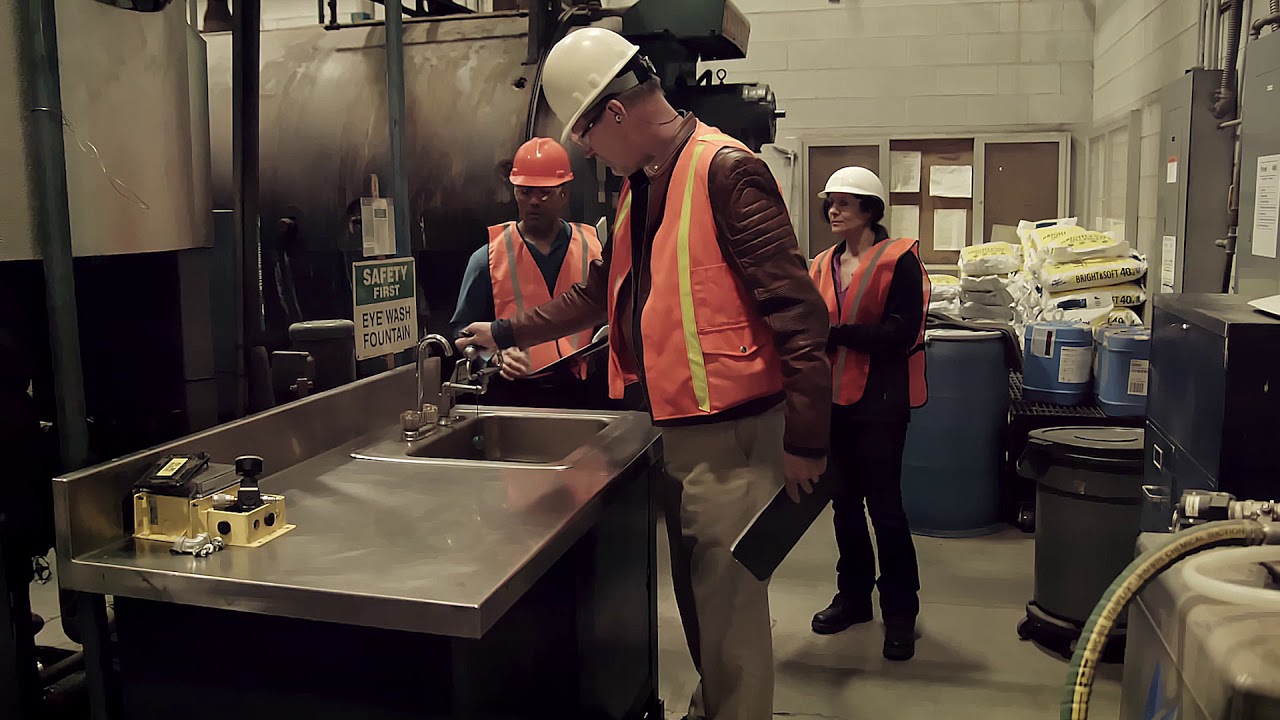
The educational reference explains inspection principles. It is not a lifting instruction, a conformity certificate or permission to operate the illustrated equipment.
Часто задаваемые вопросы
Does signing the delivery note prove the tank is ready to run?
No. Define what the receipt signature means under the agreement. Installation, pre-use safety checks and commissioning require their own approved activities and records.
Should visible transport damage be repaired immediately?
First preserve evidence and obtain the appropriate assessment and authorization. An improvised correction can hide the original condition and introduce another problem.
Can a website photograph substitute for an approved delivery drawing?
No. Use the actual agreed scope and controlled equipment documentation. A photograph does not establish dimensions, ratings, supplied accessories or the intended installation interfaces.