Brewery fermenter jacket zones should match the vessel’s working-fill range, heat load, and utility system. Splitting a jacket into zones can provide flexibility, but it does not guarantee better temperature control. Buyers need to know which zones are wetted at each fill level, how coolant flow is balanced, where product temperature is measured, and how the system behaves during cooling and cleaning. Specify an operating envelope and acceptance test before deciding how many zones to purchase; the correct arrangement depends on the actual vessel and process.
Start with working volume and wetted surface
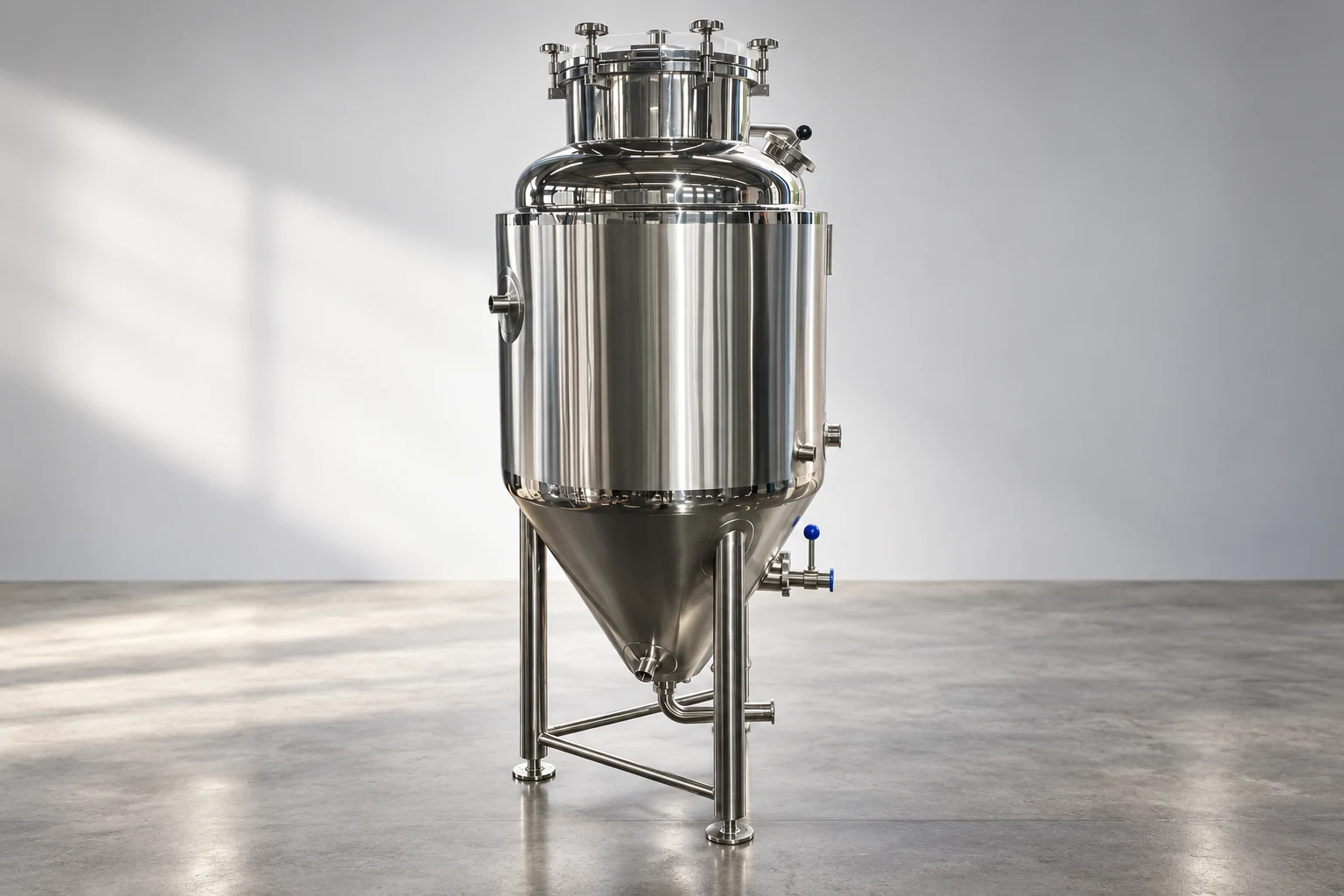
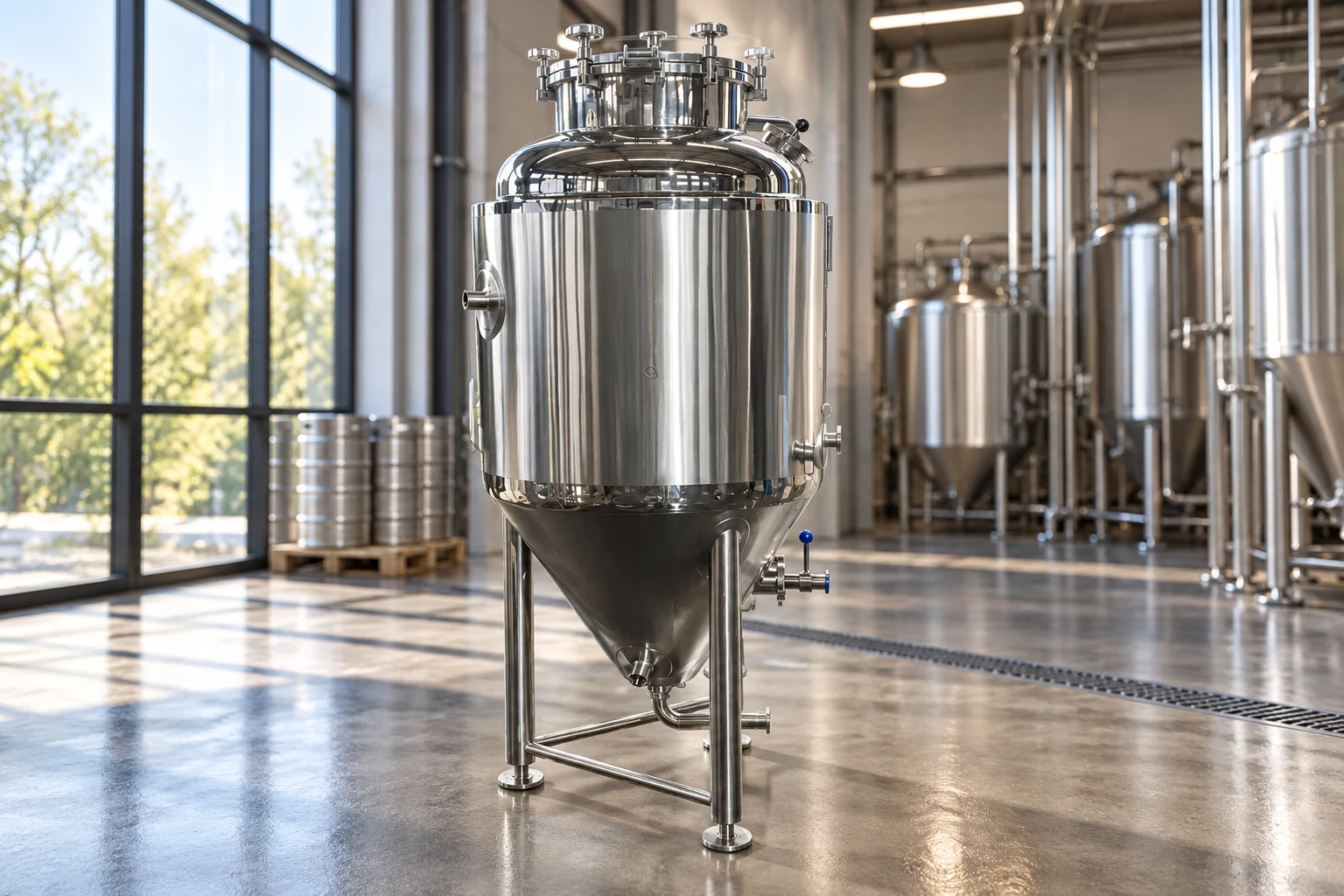
The heat-transfer area available to the liquid changes with fill level. A jacket section above the liquid surface does not transfer heat to the bulk liquid in the same way as a wetted section. Ask for a drawing that shows the intended minimum and maximum working levels against each jacket zone. The drawing should identify the shell and cone zones separately where those features exist. Do not infer hidden jacket construction from a product photograph.
Describe the expected production schedule, including partial batches and future batch sizes. A design selected solely for the maximum fill may perform differently during a smaller batch. Include the need to handle empty-vessel cleaning or other nonproduction phases, but distinguish those requirements from fermentation cooling. A zone map is useful only when it connects to documented operating conditions rather than a general promise of flexibility.
Define the heat load before choosing zone count
Fermentation cooling must accommodate the relevant process heat and the specified temperature program. Inputs can include metabolic heat, agitation, changing feed conditions, and external heat gain. Pull-down after filling may create a different duty from holding a fermenting batch at temperature. These duties should be stated separately, because they can drive different utility and control requirements. Do not substitute vessel volume alone for a thermal-duty calculation.
Эт fermenter cooling-load guide explains the complementary calculation questions. For procurement, ask the supplier to show the assumptions behind the selected area and coolant flow. The calculation should identify the controlling phase and any limitations at reduced fill. Product-specific capacity claims require verified engineering; an educational example is not proof that a particular jacket will meet a buyer’s duty.
Compare shared and independently controlled zones
A common utility circuit can simplify operation, while separately valved zones allow the design to address different liquid levels or process stages. Independent control can introduce more valves, instruments, logic, and maintenance tasks. The benefit should be demonstrated against a real need. Two poorly balanced circuits are not necessarily better than one correctly engineered circuit. Ask how zone behavior is coordinated so that valves do not repeatedly compete for limited utility flow.
The table is a specification-review aid rather than a recommendation for a particular vessel. Actual zone construction, pressures, flows, and temperature limits must be confirmed by the manufacturer.
| Operating condition | Zone question | Доказательства для запроса |
|---|---|---|
| Minimum working fill | Which jacket area is wetted? | Fill-level overlay on zone drawing |
| Peak fermentation heat | Can active zones remove the duty? | Thermal calculation with stated utilities |
| Rapid cooling phase | What limits cooling rate? | Agreed performance test and product-temperature record |
| Several vessels cooling together | Is utility flow available? | Simultaneous-demand and distribution review |
| One zone unavailable | What operating limits apply? | Approved degraded-operation procedure |
| Cleaning or thermal treatment | Are materials and zones suitable? | Confirmed limits and operating sequence |
Review coolant supply and return together
Specify coolant type, concentration where relevant, supply-temperature range, available pressure, return conditions, and flow measurement. These inputs influence the performance of the jacket circuit. A valve size and a nominal supply temperature do not establish available flow under simultaneous plant demand. The distribution system must be able to deliver the conditions used in the vessel’s calculation, including at the least favorable location.
Ask whether zones are connected in series, in parallel, or through another approved arrangement. Each configuration has implications for distribution, temperature rise, and pressure losses. Review isolation, draining, venting, and service access with the site installer. Identify which party supplies balancing equipment and who verifies settings during commissioning. Do not independently rearrange jacket connections without confirming the manufacturer’s approved routing and pressure limits.
Position the product-temperature sensor for the real process
The primary control sensor should measure a representative product condition throughout the permitted working-fill range. A location suitable at full fill may be exposed during a partial batch. A sensor near a strongly cooled wall can also behave differently from the bulk product. Its position, insertion, response, and cleaning requirements should therefore be reviewed with the vessel geometry and process circulation. More sensors do not eliminate the need for a sensible measurement strategy.
Commissioning measurements at several locations can help assess temperature differences and the relationship between the control point and the product. Define how temporary instruments are installed and checked without introducing contamination. Distinguish a utility return-temperature measurement from a product-temperature measurement. Both may be useful, but they answer different questions. Acceptance should focus on the required product conditions, not simply a stable coolant display.
Coordinate zone logic with batch level
If zone enablement depends on batch volume, the operating logic needs a dependable source of level information. Decide whether the system uses a measured level, a verified recipe volume, or an operator-controlled sequence. Identify how the logic handles missing or inconsistent inputs. An automatically enabled upper zone should not be assumed to be useful merely because it is present on the vessel. The consequence of cooling unwetted sections should be reviewed for the actual process.
Document startup, batch adjustment, cleaning, shutdown, and restart behavior. The operator interface should distinguish active, available, isolated, and faulted zones. Agree on alarms that have actionable responses rather than adding messages with no defined owner. Test the intended logic with approved simulated inputs before production. Retain a clear record of configuration changes so later adjustments do not undermine the agreed control strategy.
Treat vessel and jacket pressure limits separately
The product chamber and the utility jacket may have different allowable pressures and temperatures. Their permitted combinations must come from verified manufacturer documentation. Cooling, heating, draining, and cleaning can create conditions that differ from normal fermentation. Do not assume that a pressure-rated product vessel makes every jacket connection suitable for the available site utility. Review protection and isolation on the utility side as part of the installation.
HSE’s pressure-system introduction gives general context for pressure hazards. It is not a substitute for the rules of the destination country or the manufacturer’s instructions. Ask the supplier to identify the operating limits for both chambers, the protective arrangements within the supply scope, and any site requirements. Confirm how operators recognize trapped pressure before maintenance or disconnecting a utility line.
Verify cooling performance with a defined test
An acceptance test should specify the fluid, fill volume, initial temperature, utility conditions, ambient conditions, mixing state where relevant, and temperature-measurement locations. A water test can establish useful equipment information, but it does not automatically reproduce a fermenting broth’s properties or heat generation. State which test results are directly demonstrated and which production outcomes remain subject to process verification. This prevents a quick factory demonstration from becoming an unsupported performance guarantee.
For zoned equipment, record active-zone combinations, valve behavior, coolant supply and return temperatures, available flow, and product-temperature trends. Examine partial-fill cases where they matter commercially. Investigate unstable control and utility limitations before release. Have the acceptance criteria approved before testing so the parties do not reinterpret an ambiguous result after delivery. Include unresolved limitations in the handover documents rather than hiding them in commissioning notes.
Diagnose temperature problems systematically
When the temperature target is missed, compare the actual process and utility conditions with the design basis. Check active-zone status, fill level, available flow, supply temperature, measurement reliability, and any change in production duty. A larger valve or colder coolant is not automatically the correct response. The problem may lie in utility distribution or sensor representation rather than insufficient jacket area. Use recorded evidence to separate these possibilities.
Persistent oscillation deserves a separate control review. Examine response delays, valve operation, zone coordination, and the configured control parameters using approved procedures. Do not repeatedly alter several settings at once without recording the result. The fermenter scale-up guide places this issue in the broader context of mixing, aeration, and changing production conditions. Thermal control must remain connected to those process requirements.
Send suppliers a practical jacket specification
An enquiry for a fermentation tank should include working-fill range, batch schedule, heat-duty basis, target temperature program, coolant conditions, site pressure limits, sensor requirements, and intended cleaning phases. Request zone drawings, connection details, thermal assumptions, control narrative, maintenance access, and an acceptance procedure. Ask what happens if plant utilities fall outside the quoted conditions and whether the proposed guarantee covers partial batches.
Review the general fermenter operating guide и brewery fermenter sizing guide alongside the jacket proposal. These documents address vessel operation and capacity rather than jacket zoning, so they help build a complete purchase brief without duplicating this page’s main decision. Confirm the exact supplied construction in approved drawings before ordering.
Educational video and references
NPTEL IIT Madras’s heat-transfer lecture explains how biological and mechanical heat contributions enter the bioreactor thermal balance. It helps establish the duty that jacket zoning must serve; it does not prescribe a brewery’s zone arrangement.

Watch mod06lec28 – Heat Transfer Operations in Bioreactors – Part 1 by NPTEL-NOC IITM
For fundamentals, consult Ресурсы компании LearnChemE по передаче тепла и NPTEL bioreactor design course. Final equipment limits and acceptance conditions remain specific to the approved vessel and installation.
Часто задаваемые вопросы
Are more jacket zones always better?
No. Zone count should solve a defined fill-level, duty, or operational requirement. Added controls and pipework also introduce distribution and maintenance responsibilities.
Can the cone zone handle every partial batch?
That must be demonstrated for the actual working volume, wetted area, duty, and utilities. The presence of a cone jacket alone does not establish sufficient cooling capacity.
Is coolant temperature enough to judge performance?
No. Available flow, product heat load, temperature driving force, active area, and measurement quality also matter. Check actual product-temperature performance under defined conditions.