A slurry mixing tank restart should begin with an assessment of the settled bed, fluid condition, and permitted drive load. After a long stop, the agitator may face a compacted solids layer rather than the flowing suspension assumed during normal operation. Starting at the previous speed can overload a shaft, gearbox, coupling, or motor before useful circulation develops. The correct restart sequence depends on the actual slurry and equipment. Establish it with the supplier and process team, verify it under controlled conditions, and define when the batch must be recovered by another approved method.
Treat a settled batch as a different operating case
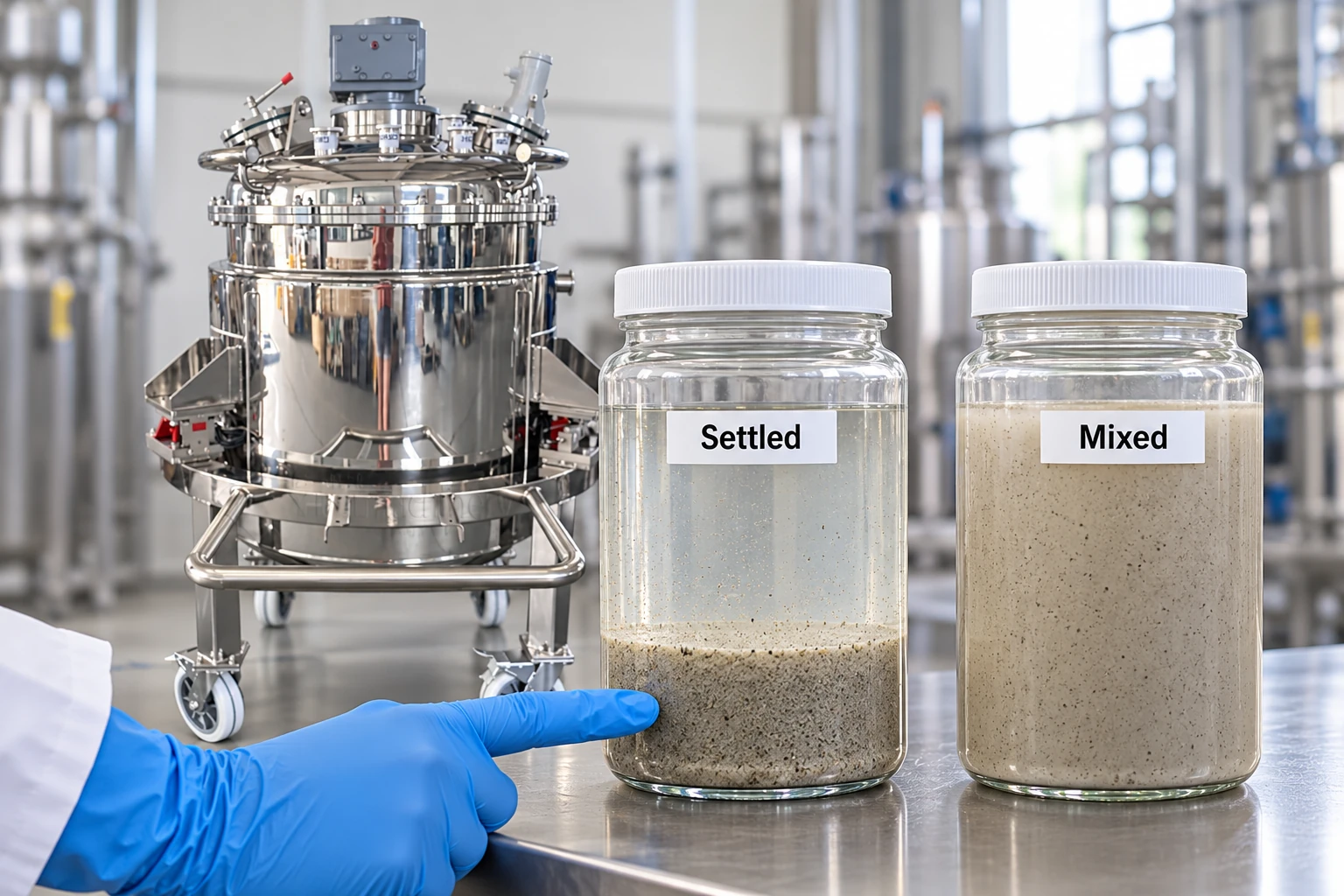
A slurry can change while the mixer is stopped. Particles settle, liquid separates, temperature falls, and chemical or biological changes can alter viscosity. Fine solids may compact or develop a yield stress. A liquid surface that looks normal gives little information about the material surrounding a lower impeller. Record the stop duration, temperature history, composition, and any evidence of separation.
The normal slurry impeller selection guide addresses suspension during operation. Restarting a settled batch adds questions about breakaway load and recovery sequence. Ask whether the installed equipment was selected for off-bottom suspension only, routine settling and restart, or a specific emergency recovery case. These are different duties and should not be assumed from the motor power alone.
Establish a safe inspection and isolation boundary
Do not probe the settled material through an open hatch while the agitator can move. Isolate hazardous energy before intrusive inspection or maintenance, following the plant procedure and applicable requirements. The Petunjuk OSHA tentang energi berbahaya explains the general need to control unexpected energization. Isolation must also address pressure, temperature, chemicals, and connected transfer equipment.
Confined-space entry, if considered at all, requires a separate competent assessment and entry arrangements. A manway is not permission to enter. Prefer external observations, designed sampling points, archived process measurements, and approved non-entry methods. Recovery tools and temporary pumps must be assessed for chemical compatibility, mechanical risks, and the consequences of disturbing the bed.
Collect the minimum useful batch evidence
Confirm the intended solids concentration and the actual mass balance. A partially discharged batch can leave a higher-solids heel than the original recipe. Identify particle size distribution, density, abrasive behavior, and whether the solids dissolve, swell, flocculate, or react. These properties help explain whether settling remains reversible or has created a different material.
Temperature matters because the continuous phase may thicken during cooling. Do not apply heat automatically: a jacket can create a hot wall while the stagnant bulk remains cold, and some products degrade or react when heated. Define any warm-up step with temperature limits, circulation requirements, and a response if the expected temperature distribution does not develop.
Review the entire load path
The drive’s electrical protection does not independently prove that every mechanical component is protected. Review motor and gearbox limits, coupling rating, shaft loading, impeller attachment, bearing arrangement, and any approved operating range. A variable-speed drive changes available speed and torque characteristics; it does not make a mechanically unsuitable agitator capable of breaking a compacted bed.
Request the supplier’s permitted starting method. Some systems require a specific low-speed sequence, some cannot start buried in settled solids, and others need an independently engineered recovery method. Do not repeatedly jog a stalled drive without authorization. Repeated attempts can increase heat and mechanical fatigue while providing little useful information about why the batch is not moving.
| Observation before or during restart | Penjelasan yang mungkin terjadi | Required response |
|---|---|---|
| High load with little visible bulk motion | Compacted bed or excessive viscosity | Stop within approved limits; assess recovery route |
| Local movement but persistent bottom deposit | Inadequate bed mobilization | Verify sample evidence and circulation before release |
| Rising temperature near wall only | Poor bulk heat transfer | Review heating method and product temperature limits |
| Unexpected noise or vibration | Mechanical damage, interference or unstable loading | Stop and inspect under isolation |
| Outlet initially gives thin liquid | Settled solids remain behind | Check batch composition and discharge uniformity |
| Load changes after a short circulation period | Material is redistributing or properties are changing | Compare with the approved trend and sample results |
The table lists diagnostic possibilities, not a permission to continue operating. Set actual stop criteria from the equipment documentation and site assessment. Units and measurement definitions should follow consistent SI conventions.
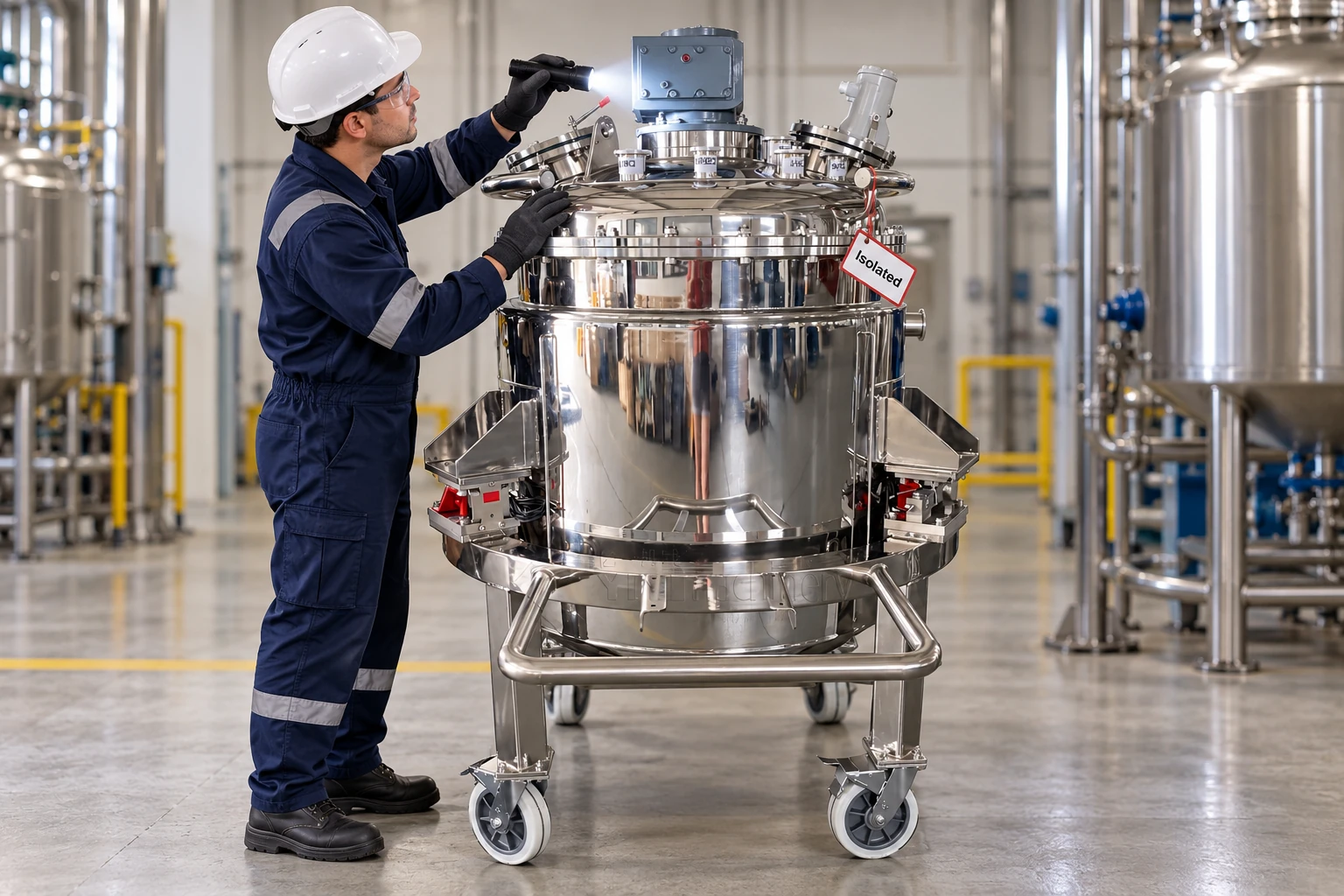
Build a controlled restart sequence
A written sequence should define prerequisites, responsible personnel, permitted settings, measurement frequency, stop criteria, and release conditions. State which valves must be open or closed, whether transfer is permitted, and whether heating or dilution is allowed. Confirm that the level is within the verified operating range before starting the mixer.
If the approved method uses dilution, calculate how much compatible liquid can be added without exceeding the batch specification or tank capacity. Adding liquid changes product concentration and downstream processing requirements. It may also displace material or create heat. Do not treat dilution as a universal fix or use an unspecified solvent simply because it reduces viscosity.
During a permitted restart, record speed, drive load, temperature, vibration indications, and sample observations. Compare the trend with the validated recovery behavior. A falling motor current is encouraging only if independent evidence shows that the batch is circulating and the solids are being incorporated. An impeller turning in a cavity above a stationary bed can also produce a misleadingly low load.
Verify resuspension before releasing the batch
Take representative samples by an approved method after the recovery sequence. Check the quality attributes relevant to the recipe, such as solids concentration, density, particle distribution, viscosity, or product performance. Compare different sampling heights or the beginning and end of discharge when that is part of the agreed method. A single surface sample is rarely enough to establish a uniform slurry.
For an illustrative mass balance, a batch containing 120 kilograms of solids and 880 kilograms of carrier has a solids mass fraction of 12 percent before losses or additions. Adding 100 kilograms of compatible carrier changes that fraction to approximately 10.9 percent. These hypothetical numbers demonstrate why a recovery dilution requires recipe approval; they are not recommended values for any slurry or equipment.
Review mixing-tank residence time when a recovered batch will enter a continuous process. Review tank drainability when residual solids can remain after discharge. Recovery is incomplete if an apparently acceptable batch leaves an unquantified concentrated heel behind.
Investigate why the stop became difficult
Distinguish an exceptional outage from a routine production pause. If settling regularly makes restart unsafe or slow, the process may need a different hold strategy, shorter interruption limit, or revised equipment. Continuous agitation is not automatically the answer; it can consume energy, alter particles, or damage shear-sensitive products. Evaluate the product and operational consequences together.
Potential changes include an approved intermittent mixing program, maintaining temperature within a verified range, changing the batch schedule, or reviewing the agitator arrangement. Each change needs evidence. For hazardous chemicals, consider the relevant process-risk framework, such as the EPA Risk Management Program information, where applicable. This does not mean every slurry falls within that program.
If the solids entered as powder, review the addition-order and wetting method before attributing differences in the settled batch solely to the drive.
Specify restart duty when purchasing a tank
Untuk sebuah tangki pencampur bubur, provide the maximum planned standstill duration, temperature range, solids properties, batch concentration, and expected settling behavior. Ask the supplier whether the proposed design can restart after that standstill and what evidence supports the answer. Request any restrictions on speed, dilution, heating, or settled-bed depth.
Acceptance should cover the actual recovery question rather than a short water run. A staged trial may be appropriate when a full settled-batch test presents unacceptable risk, but its limitations must be recorded. Retain the approved sequence, raw trend, sample results, equipment configuration, deviations, and release decision so the next operator does not have to reconstruct the method during an outage.
A useful outage log also records the last acceptable sample before shutdown and the first acceptable sample after recovery. This helps distinguish a new contamination event from ordinary redistribution. Retain rejected samples and abnormal trend segments under the plant retention policy. Those records can explain why a repeat restart requires a different recovery route even when the nominal recipe has not changed.
Further learning: suspension behavior and rheology
This university lecture discusses the behavior and rheology of dense suspensions. It supports understanding why a settled batch can differ from a flowing one, without prescribing a tank-specific restart torque or sequence.

Watch Modelling dense suspensions – I by NPTEL-NOC IITM
FAQ
Can a larger motor solve settled-slurry restart problems?
Not by itself. The gearbox, coupling, shaft, impeller, bearings, and vessel loading must support the duty, and the process still needs a verified method for mobilizing the settled material.
Does a normal-looking liquid surface mean the solids are suspended?
No. A stationary bed can remain below a circulating upper layer. Use representative sampling and the agreed operating evidence to confirm resuspension.
When should the restart procedure be reviewed?
Review it after changes to concentration, particle properties, carrier fluid, temperature, standstill duration, agitator hardware, or operating sequence, and whenever a restart behaves differently from the approved trend.