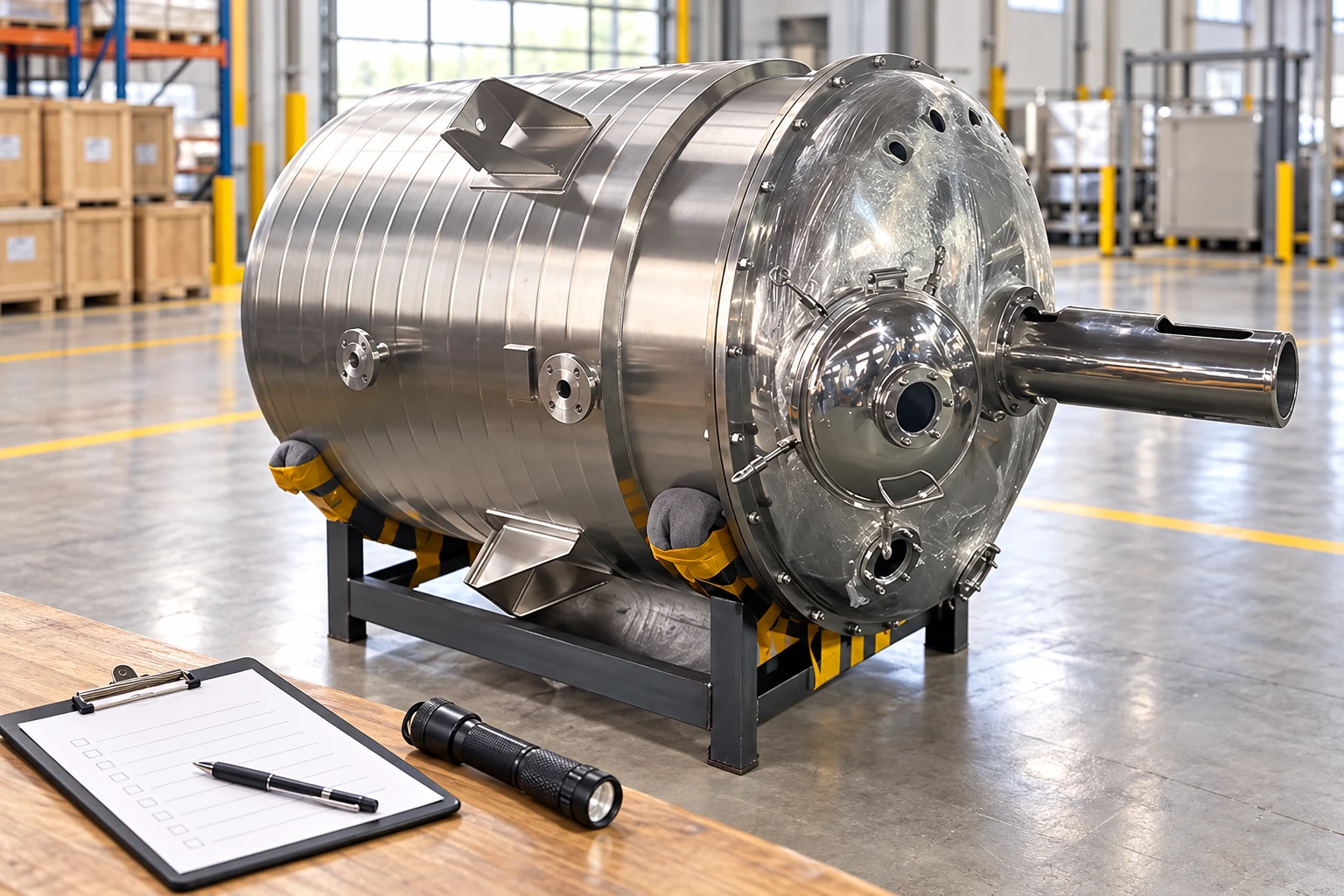
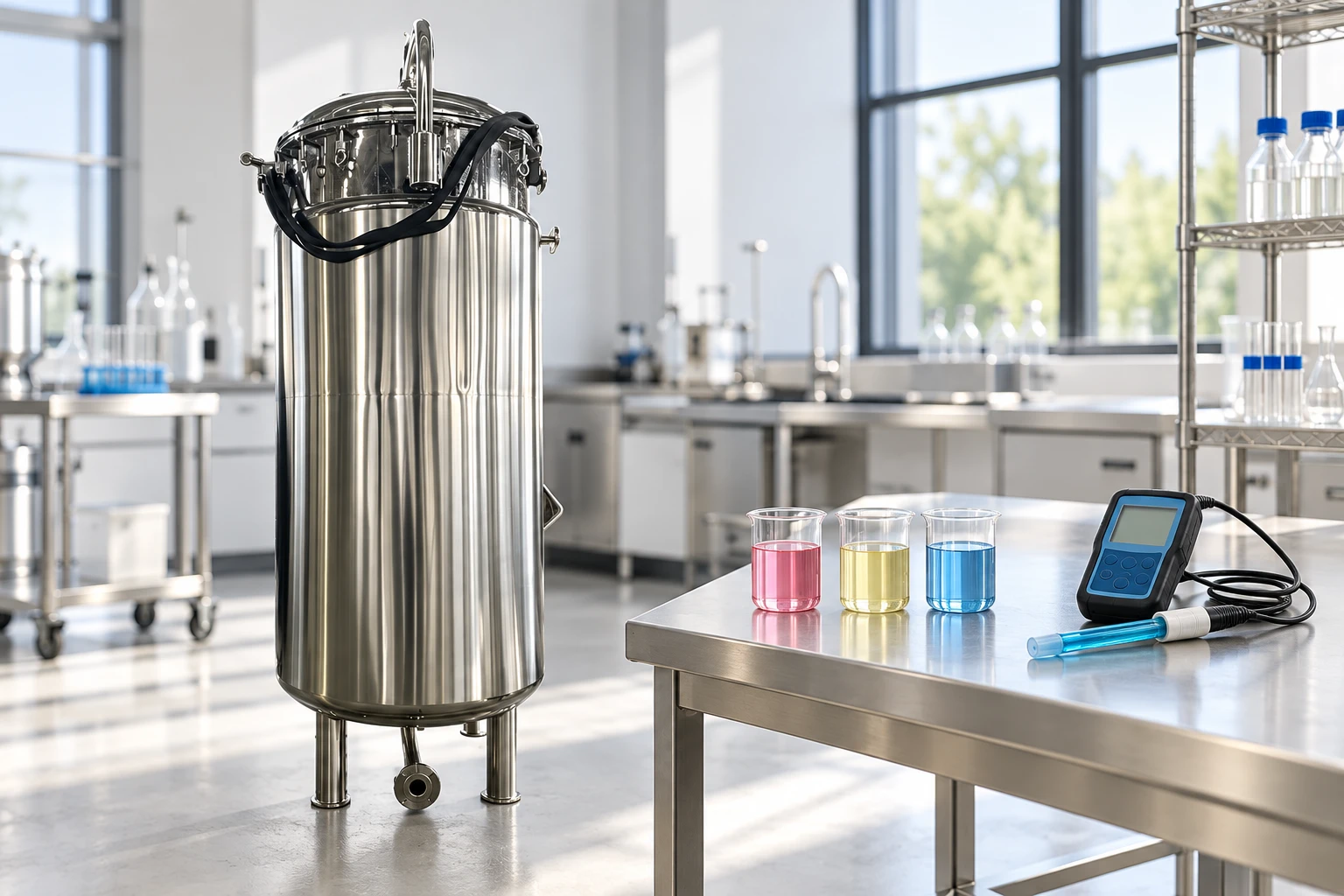
Emulsion phase inversion troubleshooting begins by checking whether the continuous and dispersed phases have actually exchanged roles. Separation, a viscosity change or a sudden appearance change can suggest a problem without proving inversion. Preserve representative samples, reconstruct the formulation and temperature history, and use suitable analytical checks before increasing mixer speed or adding corrective ingredients. A controlled small-scale investigation is more informative than an improvised production adjustment. This guide explains the diagnostic workflow for equipment buyers and process teams. It does not supply a formulation recipe, a universal inversion temperature or a guaranteed recovery method for a failed batch.
Distinguish inversion from other emulsion failures
In a simple oil-in-water emulsion, oil droplets are dispersed in a water-based continuous phase. A water-in-oil system has the opposite arrangement. Inversion concerns a change in that organization. Creaming, sedimentation, flocculation, coalescence or poor initial dispersion can also change appearance, sometimes together. A photograph of separated layers cannot distinguish every mechanism.
Write down the expected emulsion type and the property that first changed. Record whether the observation occurred during addition, heating, cooling, holding or transfer. Retain samples from a satisfactory batch where available. Avoid labeling every unstable sample inverted simply because its viscosity differs. The investigation should identify evidence for the phase arrangement and the process change, rather than selecting a familiar name for an unfamiliar appearance.
Reconstruct the formulation on a consistent basis
Review actual weighed quantities, ingredient identities and raw-material lots. Confirm whether the formula is expressed by mass or volume and whether concentrations refer to a supplied ingredient or its active component. An undocumented substitution, variable water content or a different supplied concentration can change the formulation even when the recipe sheet appears unchanged.
Include minor additions, rinse contributions and material retained in transfer equipment where they could matter. Do not quietly correct the arithmetic to make the batch record match the intended formula. Preserve the as-made record and identify discrepancies. If proprietary information is shared with a laboratory or equipment supplier, define the confidentiality arrangements, but provide enough relevant information for a meaningful assessment. Equipment selection cannot compensate for an unknown composition.
Map temperature against the addition sequence
Some emulsifying systems respond strongly to temperature and composition. The important record is therefore the actual path through the process, not only the final temperature. Note when each phase was prepared, its temperature at addition, the addition order and rate, and the subsequent heating or cooling history. Include holds and unplanned interruptions.
A research study on phase-inversion-based nanoemulsions demonstrates a particular formulation’s response to composition, temperature and dilution. Its materials and conditions are specific to that study and are not an industrial recipe for another product. The useful diagnostic principle is to investigate the path through formulation space rather than assuming every system has the same inversion point. Do not transfer a published surfactant ratio or temperature into production without product-specific development and authorization.
Use more than one suitable indicator
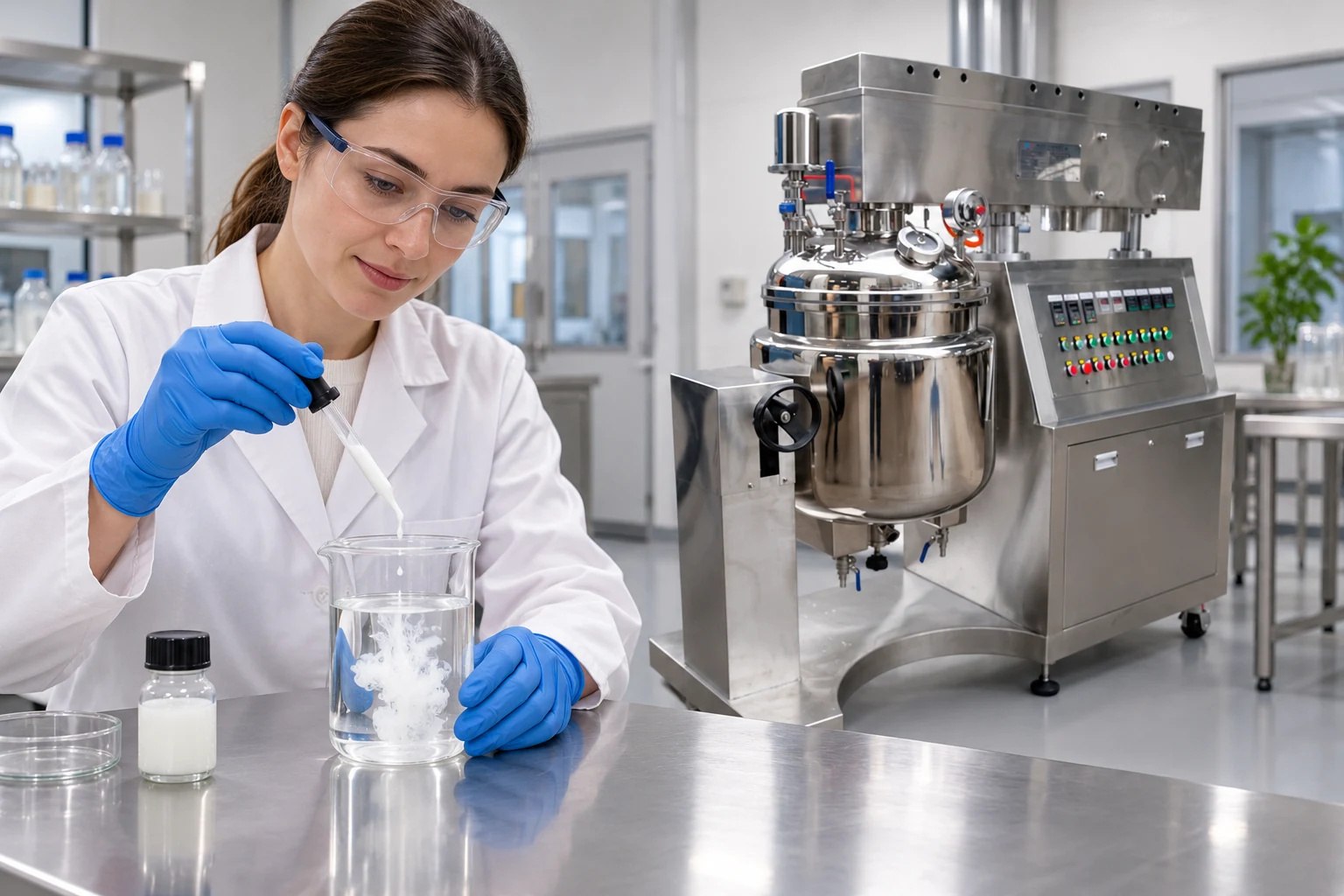
Conductivity can help distinguish phase arrangements when the phases have sufficiently different electrical behavior and the method suits the formulation. However, salts, ingredients, temperature and more complex structures can affect the reading. A change in conductivity is evidence to interpret, not a universal pass or fail criterion. Record the actual measurement temperature and instrument method.
A primary study of microemulsion microstructure illustrates how conductivity interpretation depends on composition and structure in a particular system. A microemulsion is not interchangeable with an ordinary industrial emulsion; the study does not establish a universal identification threshold. A qualified laboratory may combine appropriate conductivity observations with microscopy, a justified dilution check and other measurements. Agree what each method can and cannot establish before using it to release or rework material.
Make dilution checks a laboratory investigation
A small, controlled dilution observation can sometimes support identification of the continuous phase. It can also change the material under investigation. The diluent, quantity, temperature and mixing method therefore need to be defined. Do not treat a drop test in an uncontrolled beaker as a complete characterization or use it to invent a production addition.
Keep an untouched retained sample and document the prepared test portions separately. If the formulation contains hazardous or reactive ingredients, the qualified laboratory must establish a safe method before testing. The illustrative water-based scenes in this article do not represent a procedure for an unknown chemical formulation. Record ambiguous observations as ambiguous; forcing a binary interpretation can send the investigation toward the wrong corrective action.
Separate formulation effects from mechanical history
Mixing intensity, duration and transfer history may influence the emulsion structure. That does not mean every phase change is caused by insufficient or excessive mixing. Establish which variables changed between a satisfactory batch and the problem batch. A new raw-material lot or temperature path can be more relevant than the final mixer setting.
Do not change speed, addition order and emulsifier concentration simultaneously. A trial that changes all three may improve appearance without explaining why. Use a justified experimental plan with material-appropriate safety boundaries. Record the actual equipment configuration and process conditions. Different mixer heads and vessel arrangements cannot be made equivalent merely by using the same displayed rotational speed. The equipment supplier should review any proposed operating case outside the established envelope.
| Observed change | Information to preserve | A useful next investigation |
|---|---|---|
| Sudden viscosity shift during phase addition | Actual composition, addition sequence and temperature | Assess whether the phase arrangement changed using suitable methods |
| Different behavior after an ingredient substitution | Supplied concentration, ingredient identity and lot data | Compare a controlled small-scale formulation with the approved baseline |
| Acceptable hot sample but poor cooled sample | Complete cooling path and hold history | Observe the material through controlled temperature stages |
| Conductivity changes without an obvious appearance change | Measurement temperature, method and relevant ionic ingredients | Confirm whether the indicator remains valid for the formulation |
| Separation after repeated processing | Number of passes, duration, temperature and transfer path | Compare defined handling histories rather than simply adding more mixing |
| Trial result cannot be reproduced | Sampling, preparation and process records | Reduce uncontrolled variables before selecting a production correction |
This qualitative table organizes evidence. It contains no universal formulation limits or automatic batch-recovery instructions.
Examine samples at the right times
Collect samples at stages that can reveal when the change begins, provided the collection arrangement is safe and suitable. A final sample alone may not show whether the structure changed during emulsification, cooling, holding or transfer. Record collection time and the interval before analysis, because a sample may continue to change after leaving the vessel.
Use consistent containers and preparation. Avoid comparing an aggressively shaken problem sample with a gently handled baseline. For microscopy, have the laboratory define preparation so that the slide-making process does not create a misleading structure. Retain raw observations as well as the interpreted result. An image can be valuable evidence, but it needs sample identity, preparation information and a stated analytical purpose.

Do not assume that more shear restores the intended product
Additional mixing may alter droplet distribution while leaving the formulation in an unintended phase state. It may also add heat or expose the product to a different processing history. A visually smooth result immediately after intervention does not prove the intended stability or downstream behavior has returned. Test against the actual product requirements, including any relevant hold or use condition.
Any proposed rework needs authorization from the responsible product and quality team. Document the affected quantity, change rationale, trial evidence and acceptance criteria. Do not release a production batch based solely on an equipment supplier’s general claim about emulsification capability. The correct commercial statement is limited to the tested material and conditions; a mixer model is not a universal solution to incompatible ingredients or an uncontrolled process path.
Design a small-scale study that can inform production
Select a limited number of variables based on the evidence, not on a list of everything that could possibly affect an emulsion. Keep the starting material, preparation and evaluation methods consistent. Include the approved reference where available, and define how results will be assessed after the relevant hold period. Record failed cases as carefully as successful ones.
Before scaling a promising result, review which conditions can be reproduced in the production vessel. Addition location, circulation, heat-transfer behavior and processing time can change with scale. Do not translate a bench-mixer speed directly into an industrial speed without a justified basis. Ask the process developer and equipment supplier to agree the scale-up and acceptance plan. Preserve the difference between a formulation-development result and a demonstrated production capability.
Give the equipment supplier the right evidence
Para un YIYI vacuum emulsification homogenizer, describe the intended emulsion type, product range, temperature path, addition sequence, observed instability and required acceptance tests. Request confirmation of the actual mixing configuration, utilities, cleanability and test arrangements. The product photograph does not prove a particular internal gap, droplet size or guaranteed inversion-control capability.
Utiliza el vacuum-emulsifier selection guide for purchasing requirements, the shear-rate and batch-scale guide for scale-up inputs and the vacuum deaeration troubleshooting guide when entrained gas is the separate problem. Keeping those questions distinct prevents an air-removal adjustment from being presented as proof that an emulsion’s phase organization is correct.
Educational reference: emulsion structure
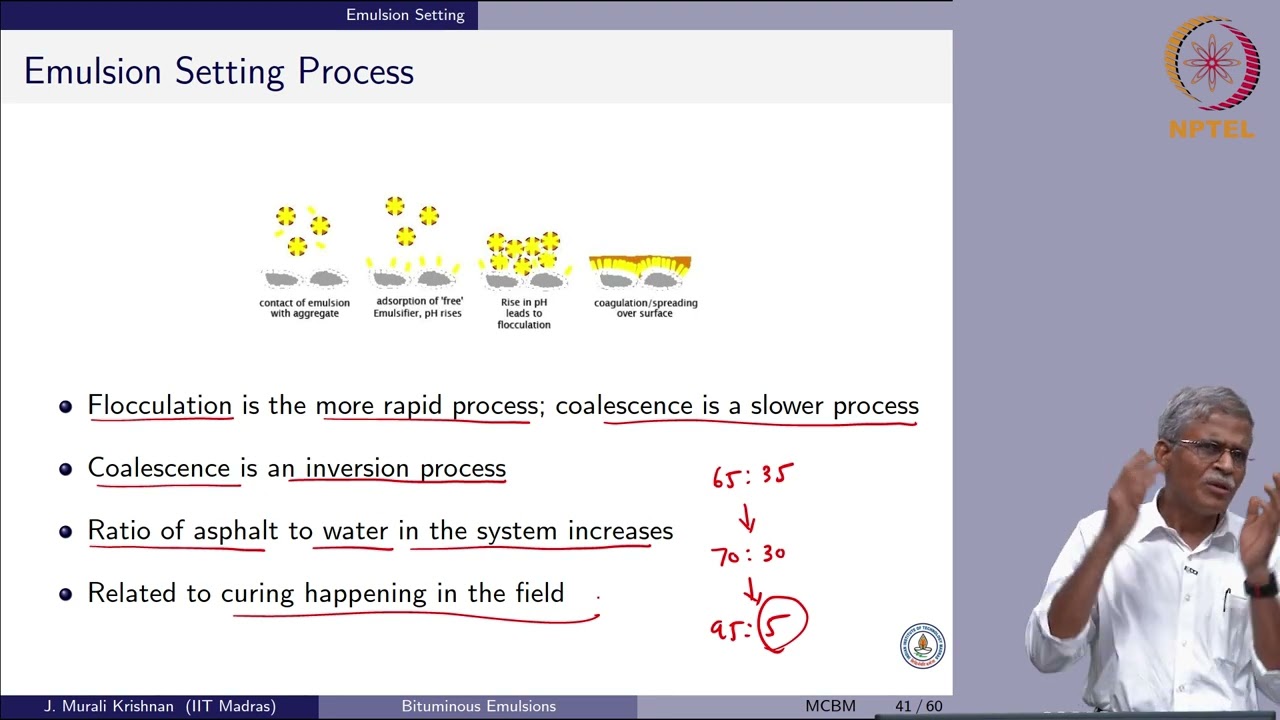
Watch Emulsion Technology – Part 1 by NPTEL-NOC IITM
The educational reference explains emulsion principles. It does not provide a validated manufacturing recipe or evidence of performance for an unspecified product in the pictured machine.
Preguntas frecuentes
Does separation prove that phase inversion occurred?
No. Several instability mechanisms can produce separation or an appearance change. Establish the intended structure and use methods appropriate to the formulation before assigning a cause.
Can conductivity alone identify every emulsion type?
No. Its interpretation depends on the formulation and measurement conditions, and complex systems require particular care. Use it only within a justified method and consider complementary evidence.
Should an inverted batch be mixed faster?
Do not assume that is the correct response. Preserve the record, investigate composition and processing history, and authorize any rework through a product-specific trial and acceptance plan.