Rotary lobe pump pulsation should be investigated using the actual operating condition and a measurement method that can resolve the variation of interest. A shaking gauge, changing flow indication or rhythmic noise does not identify one cause automatically. Periodic displacement, gas in the product, suction problems, control actions and piping behavior can produce different observations. Begin by defining the symptom and its effect on the process, then compare synchronized evidence before changing pump speed or adding a damping device. This guide provides a diagnostic framework, not a universal allowable pulse amplitude or a modification procedure for an unknown pressure system.
Describe the symptom in measurable terms
Record what changes, where it is observed and why it matters. A fluctuating pressure indication is different from inconsistent filling, changing delivered mass or vibration at a support. The observations may be related, but they should not be treated as interchangeable measurements. Identify whether the concern affects product quality, instrument reliability, equipment condition or another defined requirement.
Include when the symptom occurs: startup, a particular product, a low vessel level, a certain valve state or a change in transfer rate. Record the duration and whether it is repeatable. Descriptions such as the pump runs roughly provide little basis for comparing operating cases. Do not keep equipment operating in an unsafe condition merely to obtain a better record; follow the approved response when a safety concern arises.
Understand what positive displacement does and does not promise
A rotary positive-displacement pump transports material through its operating cycle. The instantaneous behavior need not be identical to the average flow reported over a longer interval. The actual pattern depends on the pump configuration and operating conditions. A general description of the pump family does not establish a pulse frequency or amplitude for an unidentified model.
Obtain relevant information from the manufacturer for the proposed configuration. Do not calculate a definitive pulsation frequency from a photograph or assume an internal lobe arrangement that has not been confirmed. Likewise, do not describe every periodic observation as normal. The useful question is whether the actual system meets its agreed operating and product requirements, with suitable evidence for the effect being investigated.
Draw the complete flow path
Document the supply vessel, suction connection, pipe or hose arrangement, valves, pump, discharge path and receiving equipment. Include instruments and control devices that may respond to changing conditions. A pump operating into a different line arrangement can produce a different observation even when its displayed speed is unchanged.
The Department of Energy pumping-system sourcebook uses a system-level approach to evaluating pumping performance. It is not a pulsation acceptance standard for a particular lobe pump. Its relevance is to consider interacting components rather than selecting a remedy from one isolated symptom. Keep the actual drawing and operating record with the investigation so that a temporary test arrangement is not mistaken for the installed production duty.
Check whether the measurement can resolve the event
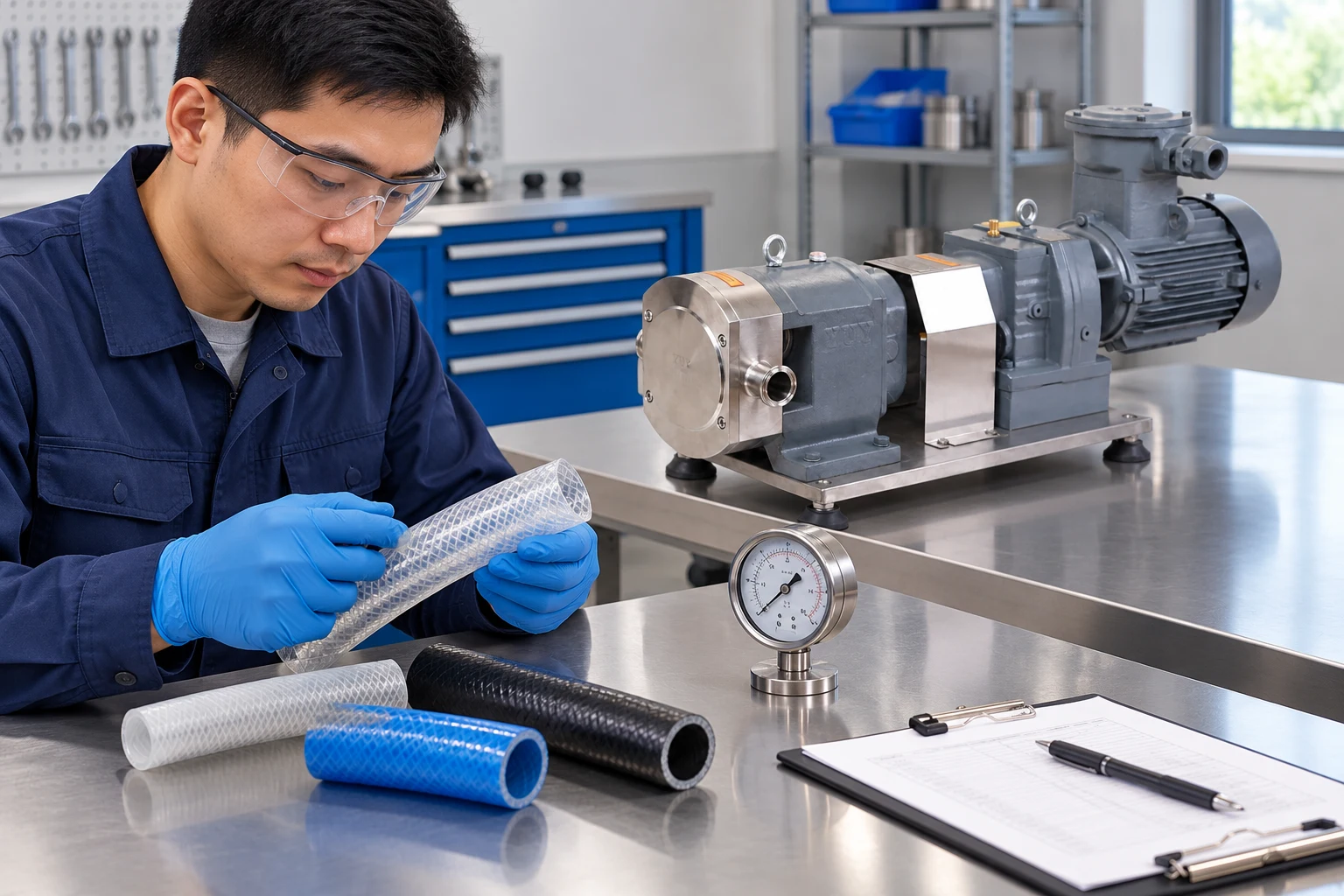
A slow display, a heavily damped gauge or a filtered control-system signal may hide rapid variation. Conversely, a visible gauge movement may be influenced by the instrument and its connection. Identify the instrument, location, range, response characteristics and any configured averaging. A high number of stored data points does not compensate for a sensor that cannot respond to the event.
Define the measurement objective with a competent instrumentation specialist where necessary. Record units, time reference and relevant limitations. The NIST guidance on measurement uncertainty supports identifying contributions to a measurement result; it does not prescribe sensor bandwidth or a permissible pump-pressure fluctuation. Use a method appropriate to the actual decision rather than treating the smoothest available trace as the truest one.
Separate suction-side conditions from discharge observations
Review the product supply condition, vessel level, temperature and the actual suction arrangement. Entrained gas, an intermittent feed condition or a restriction can contribute to unstable operation. Those observations require investigation, not an immediate conclusion that the pump’s displacement pattern is the only cause.
Do not assume that a discharge gauge proves the suction condition. Establish what information is available at each location and what the instruments can show. If a temporary measurement is proposed, use an engineered arrangement suitable for the service and approved operating conditions. This article does not authorize opening a live line, removing a guard or defeating pressure protection to obtain a diagnostic observation.
| Observation | Information to collect | Question it helps answer |
|---|---|---|
| Repeatable rhythmic pressure variation | Suitable synchronized pressure and operating data | Is the observation tied consistently to the operating cycle? |
| Variation appears at low supply level | Vessel condition, product state and suction-path details | Is material supply or gas entry contributing? |
| Only the control-system value oscillates | Sensor configuration, filtering and control events | Is the signal or control loop part of the observed behavior? |
| Filling changes while average flow seems stable | Delivered quantity over the relevant filling interval | Does the reported average hide a process-significant variation? |
| Vibration changes after a piping alteration | Updated supports, connections and operating cases | Has the installed system response changed? |
| The symptom changes with formulation | Temperature, rheology, gas and material records | Is the product state influencing the system rather than speed alone? |
These are qualitative investigation prompts. They do not assign universal limits or establish that any particular observation is safe to ignore.
Compare operating cases without changing everything at once
Choose a small set of justified cases inside the approved operating envelope. Record actual speed, relevant pressures, temperature, product identity and flow or delivered quantity where available. Avoid changing a valve, formulation, speed and instrument setting simultaneously. An apparently improved result then becomes difficult to explain or reproduce.
Keep a suitable baseline and identify the reason for each change. If the symptom is intermittent, collect enough contextual information to distinguish a genuine improvement from the absence of the triggering condition. Do not select only favorable sections of a trend. A useful investigation includes the cases that did not support the initial explanation and states what remains uncertain.
Assess the consequence at the relevant timescale
A process may tolerate variation that an individual filling cycle does not. Conversely, a moving gauge may have little effect on the delivered product while indicating an instrument or connection issue that still deserves attention. Define the acceptance question in terms of the actual process rather than a general preference for a perfectly flat graph.
If delivered quantity matters, use an appropriate quantity measurement over the relevant interval. If a pressure-related concern matters, obtain suitable pressure evidence. If product integrity matters, use a separate product-assessment method. One signal should not silently become a substitute for all three. Record the method and its capability so that a later reviewer can understand what the trial did and did not establish.

Treat damping hardware as an engineered selection
A proposed pulsation damper or other system modification needs a defined purpose and selection basis. Compatibility, operating conditions, installation, maintenance and applicable pressure-system requirements matter. A device that makes one gauge look steadier does not automatically resolve an unacceptable process condition elsewhere.
Ask the responsible supplier or designer to identify the evidence supporting the proposal and the operating cases it covers. Do not choose a vessel size, precharge or installation location from an unrelated online example. Any relevant protective functions must remain effective. Retain the approved design information and operating instructions, then verify the intended result under representative conditions. The article illustrations show detached training instruments, not a verified damping package supplied with the pump.
Check supports and mechanical observations safely
Changes in observed vibration may involve the installed piping, supports or connections. Record the location and conditions without assuming a mechanical defect from sound alone. A qualified assessment may be required to distinguish causes and determine the appropriate response. Follow the site’s approved isolation and access procedures before any hands-on inspection.
Do not loosen connections or remove protective covers while equipment is operating. Do not regard tightening a support as a universal repair. Preserve the original observations and the assessment behind any correction. A successful change should be demonstrated against the defined requirement, rather than described as fixed because the equipment sounded quieter during one brief observation.
Make the final conclusion narrower than the available evidence
A clear report states the symptom, operating cases, methods, observations and the supported explanation. Identify alternative explanations that remain open and the information needed to resolve them. If a modification was made, record its approval and the before-and-after comparison. An inconclusive result is more useful than a confident cause assigned without adequate data.
Retain the approved configuration and define which changes require reassessment. A new product, different suction arrangement or altered filling cycle may change the relevant behavior. Do not convert one satisfactory trial into an unlimited claim of pulse-free operation. The defensible conclusion concerns the documented equipment and conditions and the specific process requirement that was actually checked.
Bring the system information to the pump enquiry
For a YIYI rotary lobe pump, provide the material behavior, transfer arrangement, operating envelope and the process effect associated with the pulsation concern. Request confirmation of the actual proposed configuration and any manufacturer data relevant to its expected behavior. A product photograph does not establish internal geometry or a guaranteed pressure waveform.
Use the pump cavitation guide for a separate suction-related investigation, the high-viscosity speed guide for operating-input discussion and the shear-sensitive product guide when product damage is the acceptance question. Keeping these investigations distinct prevents a generic speed adjustment from being presented as proof that every observed problem has been solved.
Educational reference: positive-displacement pumping

Watch W3L5_Positive displacement pump by NPTEL-NOC IITM
The educational explanation supports understanding of pump principles. It does not establish the internal construction, allowable fluctuation or approved modification of the pictured pump.
Frequently asked questions
Does a fluctuating gauge prove that the pump is faulty?
No. Instrument response, supply conditions, the pump cycle and the installed system can contribute. Describe the actual consequence and collect suitable evidence before assigning a cause.
Can a damper be selected from the pipe connection size alone?
No. The purpose, operating conditions, compatibility and approved selection basis need to be established. Follow competent system design and the relevant manufacturer’s instructions.
Is average flow enough to assess a filling problem?
Not always. An average over a long interval can conceal variation relevant to an individual fill. Use a suitable delivered-quantity assessment at the timescale that matters to the process.