

A mixing tank gearbox lubricant substitution should be reviewed against the exact drive manufacturer’s requirements, the proposed oil’s technical identity, and the lubricant already inside the unit. Matching viscosity alone does not establish suitability or compatibility. Keep an alternative product out of the approved maintenance stock until the responsible reviewer has resolved these points and documented any required changeover instructions. This guide explains how purchasing, maintenance and engineering can assemble that decision package. It does not select an oil grade, prescribe flushing, or authorize mixing products in an operating gearbox.
Start with the installed drive, not the tank description
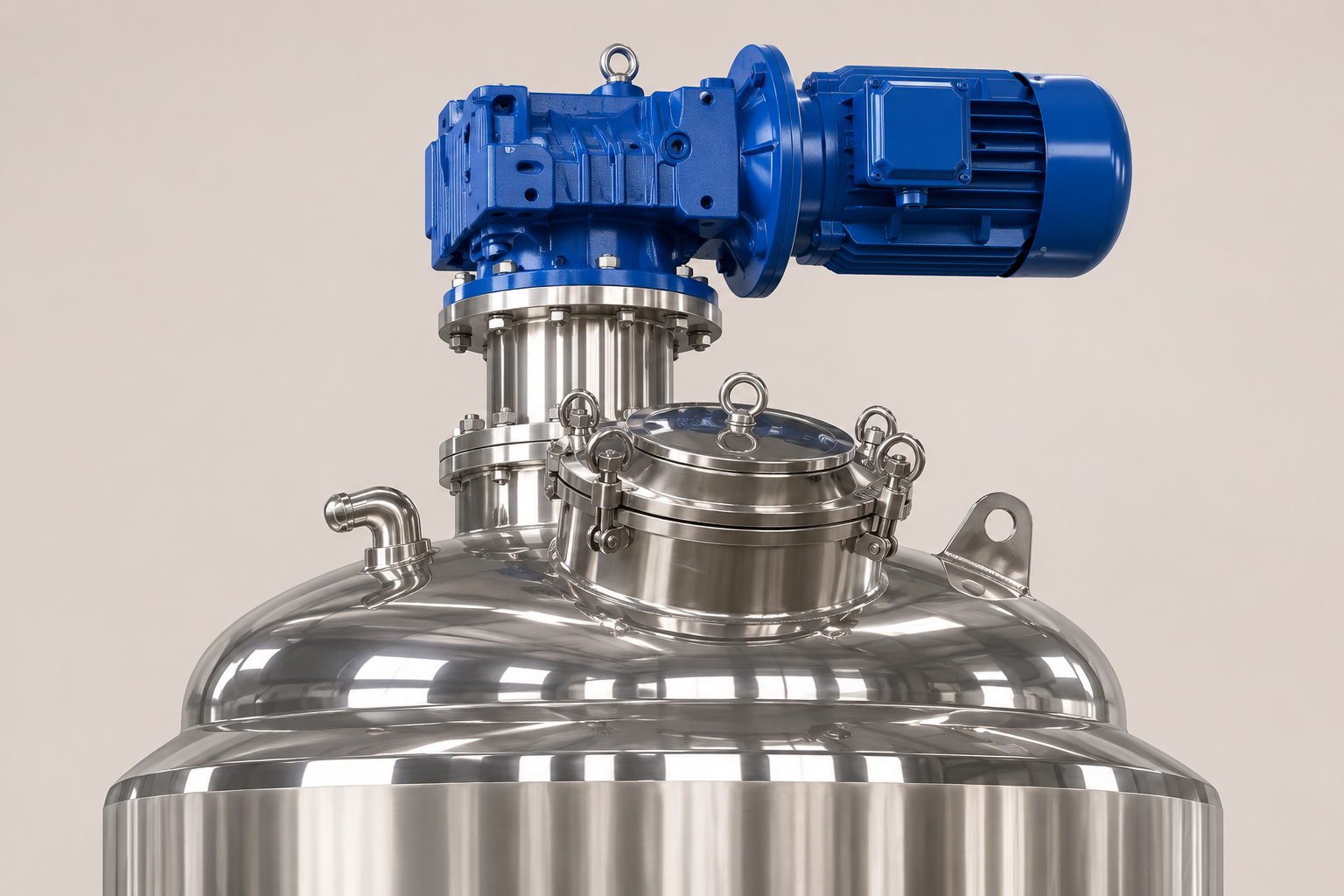
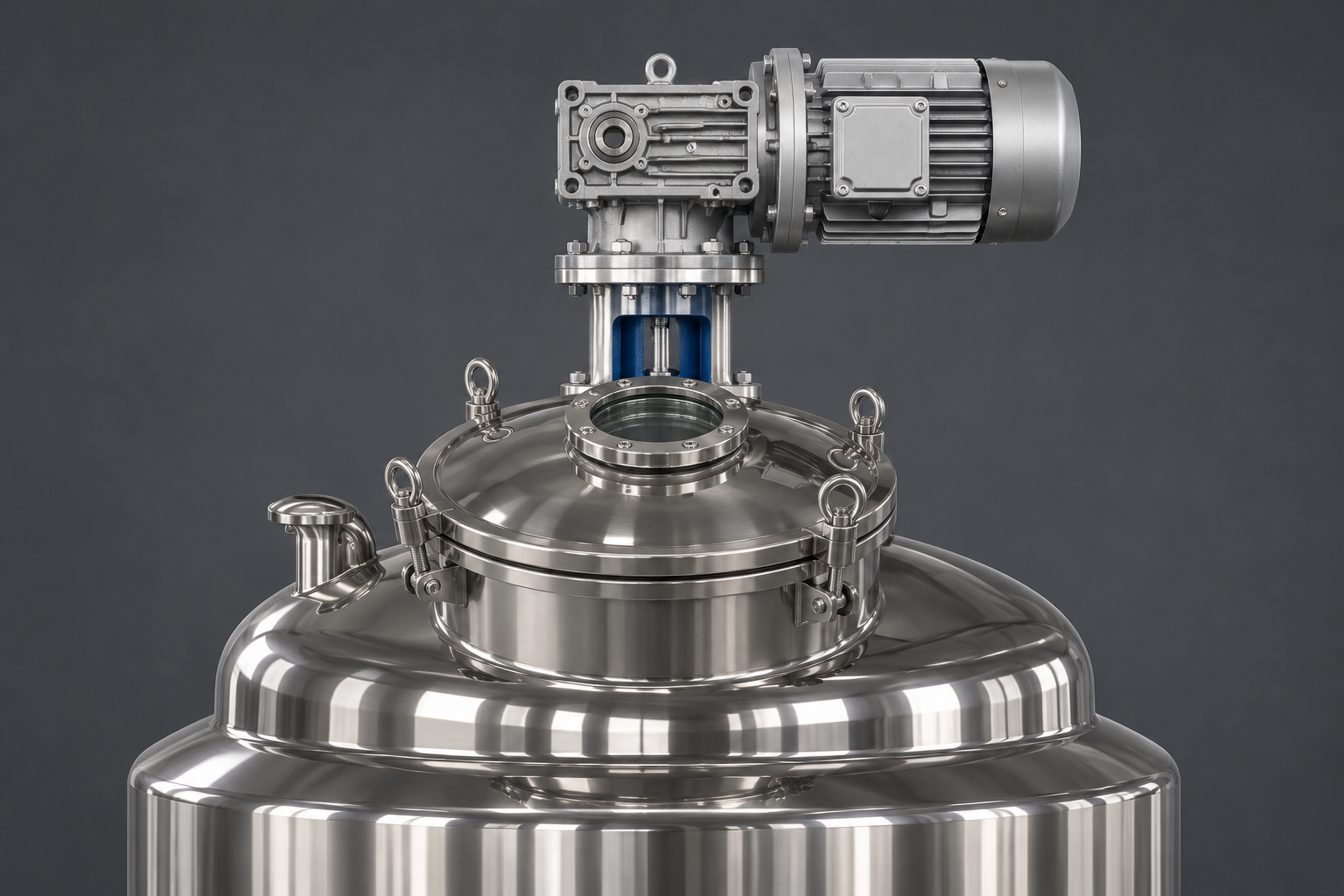
A vessel’s capacity or process name does not identify its gearbox lubricant. Two visually similar tanks can carry different drives, and a replacement motor does not necessarily mean the gear unit changed. Record the tank asset tag, gearbox manufacturer, model, serial number and applicable manual revision. Distinguish the electric motor, gearbox and shaft connection in photographs and records so that an oil recommendation for one component is not applied to another.
إن YIYI mixing tank product page shows the equipment context for this review. Its photographs do not establish a particular gearbox oil, internal seal material, approved lubricant list or maintenance interval. Request the actual supplied drive documentation for the installation. Where the drive identity is unreadable, resolve that uncertainty before evaluating a substitute against an assumed specification.
Keep the lubricant review alongside the wider mechanical seal interchangeability review. These are separate approval questions: a correctly identified seal does not prove oil compatibility, and a suitable oil does not establish that a replacement seal fits.
Separate suitability, compatibility and permission
Suitability asks whether the proposed oil meets the installed gearbox’s requirements under the actual duty. Compatibility asks how the proposed product interacts with remaining oil and materials in the system. Permission asks who has accepted the change and under what conditions. A supplier’s statement that an oil is an equivalent may address only part of that chain.
Compare the exact product designation rather than a brand family. Capture viscosity classification, base-oil description, relevant performance claims, manufacturer approvals and limitations from current technical documents. Do not treat a safety data sheet as a complete performance specification: its purpose differs from a technical data sheet or an equipment approval list. Record document dates because product names and formulations can evolve while familiar packaging remains in circulation.
إن 2025 U.S. CFR text on lubricants with incidental food contact sets out conditions for that use. It does not establish approval for a particular gearbox. When the plant requires food-contact evidence, ask the responsible reviewer to check the exact product’s applicable compliance documents and current requirements separately from mechanical suitability. Do not assume that a food-processing application makes every lubricant exposure acceptable.
Build a comparison file that shows unresolved questions
Use a short matrix to make missing evidence visible. The following is an administrative review aid, not a lubricant specification. Its entries should point to the installed drive’s instructions and supplier responses; a blank value remains a question rather than becoming an inferred match.
| بند المراجعة | الأدلة التي يجب جمعها | Reason to hold the substitution |
|---|---|---|
| Installed gearbox | Model, serial number and applicable instructions | Only a tank description or motor label is available |
| Existing lubricant | Exact product and reliable service history | The current fill is unknown or several products were used |
| Proposed product | Current technical sheet and full designation | The offer names a broad brand or viscosity only |
| Equipment approval | Applicable approval or written OEM response | A general equivalence claim replaces equipment acceptance |
| Material interaction | Product-specific assessment where relevant | Seal or coating compatibility is assumed |
| تغيير الدفعات | Approved instructions and responsibilities | Personnel are expected to improvise draining or flushing |
| Food-contact requirement | Exact registration or other required evidence | A generic food-grade phrase is the only support |
| Release record | Reviewer, date, scope and remaining conditions | Purchasing approval is mistaken for maintenance release |
A useful evidence request quotes the gearbox identity and both oil products in one message. Ask the respondent to state the scope of its conclusion, including assumptions about residual oil. This prevents a technically correct answer about a new, empty unit from being misapplied to an existing installation with an uncertain fill history.
Reconstruct the current fill before comparing alternatives
Start with the last accepted maintenance record, stock issue record and original lubricant recommendation. Check whether containers used for top-ups carried the same full designation. A service entry that says only gear oil is incomplete evidence. Retain that wording in the history and explain the gap; do not silently replace it with the product that would normally have been used.
If the fill cannot be identified reliably, ask the responsible engineering and lubricant specialists how to proceed. Do not create an informal mixing trial, set a universal allowable residual percentage, or use appearance as proof of compatibility. Clear-looking oils can still present a problem, while a laboratory result needs interpretation against the equipment and intended service. Sampling, testing and changeover arrangements belong in an approved job plan.
دليل التمدد الحراري للمبادل الحراري agitator lubricant contamination risk guide addresses exposure pathways and housekeeping. Use it to keep handling concerns visible, while retaining this substitution file as the record of why the exact alternative was accepted or rejected. The two records should share the asset identity without duplicating each other’s instructions.
Ask for a written answer that technicians can use
A useful response names the gearbox, current oil, proposed oil, relevant duty and conditions attached to acceptance. If the answer depends on temperature, mounting position or service load, provide the actual installation information. Do not supply guessed operating values simply to complete a supplier form. Identify who confirmed each input and retain the source.
Distinguish an OEM approval from a lubricant supplier recommendation and from an internal engineering decision. Each can be useful, but they are different types of evidence. If the equipment manual lists an approval system, check whether the proposed oil has that approval or only claims to meet a related performance requirement. Record the distinction in plain language for purchasing and stores.
A conditional acceptance should become a conditional work instruction. For example, a reviewer may require clarification of the existing fill before release. The record should then remain on hold until that clarification is complete. Signing a purchase requisition should not erase the technical condition or make the product available for an unplanned top-up.
Plan implementation without turning the article into a procedure
إن توضح إرشادات الصحة والسلامة المهنية حول صيانة المعدات supports planning work with appropriate competence and the manufacturer’s instructions. For this task, that means moving from an approved substitution decision to a specific maintenance plan. The plan must address the actual installation, hazards, access and isolation arrangements through the site’s established process.
This article deliberately supplies no drain temperature, flushing quantity, cleaning solvent or restart sequence. Those details depend on the equipment and products. A general recommendation found online should not replace the applicable instructions. If the approval requires a particular conversion process, attach the authorized instructions to the job rather than summarizing them from memory on a stock label.
Identify responsibilities before ordering: purchasing obtains the specified product; stores preserves its identity; engineering approves scope; maintenance performs the authorized work; and the designated reviewer closes the record. A small site may combine roles, but the decisions should remain distinguishable. Keep the old and new product codes separated until the change is complete and obsolete stock is controlled.
Handle delivery and future top-ups as part of the change
At receipt, compare the delivered designation, pack condition and batch information with the approved order. A similarly named product or a packaging change needs reconciliation before issue. Keep technical documents linked to the product actually received, including any supplier notice explaining a renamed or reformulated item. Avoid accepting a substitute within the substitute without review.
Update lubrication charts, stock codes and job references after the change has been accepted. Retain the previous entry as history so that a later reviewer can reconstruct what happened. Remove obsolete instructions from active use through the document-control process. If several mixing tanks use different drive variants, define exactly which assets the substitution covers; do not expand acceptance to the entire production area by association.
A later unusual observation should be reported through the plant’s fault process and assessed by competent personnel. It is not evidence that personnel should add another product or experiment with additive treatments. Record observations, time and asset identity while preserving the maintenance decision trail.
Prepare a focused request for YIYI or the drive supplier
For an existing installation, provide the tank order reference, clear drive photographs, serial information, current manual, known lubricant history and the full proposed product documents. State whether the request concerns a future planned change or an urgent stock shortage. Ask for confirmation of the applicable drive instructions and the appropriate technical contact for lubricant approval.
If the project also replaces the drive motor, keep its motor nameplate comparison as a separate check. Motor ratings and mounting information cannot establish the gearbox lubricant requirement.
For a new tank purchase, request the drive documentation and lubricant responsibility as part of the handover package. Clarify whether lubricant is supplied, which document controls selection, and how future alternatives should be reviewed. These questions improve maintainability without assuming that the website photograph establishes the supplied drive configuration or any specific approval.
Further learning: safe maintenance planning
The neutral maintenance education video below provides context for planning and controlling equipment work. It is supplementary; the installed gearbox instructions and written product-specific assessment remain the basis for a lubricant decision.
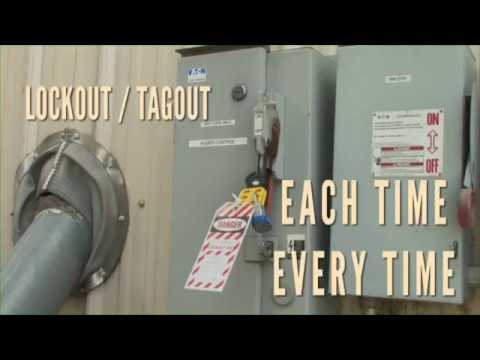
مراكز السلامة والصحة الزراعية في مصر: التحكم في الطاقة الخطرة لقفل/وسم.
الأسئلة الشائعة
Can I substitute an oil with the same viscosity grade?
Matching viscosity is only one comparison point. Confirm the installed gearbox requirements, exact product identity, relevant approvals, materials and compatibility with the current fill. Keep the alternative on hold until the responsible reviewer accepts the complete evidence.
Does food-grade registration prove gearbox suitability?
No. A food-contact classification addresses a different requirement from gearbox performance and equipment approval. Check the exact product’s required hygiene evidence and its suitability for the installed drive as separate parts of the review.
What should I do when the existing oil is unknown?
Preserve the incomplete history and refer it to the responsible engineering and lubricant specialists. Do not guess the fill, perform an informal mixing test, or create your own flushing instructions. Obtain an approved plan before releasing the replacement lubricant.


