Rotary lobe pump mechanical seal leakage should be investigated by identifying the escaping fluid, locating the first visible wet point and recording the operating conditions before deciding which part has failed. Liquid under a pump does not automatically prove a damaged mechanical seal: a front-cover joint, pipe connection, cleaning residue or auxiliary circuit can produce a similar observation. Make the equipment safe under the site’s procedure, preserve the evidence and use the pump manufacturer’s limits and service instructions. A generic allowable drip rate or a guessed seal kit is not a reliable repair basis.
Separate immediate response from diagnosis
The first decision concerns people, product and containment. Follow the site’s response plan for an unknown, hot, hazardous or potentially contaminating release. Do not approach rotating couplings, remove guards or reach beneath a running machine to find the source. A photograph from an authorized safe position can preserve useful evidence without creating a maintenance intervention.
Record whether the pump was moving product, being cleaned, starting, stopping or standing idle when the leak was noticed. Note alarms and recent changes. If the pump has already stopped, keep that fact in the record; an observation made after shutdown cannot establish exactly what happened during operation.
For intrusive work, use the plant’s isolation and verification procedure. The HSE guidance on equipment maintenance explains the need to control power, stored energy and process hazards before maintenance. The actual isolation boundary must fit this installation, including connected tanks, cleaning circuits and any auxiliary seal supply.
Identify the installed pump and seal arrangement
Collect the pump serial number, model, drawing revision and maintenance history. Confirm whether the installation has a single seal, a double arrangement or another configuration approved for the application. Do not infer the seal faces, elastomers or flush requirements from the visible stainless casing.
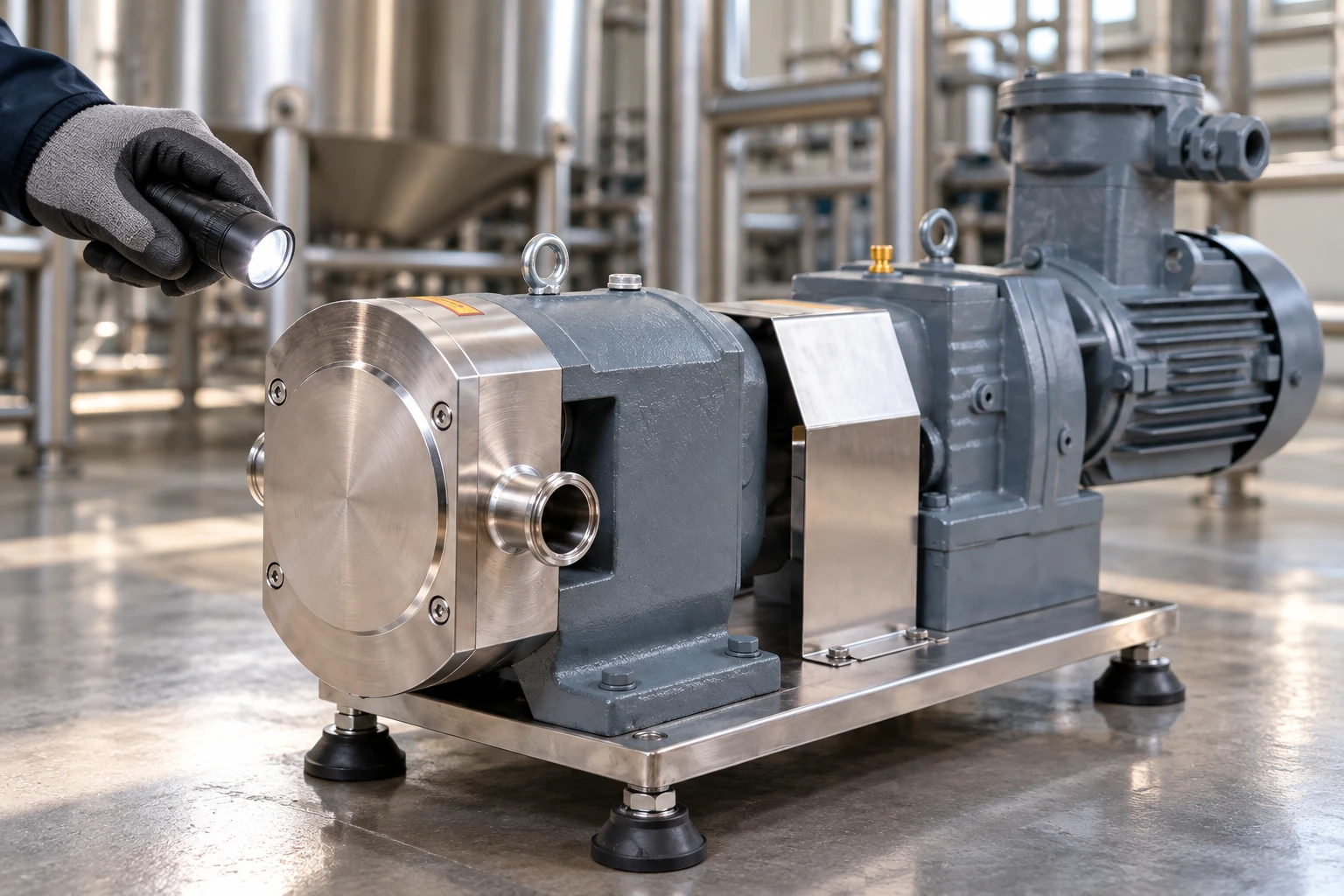
Эт YIYI high-viscosity cam rotor pump product provides a starting point for an equipment enquiry. Its external photograph does not identify every internal service option. Ask for the configuration associated with the actual serial number and service documentation before selecting parts.
Identify the liquid carried by any auxiliary lines. A flush, barrier or quench system can have a different function and operating requirement. Use the manufacturer’s terminology consistently in the service request. Calling every small tube a flush line can lead to the wrong question and an unsuitable corrective action.
Find the first wet point rather than the largest puddle
Liquid travels along castings, guards and baseplates. The point where it drips onto the floor may be far from its source. After authorized isolation, cooling and decontamination, a competent person can inspect accessible exterior surfaces according to the approved method. Keep observations separate from conclusions.
Distinguish pumpage, cleaning solution, lubricant, condensate and auxiliary fluid where the site can do so safely. Use existing process records, approved sampling or qualified laboratory analysis if identity matters. Never taste, touch or deliberately smell an unknown liquid. A matching colour is a clue, not positive identification.
Document whether the wetness begins at a casing joint, pipe connection, shaft area or auxiliary fitting. Record visibility limits: a guard or closely spaced component may prevent a reliable view. “Source not yet visible” is more useful than a confident but unsupported diagnosis that directs the repair team to the wrong component.
Organize observations into testable possibilities
Use a structured record so that each proposed cause has supporting evidence and an appropriate next check. The table below is a diagnostic planning aid. It does not authorize running a damaged pump or opening any connection under pressure.
| Observation | Possibility to assess | Доказательства для запроса | Decision boundary |
|---|---|---|---|
| Wetness at a pipe joint | Connection or gasket issue | First wet point and joint history | Confirm before ordering shaft-seal parts |
| Wetness near shaft area | Seal or adjacent path | Fluid identity and installed seal drawing | External view alone may be inconclusive |
| Leakage only after cleaning | Cleaning exposure or thermal transition | Actual cycle record and compatibility review | Do not assume product service is equivalent |
| Repeated failure after replacement | Unresolved installation or service condition | Previous parts, fitting record and duty | Avoid replacing the same kit without review |
| Auxiliary fluid loss | Supply-system or seal-system issue | Approved circuit diagram and trend | Use configuration-specific limits |
| Leakage with abnormal vibration | Mechanical or system interaction | Authorized vibration and maintenance evidence | Escalate rather than adjust while operating |
The US Department of Energy’s pumping-system maintenance guidance distinguishes packing from mechanical seals and refers seal leakage decisions to manufacturer specifications. Do not transfer a packing drip allowance to a mechanical seal, or a centrifugal pump adjustment to an unrelated lobe-pump assembly.
Reconstruct the duty at the time of the event
Record the product, actual temperature, estimated or measured viscosity basis, pump speed and available suction and discharge information. Include whether valves, filters, hoses or the receiving vessel changed recently. If no trustworthy pressure reading exists near the pump, say so rather than using a remote gauge as though it described the seal chamber.
Preserve relevant trends with timestamps and instrument identities. A daily average can hide a short startup event. Conversely, a single maximum does not show whether the condition persisted. Explain the sampling interval and any missing data so the manufacturer can judge the evidence appropriately.
Use separate investigations for distinct symptoms. The guide to rotary lobe pump pulsation addresses pressure and flow variation. A pulsating gauge may help describe the service, but it does not prove the leakage mechanism. Avoid collapsing several simultaneous observations into one assumed cause.
Review dry-running and cleaning history carefully
Loss of liquid supply, air ingestion or an incomplete prime can be relevant to some seal failures. Establish what actually happened through operator reports, level information and event records. A low source-tank level by itself does not prove that a particular seal ran dry; the installed arrangement and liquid path matter.
The separate rotary lobe pump dry-running guide explains the information needed for that review. Never perform an improvised dry-running trial to reproduce damage. Ask the manufacturer to define the permitted operating envelope for this exact pump, seal and fluid.
Review cleaning chemistry, concentration, temperature, duration and rinsing against the approved procedure. An elastomer compatible with one product is not automatically compatible with every cleaning chemical. Record changes in supplier formulation or cycle settings, but do not declare them causal until the evidence supports that conclusion.
Preserve removed parts as evidence
If authorized maintenance proceeds, identify removed components by location and orientation using the manufacturer’s instructions. Keep relevant parts separated and labelled under the site’s contamination-control arrangements. A bag containing mixed components from several pumps cannot reliably support a failure review.
Record what was found before cleaning or polishing changes the surfaces. Photographs may show deposits, fractured features or wear patterns, but interpreting them can require specialist examination. Distinguish a laboratory finding from an operator’s provisional description. Do not publish an internal damage diagnosis based only on an external photograph.
The replacement record should identify the kit, material codes, drawing revision and installer. Record deviations and any missing installation tools. Generic internet torque values, shaft dimensions or adjustment procedures should not replace the instructions supplied for this assembly.
Challenge repeat failures at the system level
A recurring leak after a correctly documented replacement deserves a broader review. Consider the operating envelope, alignment evidence, pipe strain, seal-system condition and how the pump is started and cleaned. The appropriate checks depend on design; this is a list of questions for the responsible engineer, not a list of adjustments to try at random.
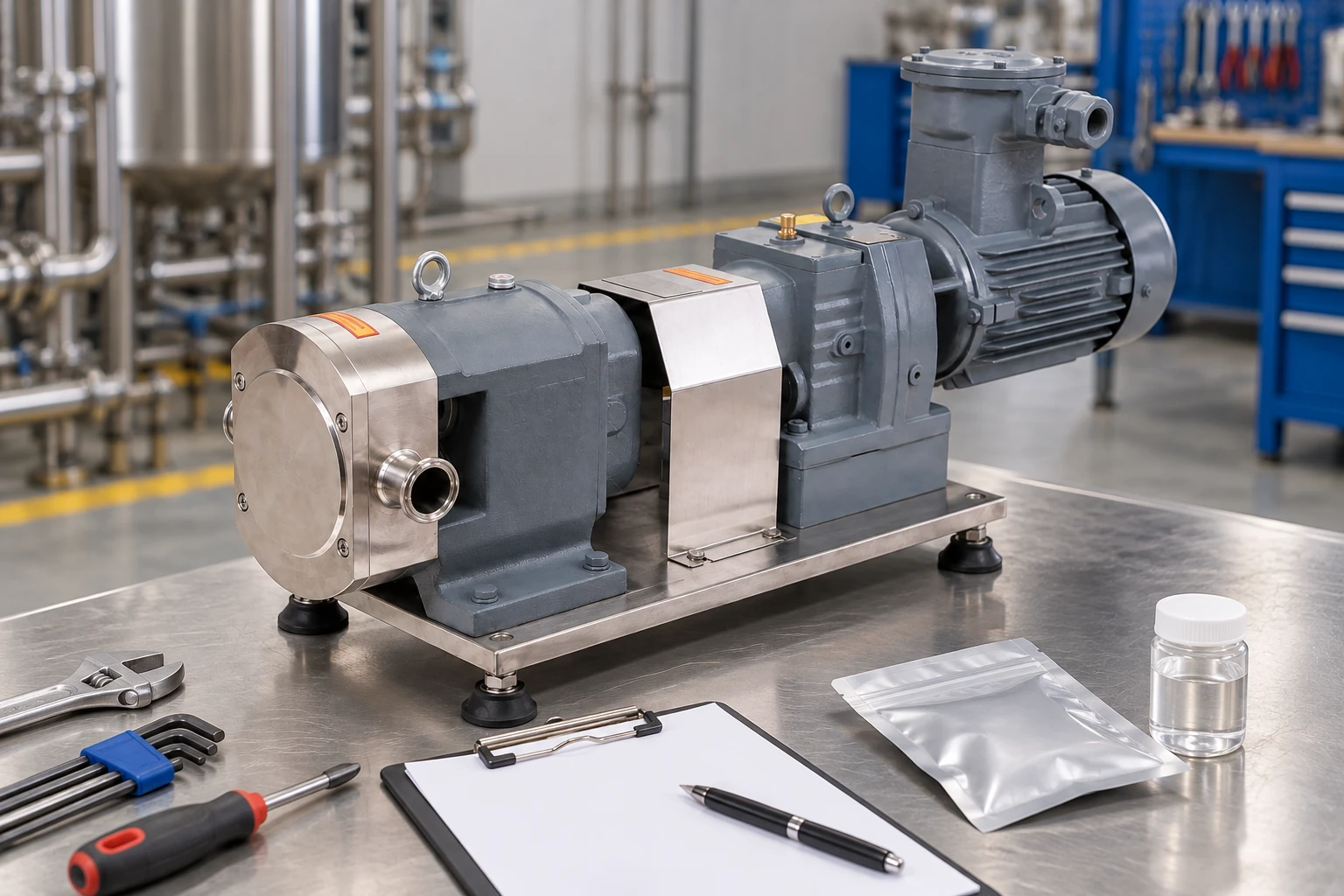
Link each proposed corrective action to the evidence it is intended to address. If the only action is fitting another identical kit, explain why the previous failure is believed to be isolated. If a service change is proposed, obtain confirmation that the pump, seal materials and process can tolerate it.
Эт rotor pump selection guide can help organize the complete duty for an enquiry. A replacement discussion should include both current operating conditions and expected future changes so that a short-term repair does not silently become a new application.
Agree restart evidence before closing the work order
Define who verifies assembly, guards, process connections, auxiliary supplies and instrument readiness. Use the manufacturer’s approved restart method within the site’s authorization system. Do not use production as an uncontrolled test of an unresolved hazardous release.
Specify observation conditions and acceptance limits before the test. Identify which operating states must be covered and who may stop the trial. A dry floor after a brief idle period cannot establish leak-free performance at the intended production duty. Likewise, a successful water check may not represent a hot, viscous or chemically different product.
Send YIYI the serial number, duty summary, first-wet-point photographs, event history, seal configuration and previous maintenance record. Ask for a configuration-specific parts recommendation and service instructions. This evidence package supports a more useful response than an unexplained request for “a standard seal.”
Educational reference: controlling hazardous energy
The following safety education video explains hazardous-energy control principles. It is relevant to preparation for maintenance, but it does not demonstrate seal replacement on this pump or replace the site’s verified isolation procedure.

Watch Control of Hazardous Energy for lockout/tag out by U.S. Agricultural Safety and Health Centers
Часто задаваемые вопросы
Does liquid under a rotary lobe pump prove mechanical seal failure?
No. Identify the fluid and first wet point. Pipe joints, casing connections and auxiliary systems can produce similar visible wetness, so preserve uncertainty until the source is established.
Is there a universal acceptable mechanical seal drip rate?
No. Use the limit and method specified for the installed seal and service. Packing guidance must not be applied automatically to a mechanical seal.
What should accompany a request for replacement seal parts?
Provide the pump identity, installed configuration, process and cleaning conditions, leak observations and maintenance history. Ask the manufacturer to confirm the kit and instructions for that exact assembly.